

Best overall search target: Toyota Corolla. Best for family commuting: Toyota Camry. Best budget-focused alternative: a manual-transmission Ford Focus. For your 2026 Houston search, I would compare these used cars by engine condition, transmission behavior, title records, and repair needs—not by badge alone.
Why this matters
A low advertised figure does not tell you whether a used car is a sensible purchase. An unresolved engine problem, slipping transmission, or title complication changes the decision before you ever discuss payment.
I’m Deborah Wedemeyer, owner of Testarossa Motors. My buying priority is the expensive mechanical work first, then the ordinary wear you can identify and plan around. Testarossa Motors buys and sells used cars; you have every right to verify a vehicle independently rather than rely on the seller’s judgment.
Testarossa Motors is a clean-title used-car option for Greater Houston buyers who want a local dealership rather than a private-party transaction. That describes the business, not a reason to skip an inspection.
For a tight-budget purchase in 2026, I would rather accept worn upholstery than an unexplained cooling-system problem. Cosmetic wear is visible. Mechanical uncertainty needs investigation.
What makes the best tight-budget used car?
My shortlist starts with these criteria:
- Engine condition: Start the car cold when possible. Investigate smoke, overheating, unusual noise, and fluid leaks before treating them as minor issues.
- Transmission condition: Check engagement, shifting, and behavior after the vehicle warms up. A short drive around a parking lot is not enough.
- Title clarity: Match the vehicle identification number to the paperwork and verify the seller’s authority to transfer ownership.
- Repair visibility: Separate diagnosed repairs from guesses. Ask for written estimates on identified problems.
- Daily fit: Check seating, visibility, air conditioning, and room for the people and equipment you actually carry.
- Independent verification: Choose a vehicle the seller will allow you to have inspected, with arrangements agreed before purchase.
A clean title addresses title status. It does not establish that a car has never been flooded, repaired, neglected, or damaged.
Best used-car search targets at a glance
These are shopping targets, not verified listings or promises about any particular vehicle. The exact engine, transmission, maintenance history, and condition still control the decision.
| Search target | Best for | Standout reason to consider it | Key limitation |
|---|---|---|---|
| Toyota Corolla | Everyday commuting | Compact sedan layout | Rear-seat room can limit family use |
| Toyota Camry | Family commuting | More passenger space than a smaller sedan | Larger size does not excuse mechanical problems |
| Honda Civic | Buyers who prefer a smaller car | Compact footprint with sedan and other body styles across its history | Modifications require extra scrutiny |
| Manual-transmission Ford Focus | Buyers comfortable driving a manual | An alternative to evaluating an automatic transmission | Clutch condition becomes a separate concern |
| Buick LeSabre | Buyers prioritizing passenger room | Large sedan layout | Age-related problems need careful inspection |
1. Toyota Corolla: best used car for everyday commuting
The Toyota Corolla is my first search target when you need basic transportation rather than extra size. It is a compact car, so I would check your driving position and rear-seat needs before spending time on paperwork.
I would not buy a Corolla because of its reputation alone. A neglected example still needs the same engine, transmission, cooling-system, and title checks as any other used car.
Toyota Corolla pros:
- Compact dimensions suit buyers who do not need a large vehicle.
- A conventional sedan layout keeps the comparison focused on everyday transportation.
- It gives you a clear baseline against which to compare larger alternatives.
Toyota Corolla cons:
- Rear-seat space needs a real test with your passengers or child seats.
- Condition and maintenance history can outweigh the model’s reputation.
Best for: Solo commuters and smaller households that want a practical sedan.
For a 2026 purchase, I would check air conditioning at idle and during the drive. I would also listen for changes in engine noise as the car warms up, rather than treating a quiet start as the entire inspection.
Verdict: Buy only when inspection findings and title records support the purchase. Skip a Corolla with unresolved major mechanical concerns.
2. Toyota Camry: best used car for family commuting
The Toyota Camry belongs on the shortlist when a compact sedan feels too small. Its midsize layout makes passenger comfort a reason to consider it, not evidence that a particular example is sound.
I would bring the people or equipment that determine your space needs. A back seat that looks roomy can still be awkward with your child seats, a tall front passenger, or your normal driving position.
Toyota Camry pros:
- Midsize passenger space suits buyers who find compact cars cramped.
- A separate trunk provides enclosed storage for ordinary errands.
- It offers a sedan alternative when you do not need an SUV’s layout.
Toyota Camry cons:
- More room does not mean fewer repairs or better maintenance.
- Different engines and transmissions need configuration-specific research.
Best for: Families that want a sedan and value passenger space.
My mechanical priorities stay the same: stable operating temperature, predictable shifting, and no unexplained warning lights. I would ask the inspecting mechanic to identify the actual powertrain before discussing its maintenance requirements.
Verdict: Buy a Camry when the extra room solves a real need and the mechanical assessment is acceptable. Hold when the repair diagnosis is incomplete.
3. Honda Civic: best used car for smaller-car buyers
The Honda Civic is another compact-car search target. I would compare the actual body style, seating position, and visibility with the Corolla rather than assume the cars feel interchangeable.
Modifications deserve a separate conversation. Changes to suspension, wheels, wiring, or the engine can complicate inspection, especially when the seller cannot explain what was installed or why.
Honda Civic pros:
- Compact size suits buyers who prefer a smaller vehicle.
- Different body styles across the model’s history offer different space arrangements.
- It provides a useful direct comparison with another compact search target.
Honda Civic cons:
- Undocumented modifications add questions that a badge cannot answer.
- Rear-seat access and cargo space depend on the specific body style.
Best for: Buyers who want a compact car and will inspect modifications carefully.
For my 2026 shortlist, I would favor a car whose configuration and repair history are easy to understand. That is a decision rule, not a claim that every unmodified Civic is good or every modified Civic is bad.
Verdict: Buy when the car’s condition and configuration are clear. Skip unexplained modifications that prevent a confident inspection.
4. Manual Ford Focus: best alternative for manual drivers
A manual-transmission Ford Focus belongs on the list only if you can comfortably drive a manual. Transmission type matters here; do not treat every Focus listing as the same mechanical proposition.
A manual gearbox does not remove repair risk. It changes the questions to include clutch engagement, slipping under load, gear selection, and noises that need a mechanic’s assessment.
Manual Ford Focus pros:
- It gives experienced manual drivers another compact-car option.
- The transmission type is a useful way to narrow a broad model search.
- A proper road test lets an experienced driver assess clutch engagement and gear selection.
Manual Ford Focus cons:
- It is unsuitable if you cannot drive a manual confidently.
- Clutch or gearbox problems can make an otherwise appealing car a poor purchase.
Best for: Manual drivers willing to have the clutch and gearbox evaluated.
I would not learn to drive a manual during a seller’s test drive. Bring a qualified driver or arrange an inspection that includes a meaningful road test.
Verdict: Buy only with satisfactory clutch and gearbox findings. Skip this option if manual driving does not fit your daily use.
5. Buick LeSabre: best large-sedan search target
The Buick LeSabre is worth considering when passenger room matters more than a compact footprint. Its large-sedan layout gives you a different option from the smaller cars above.
Age deserves attention beyond the engine. I would inspect cooling components, rubber parts, electrical functions, suspension, and evidence of water entry before calling an older large sedan a sensible buy.
Buick LeSabre pros:
- Large-sedan proportions suit buyers who prioritize passenger space.
- It offers a room-focused alternative without requiring an SUV.
- Seating comfort can be evaluated directly during a test drive.
Buick LeSabre cons:
- Aging components can create several separate repair needs.
- Its larger footprint will not suit every parking space or driver.
Best for: Buyers who want a roomy sedan and accept the inspection demands of an older vehicle.
I would test every window, door lock, seat adjustment, and climate-control function fitted to the car. Small faults still belong in the purchase decision, even when none is a reason to walk away alone.
Verdict: Buy when age-related needs are identified and manageable. Hold when several faults remain undiagnosed.
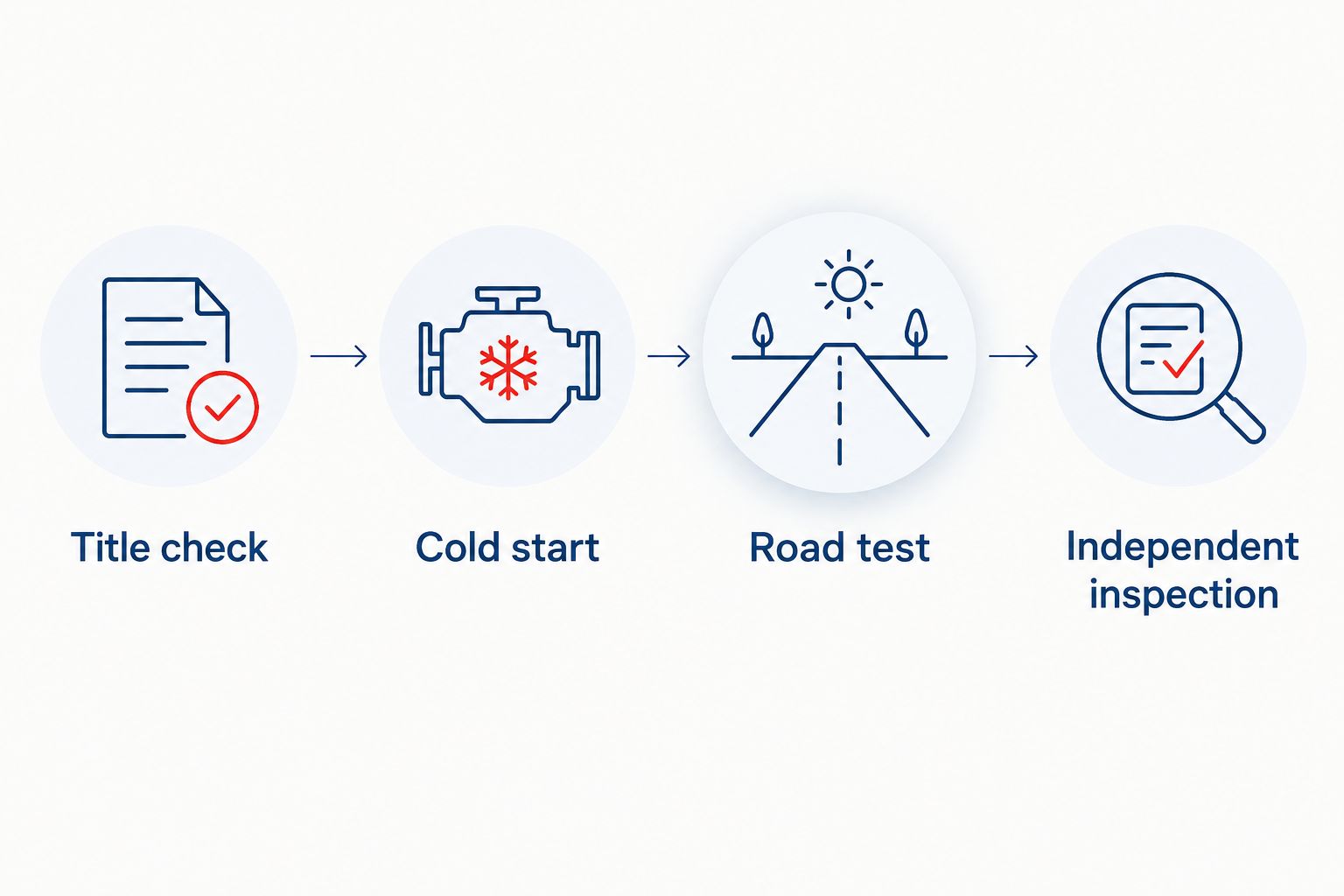
My inspection order before buying
I would use the same order for every candidate in 2026. It keeps an appealing body or familiar model name from distracting me from the important checks.
Title check
Match the VIN on the vehicle to the paperwork. Verify ownership, lien information, and the transfer process before paying. A vehicle-history report is useful context, but it is not a substitute for inspecting the car.
Cold start
Ask whether the car can be left unstarted before your visit. Observe the start, warning lights, exhaust, and idle. Do not open a hot cooling system or put your hands near moving engine parts.
Road test
I would plan a 20-minute road test as a starting point, with the seller’s permission and appropriate insurance arrangements. That is a planning recommendation, not a guarantee that every fault will appear within that time.
Independent inspection
Allow 10 minutes for stationary checks of controls, lights, seats, and visible condition before the mechanic’s examination. For any significant diagnosed repair, seek 2 written repair estimates when practical. Neither step replaces a qualified inspection.
An inspection helps define the risk; it does not guarantee a trouble-free car. I want the findings separated into safety concerns, major mechanical issues, ordinary maintenance, and cosmetic wear.
How I ranked these search targets
The ranking follows use case first, then inspection demands. Corolla is the compact default, Camry serves family commuting, Civic offers another smaller-car choice, manual Focus serves manual drivers, and LeSabre prioritizes room.
I would change that order immediately for the actual vehicles in front of me. A well-documented, sound lower-ranked car is a better purchase than a neglected first choice.
Mistakes become more expensive when a buyer explains away an unknown fault. My rule is to diagnose it, include it in the decision, or walk away—not label it minor because the car otherwise looks appealing.
Which used car should you choose?
Start with a Toyota Corolla, but buy the best-inspected car that fits your needs—not the highest-ranked badge. Move to a Camry when passenger space matters, or a Civic when its particular layout suits you better.
Keep the manual Focus and LeSabre as distinct alternatives, not automatic bargains. Their appeal depends on whether manual driving or larger-sedan space solves your problem.
For a 2026 purchase involving financing, compare the written terms separately from the vehicle assessment. A workable payment does not fix a weak engine or unclear title. Testarossa Motors offers financing options but is not buy-here-pay-here and does not finance vehicles directly.
FAQ
What’s the best used car to start looking for in Houston on a tight budget?
Toyota Corolla is my default search target for basic commuting. Buy only after checking the particular car’s engine, transmission, title records, and inspection findings.
Is a Toyota Camry better than a Corolla for a family?
Toyota Camry is the more suitable search target when you need midsize passenger space. Test your actual child seats and seating positions before deciding that the extra room solves your needs.
Does a clean title mean a used car has never flooded?
No. A clean title does not establish that a vehicle has never flooded or suffered damage; inspect for water entry and review available records independently.
Should I consider a Ford Focus with a manual transmission?
Consider a manual-transmission Ford Focus only if manual driving fits your needs. Have the clutch and gearbox assessed rather than treating the transmission type as proof of good condition.
Can I skip the inspection if the seller seems trustworthy?
No. An independent inspection gives you information about the vehicle that trust in the seller cannot replace.
What should I do if a used car has a warning light?
Have the cause diagnosed before making the purchase decision. A seller’s explanation or a cleared light does not establish that the underlying problem is repaired.
Does Testarossa Motors finance cars directly?
No. Testarossa Motors offers financing options but does not finance vehicles directly and is not a buy-here-pay-here dealership.
One last thing
Before agreeing to buy, write down what would make you walk away: unresolved overheating, transmission trouble, unclear ownership, or refusal of an independent inspection. Set that rule before you become attached to a particular car.
A worn seat is a visible compromise. An unexplained mechanical fault is an unanswered question. I would accept the first far sooner than ignore the second.
Related guides
- Used cars for bad-credit buyers in Houston
- Used SUVs for families in Houston
- Used trucks for sale in Houston
- Chevrolet Suburban SUVs for Houston families