
Written by Deborah Marie Wedemeyer
My first pick is the Toyota Prius for a stop-and-go Houston commute; I would choose the Toyota Camry Hybrid for family-sedan space and the Honda Accord Hybrid for a more responsive drive. The best used hybrid is the individual car that passes an independent inspection, not simply the model with the strongest reputation.
I’m Deborah Wedemeyer, Founder and President of Testarossa Motors. I sell used vehicles, so I have a commercial interest in your purchase. You should still choose your own mechanic and verify the car independently. My used-car inspection checklist gives you a starting point.
Why does the individual hybrid matter more than the badge?
A used hybrid combines an engine, an electric drive system and a high-voltage battery. A good model name does not tell you how those systems have been maintained or whether the particular car has hidden damage.
For Greater Houston buyers, I would put flood-history checks beside the mechanical inspection, not leave them until signing. Inspect beneath the carpet, inside the spare-tire area and around seat mounts for silt, corrosion or evidence of water entry. One suspicious finding calls for investigation; a clean-looking cabin does not settle the question.
These are model recommendations, not statements that any particular vehicle is for sale at Testarossa Motors. Verify the exact car, equipment and records before making a trip.
What makes the best used hybrid car?
I would judge each candidate against these criteria before comparing badges:
- Battery evidence: A hybrid-capable mechanic should evaluate the high-voltage battery and related fault codes. Dashboard silence alone is not proof of health.
- Maintenance records: Match service records to the vehicle identification number and odometer history. Read what was done, not just whether a service entry exists.
- Useful body shape: Test your child seats, luggage or work gear. A sedan trunk and a hatchback solve different problems.
- Driving fit: Include stop-and-go traffic, highway merging and parking in the test drive. Keep the air conditioning running.
- Repair exposure: Get written findings and estimates for unresolved faults before deciding. Do not turn an unknown problem into your responsibility.
- Title and water history: Compare ownership records with the physical inspection. Neither replaces the other.
Used hybrid cars at a glance
These rankings separate buying needs rather than declare one model right for everyone. Equipment, cargo layout and driving behavior vary by generation and trim.
| Rank and model | Best for | Standout characteristic | Key limitation |
|---|---|---|---|
| 1. Toyota Prius | Stop-and-go commuters | Hybrid hatchback layout | Driving position and visibility need a personal check |
| 2. Toyota Camry Hybrid | Family-sedan buyers | Conventional midsize sedan format | Trunk access is less flexible than a hatchback |
| 3. Honda Accord Hybrid | Drivers who value response | Electric-motor-led response in later generations | Hybrid systems differ across generations |
| 4. Ford Fusion Hybrid | Buyers who prefer a familiar sedan layout | Traditional sedan cabin and controls | Battery packaging reduces cargo space |
| 5. Hyundai Ioniq Hybrid | Buyers who prefer stepped gear changes | Hybrid hatchback with a dual-clutch transmission | Low-speed transmission behavior needs close inspection |
1. Toyota Prius: best used hybrid for stop-and-go commuters
The Toyota Prius is my default starting point for a Houston commuter who wants a hybrid hatchback. Its rear opening also makes it worth considering when a sedan trunk is awkward for your everyday cargo.
I would choose the generation and seating position before choosing a particular listing. Sit in the car long enough to check the windshield view, rear visibility and dashboard layout. A car that feels wrong from the driver’s seat will not become comfortable because of its reputation.
Toyota Prius pros:
- Hatchback access accommodates bulky items more easily than a conventional trunk opening.
- The hybrid system manages engine and electric operation without manual switching.
- Different generations give you distinct cabin and body-layout choices.
Toyota Prius cons:
- Sightlines and instrument placement do not suit every driver.
- Battery condition and engine condition require separate evaluation.
- Maintenance history matters even when the test drive feels normal.
Ask the inspecting mechanic to check the battery-cooling path where applicable and investigate warning lights or stored codes. Do not accept a generic code scan as a full hybrid inspection.
Best for: Commuters who want hatchback utility and spend substantial time in traffic.
Verdict: Buy the Toyota Prius only after its inspection supports the reputation.
2. Toyota Camry Hybrid: best used hybrid for family-sedan buyers
The Toyota Camry Hybrid belongs on your list when you want a midsize sedan rather than a compact hatchback. I would begin with rear-seat fit, ride comfort and how your family uses the trunk.
Bring the child seats or mobility equipment you actually carry. A roomy-looking cabin is not the same as a convenient daily setup, especially when the front seats must also fit taller adults.
Toyota Camry Hybrid pros:
- A conventional sedan layout makes it straightforward to assess against your current car.
- Rear-seat space makes it a relevant family-car candidate.
- A separate trunk keeps luggage out of the passenger cabin.
Toyota Camry Hybrid cons:
- The trunk opening limits the shape of objects you can load.
- Battery placement and cargo arrangements differ across generations.
- Comfort and driver-assistance equipment depend on the exact vehicle.
I would drive the Camry Hybrid on rough pavement as well as a smooth road. Listen for suspension noise and check braking feel during gentle stops. Hybrid operation does not excuse worn tires, steering problems or neglected suspension parts.
Best for: Families who want a sedan and do not need SUV-style cargo access.
Verdict: Buy the Toyota Camry Hybrid when passenger fit matters more than hatchback flexibility.
3. Honda Accord Hybrid: best used hybrid for responsive driving
The Honda Accord Hybrid is the model I would compare when driving response carries extra weight in your decision. Later-generation versions use a different hybrid arrangement from the early Accord Hybrid, so research the exact vehicle rather than treating the name as one mechanical design.
During the test drive, judge acceleration, engine sound and brake response together. Engine speed does not always follow road speed in the same way it does in a conventional automatic car.
Honda Accord Hybrid pros:
- Later-generation hybrid systems provide electric-motor-led response in many driving conditions.
- The sedan layout suits buyers who prioritize passenger space.
- It offers a useful comparison against the Camry Hybrid for driving feel.
Honda Accord Hybrid cons:
- Generation differences make model-specific research essential.
- Engine sound under acceleration will not suit every driver.
- Trunk flexibility remains below that of a hatchback.
I would ask a hybrid-capable mechanic to explain any vibration, hesitation or warning message before considering the purchase. An unfamiliar sensation needs a diagnosis, not a seller’s reassurance that all hybrids do it.
Best for: Sedan buyers who place driving response ahead of hatchback cargo access.
Verdict: Buy the Honda Accord Hybrid if its driving behavior suits you and the inspection is sound.
4. Ford Fusion Hybrid: best used hybrid for a familiar sedan layout
The Ford Fusion Hybrid suits buyers who want a conventional sedan cabin with hybrid operation. Check the exact powertrain designation: the Fusion Hybrid and plug-in Fusion Energi are different versions.
I would inspect the trunk early. Battery packaging affects usable space, and a photo rarely shows whether your luggage will fit comfortably.
Ford Fusion Hybrid pros:
- A traditional sedan layout offers familiar controls and seating.
- The non-plug-in hybrid does not require charging equipment.
- Its separate trunk suits buyers who prefer enclosed luggage storage.
Ford Fusion Hybrid cons:
- Battery packaging takes up cargo space.
- Similar model names make powertrain verification necessary.
- Age-related wear still needs attention throughout the car.
Have the mechanic assess transmission operation, cooling systems and stored faults alongside the hybrid battery. I would not overlook a mechanical concern because the cabin looks tidy.
Best for: Drivers who prefer conventional sedan controls and can work with the trunk layout.
Verdict: Buy the Ford Fusion Hybrid only after confirming the powertrain and cargo fit.
5. Hyundai Ioniq Hybrid: best used hybrid for stepped gear changes
The Hyundai Ioniq Hybrid combines a hatchback body with a dual-clutch transmission. That makes it a different driving proposition from the Prius, not simply another version of the same experience.
Confirm that the car is the regular Hybrid. The Ioniq name also appears on plug-in and electric vehicles, which have different ownership requirements.
Hyundai Ioniq Hybrid pros:
- Hatchback access adds loading flexibility.
- Stepped gear changes appeal to buyers who prefer that driving feel.
- The regular Hybrid does not need external charging.
Hyundai Ioniq Hybrid cons:
- Clutch engagement deserves attention in slow traffic.
- Hybrid, plug-in and electric versions require different research.
- Rear headroom and entry comfort need an in-person check.
Test gentle starts, reversing and repeated low-speed movement after the car warms up. Ask a qualified mechanic to investigate shuddering or hesitation rather than guessing whether it is normal.
Best for: Hatchback buyers who prefer stepped shifts and accept a transmission-specific inspection.
Verdict: Buy the Hyundai Ioniq Hybrid only when low-speed operation checks out.
What would I check before buying a hybrid in Houston?
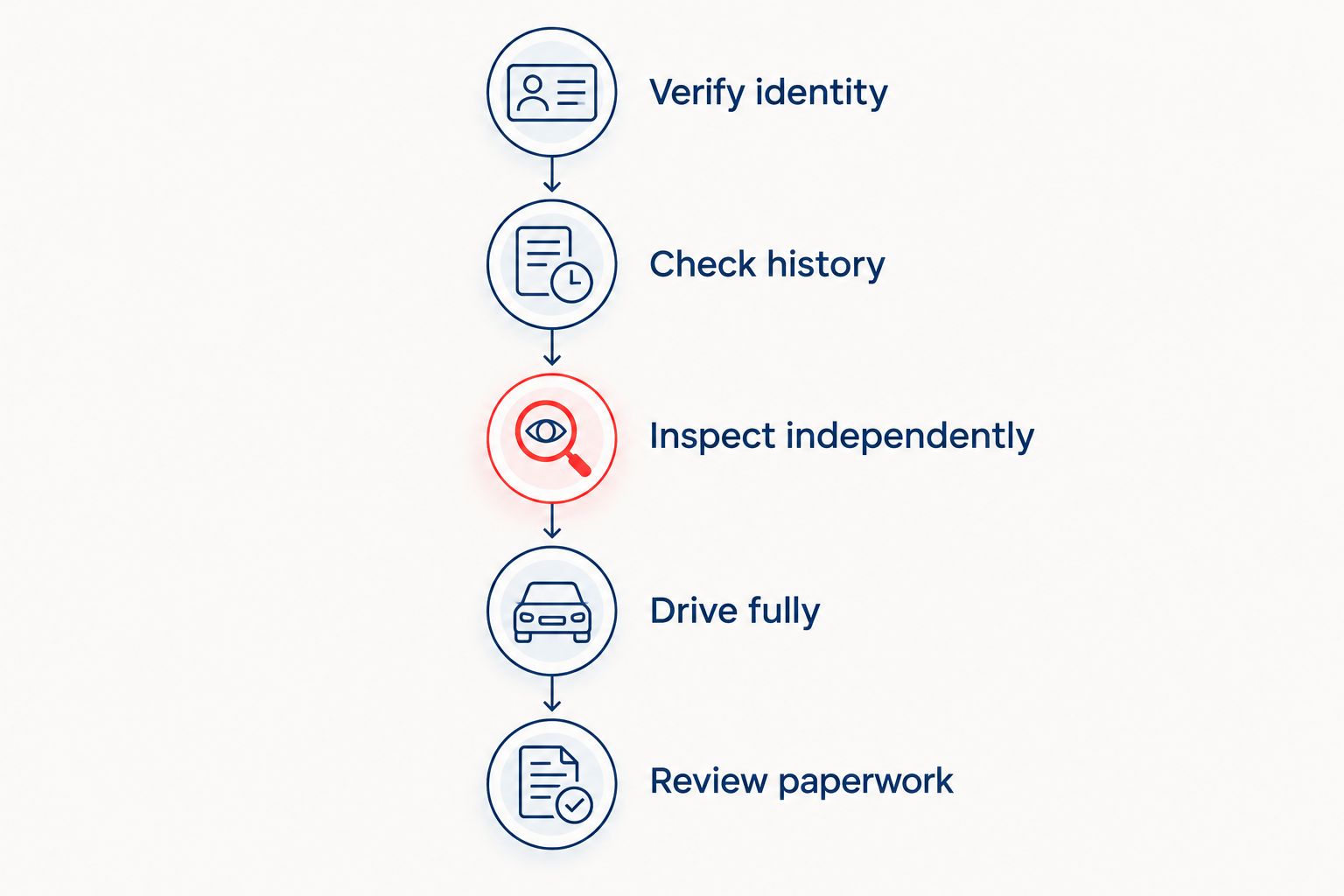
I would use this order so a comfortable test drive does not distract from an unresolved title or mechanical problem.
- Verify identity. Match the VIN on the vehicle, records and purchase paperwork. Confirm the exact hybrid version.
- Check history. Review title information, service records and possible water exposure. A clean title does not prove a car has no problems.
- Inspect independently. Choose a mechanic with the equipment and knowledge to evaluate that hybrid system. Request written findings.
- Drive fully. Include a cold start when practical, traffic, merging, braking and parking. Check air conditioning throughout.
- Review paperwork. Resolve discrepancies before signing. Ask for any coverage terms in writing rather than relying on a conversation.
For a local registration check, Texas DPS lists Harris, Galveston, Brazoria, Fort Bend and Montgomery among emissions-testing counties in 2026. Gasoline-electric hybrids are not automatically exempt just because they use an electric motor. Check the exact vehicle’s requirements with Texas DPS and your registration county.
How are these hybrid recommendations ranked?
I rank the Toyota Prius first for its commuter-and-hatchback combination, then separate the other models by the buying problem they solve. These are fit-based recommendations, not results from a road test or a claim that every example is dependable.
Condition can reverse the order. I would choose a well-documented Camry Hybrid over a Prius with unresolved faults, even if the Prius body style were my first choice.
Which used hybrid should you choose?
Start with the Toyota Prius if you are undecided. Compare the Toyota Camry Hybrid when family seating matters more, and the Honda Accord Hybrid when driving response is your priority. The Ford Fusion Hybrid and Hyundai Ioniq Hybrid earn consideration for their distinct cabin and transmission layouts.
Testarossa Motors sells clean-title used vehicles, but my recommendation for used-hybrid buyers is to verify the individual car independently. Do not substitute a dealer’s name, or a model ranking, for evidence.
FAQ
What is the best used hybrid car for Houston commuting?
The Toyota Prius is my starting pick for stop-and-go Houston commuting because it combines hybrid operation with hatchback utility. Buy only after reviewing maintenance records and getting an independent inspection.
Is a Toyota Camry Hybrid better than a Toyota Prius?
The Toyota Camry Hybrid is the better fit when you want a midsize family sedan; the Toyota Prius is the better starting point when hatchback access matters. Compare the actual cars for seating comfort and condition.
Do I need to plug in a regular hybrid?
A conventional hybrid does not require external charging. Confirm the exact version because some model families also include plug-in hybrids or electric vehicles.
How do I check a used hybrid battery before buying?
Have a hybrid-capable mechanic evaluate the battery, fault codes and related systems using equipment appropriate to that model. A dashboard without warning lights is not a complete battery assessment.
Does a clean title mean a hybrid has no flood damage?
No, a clean title does not establish that a hybrid has no water damage or other problems. Review its history and arrange a physical inspection for evidence of water entry and corrosion.
Can I finance a used hybrid through Testarossa Motors?
Testarossa Motors arranges financing through outside lenders rather than financing vehicles directly. Ask about the requirements for the specific vehicle and application; approval is not guaranteed.
One last thing
Ask who diagnosed the hybrid system and what the inspection covered. A replacement battery receipt is useful evidence, but it does not establish the condition of the engine, brakes, cooling system or transmission. Buy the whole car, not one reassuring document.
Related guides
- Used cars for Houston commuters ranked by mileage
- The difference between dealer financing and bank financing
Deborah Wedemeyer, Founder and President
Last updated: 2026