

Best overall: Mercedes-Benz GLC. Best for a growing family: Mercedes-Benz GLE. Best for occasional extra passengers: Mercedes-Benz GLB. Best for a smaller footprint: Mercedes-Benz GLA. Best for regular third-row use: Mercedes-Benz GLS. For your used Mercedes-Benz SUV search in Houston in 2026, I would start with the GLC, then change the shortlist only when your passenger needs justify it.
Why the vehicle matters more than the badge
I’m Deborah Wedemeyer, owner of Testarossa Motors. My buying decision starts with the engine, transmission, title, and repair exposure—not the badge or the equipment list.
Since 1995, the dealership has independently bought more than 18,000 used vehicles. That buying perspective is useful here: a Mercedes-Benz SUV that fits your family still needs to make sense as a particular used vehicle.
For Greater Houston buyers, I separate two questions. Which model fits your life? And is the individual example sound enough to buy? This guide answers the first question and gives you a process for the second; it is not a claim that any listed model is currently offered by the dealership.
What makes the best used Mercedes-Benz SUV?
For a 2026 purchase, I would judge each candidate against these criteria before comparing equipment:
- Mechanical condition: Engine behavior, transmission operation, leaks, warning lights, and inspection findings come before appearance.
- Usable passenger space: Test your actual seating needs, including child seats and access to any third row.
- Documented upkeep: Review records against the maintenance requirements for the exact vehicle, not just the model name.
- Repair exposure: Identify unresolved work and get written estimates before accepting the risk.
- Everyday fit: Check parking, visibility, cargo access, and whether your normal load fits comfortably.
- Title and financing: Verify ownership documents and understand the loan terms separately from the vehicle assessment.
My default is the smallest SUV that comfortably meets your regular needs and passes an independent inspection. Buying extra size does not fix missing records or mechanical problems.
Used Mercedes-Benz SUVs at a glance
These are use-case recommendations, not a ranking of every engine, trim, or model year. Equipment and seating vary, so the actual vehicle controls the decision.
| Rank and model | Best for | Standout reason to consider it | Key limitation |
|---|---|---|---|
| 1. Mercedes-Benz GLC | Everyday use without a third-row requirement | A compact SUV with 5 seats | No third row; test your family’s cargo load |
| 2. Mercedes-Benz GLE | Growing families needing more room | More passenger and cargo space than the GLC | A larger footprint; seating configuration needs verification |
| 3. Mercedes-Benz GLB | Occasional extra passengers | Some examples have an optional third row and up to 7 seats | Rearmost seating needs a real passenger test |
| 4. Mercedes-Benz GLA | Buyers prioritizing a smaller footprint | A smaller SUV format than the GLC | Less room for passengers and bulky family gear |
| 5. Mercedes-Benz GLS | Families using a third row regularly | A large SUV with 3 rows | Size can complicate parking and everyday use |
1. Mercedes-Benz GLC: best for everyday Houston driving
The Mercedes-Benz GLC is my starting point when you want an SUV but do not need a third row. It has 5 seats and avoids moving into a larger vehicle solely for occasional needs.
I would test the GLC with your usual passengers and luggage before comparing trim details. A compact SUV is a sensible choice only when its compactness does not make daily life awkward.
Mercedes-Benz GLC pros:
- Its compact format suits buyers who do not need a large family SUV.
- A conventional seating layout keeps the decision focused on everyday needs.
- It gives you a clear baseline for deciding whether the GLE’s extra space is necessary.
Mercedes-Benz GLC cons:
- It does not solve a third-row requirement.
- Child seats and bulky cargo need a physical fit check.
Best for: Buyers carrying a small family or a few passengers who want a practical default shortlist.
My inspection priorities remain engine condition, transmission behavior, maintenance records, and unresolved faults. I would not choose a GLC with questionable mechanical condition simply because it has preferred equipment.
Verdict: Buy a Mercedes-Benz GLC only after its condition and space pass your checks; it is my overall starting choice.
2. Mercedes-Benz GLE: best for a growing family
The Mercedes-Benz GLE belongs on your shortlist when the GLC feels cramped during an actual family test. It offers more space, but I would make that advantage prove itself with your passengers and belongings.
Do not assume every GLE has the seating arrangement you need. Check the individual example rather than relying on photographs or a model description.
Mercedes-Benz GLE pros:
- More space than the GLC gives growing families another option.
- Its larger cabin deserves consideration when rear-seat comfort is a priority.
- It provides an alternative to choosing a GLS solely for extra room.
Mercedes-Benz GLE cons:
- The larger footprint needs a parking and garage check.
- Seating and equipment vary between examples.
Best for: Families whose regular passenger or cargo needs exceed what the GLC comfortably accommodates.
For a 2026 purchase, I would compare the actual GLE and GLC side by side. Put the same child seats and everyday cargo in both. That tells you more than choosing from exterior dimensions alone.
Verdict: Buy a Mercedes-Benz GLE when the extra usable room solves a regular problem and the inspection supports the purchase.
3. Mercedes-Benz GLB: best for occasional extra passengers
The Mercedes-Benz GLB is the option I would examine when you want compact proportions and occasional additional seating. Some examples have an optional third row, allowing up to 7 seats.
That configuration is not standard across every used GLB. I would verify the seats first, then test whether the intended passengers can enter, sit, and exit comfortably.
Mercedes-Benz GLB pros:
- An optional third row gives certain examples additional passenger flexibility.
- Its compact format offers a different compromise from the larger GLS.
- Folding-seat flexibility helps you compare passenger needs with cargo needs.
Mercedes-Benz GLB cons:
- Not every example has the optional third row.
- Extra seats do not guarantee comfortable accommodation for your passengers.
Best for: Buyers who occasionally carry extra passengers and can confirm that the specific seating arrangement works.
I would bring the people who will use the rearmost seats whenever practical. I would also load the belongings that travel with them; passenger capacity without useful luggage space can be the wrong compromise.
Verdict: Hold on a Mercedes-Benz GLB until you verify its seating configuration and test the third row.
4. Mercedes-Benz GLA: best for a smaller footprint
The Mercedes-Benz GLA fits the shortlist when you prioritize a smaller vehicle over maximum family space. It is smaller than the GLC, so I would assess it as a deliberate space trade-off—not simply another interchangeable SUV.
Your test should cover front-seat comfort, rear-seat use, visibility, and the cargo you actually carry. A smaller SUV that fits your routine is a better decision than a larger one you do not need.
Mercedes-Benz GLA pros:
- Its smaller format suits buyers who want to limit vehicle size.
- It gives you a useful comparison point before stepping up to the GLC.
- It keeps the buying decision focused on essential space rather than unused capacity.
Mercedes-Benz GLA cons:
- Passenger and cargo space are more limited than in larger choices here.
- It is not the answer to a third-row requirement.
Best for: Individuals, couples, and buyers whose regular passenger and cargo demands are modest.
I would not accept awkward seating or insufficient cargo room just to get a Mercedes-Benz badge. Fit is a requirement. If your normal load does not work, move to a different candidate rather than explaining away the problem.
Verdict: Buy a Mercedes-Benz GLA for its smaller footprint only after your everyday load fits comfortably.
5. Mercedes-Benz GLS: best for regular third-row use
The Mercedes-Benz GLS is the large-SUV choice in this comparison, with 3 rows. I would consider it when additional seating is a regular requirement, not an occasional possibility.
Size still needs testing. Check access to the rearmost seats, passenger comfort, and the cargo area with the seats arranged as you will normally use them.
Mercedes-Benz GLS pros:
- Its three-row layout addresses a regular extra-passenger requirement.
- Its larger format gives families a different option from the compact GLB.
- It lets you assess passenger and cargo needs together in a full-size candidate.
Mercedes-Benz GLS cons:
- Its size requires careful parking and garage checks.
- More space does not offset unresolved mechanical faults or incomplete inspection work.
Best for: Families that routinely need a third row and have room to use a large SUV comfortably.
I would also operate the fitted equipment during the inspection. Seat controls, climate controls, cameras, and other systems need checking individually; the equipment list is not evidence that everything works.
Verdict: Buy a Mercedes-Benz GLS when regular third-row use justifies the size and an independent inspection clears the candidate.
My inspection order before choosing a vehicle
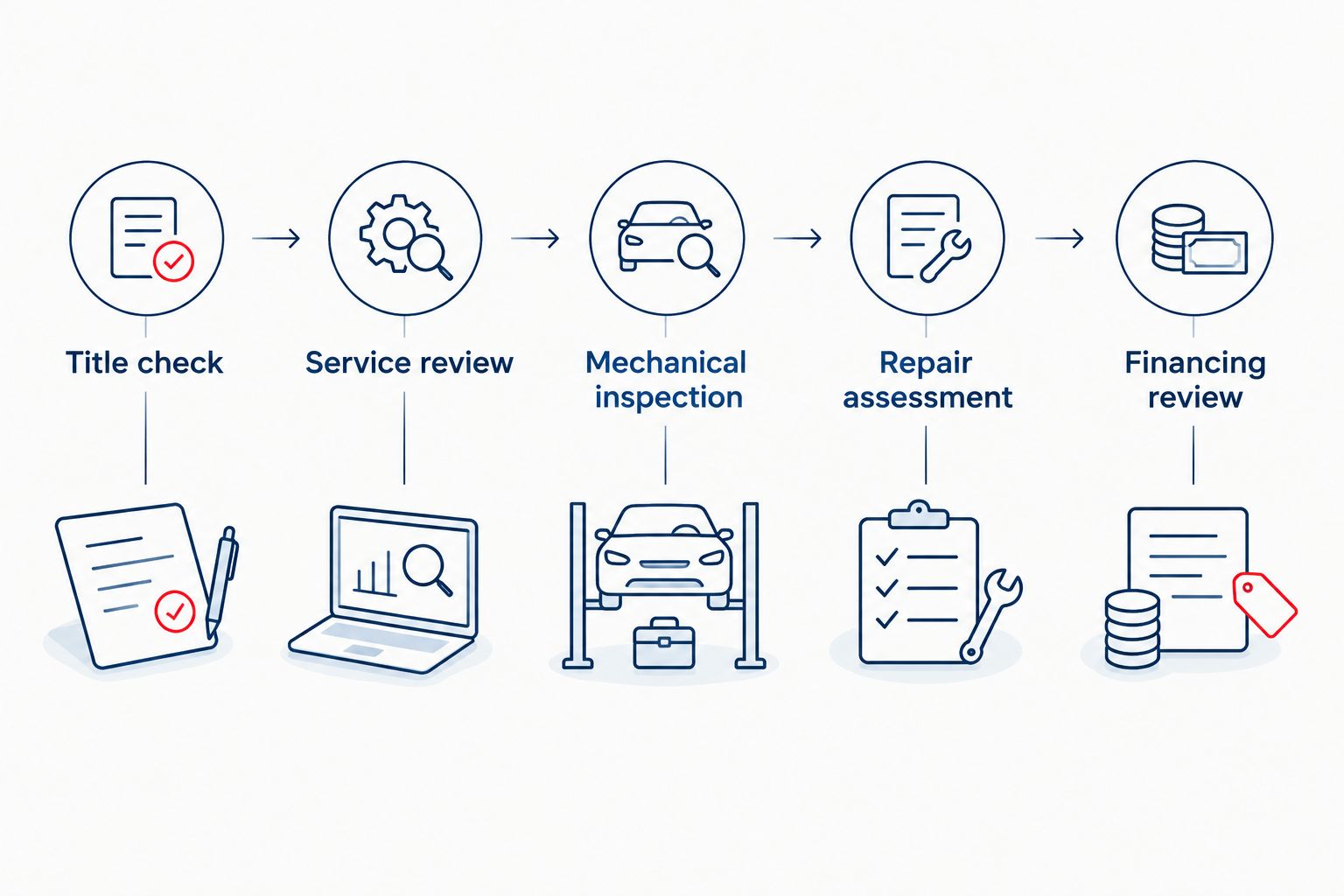
For a used Mercedes-Benz SUV purchase in 2026, I would work through the same sequence regardless of model. Each step answers a different question; none replaces the others.
Title check
Match the vehicle identification number on the vehicle and documents. Review ownership information and any history records you obtain. A clean title does not establish that a vehicle has never had damage, flooding, or repairs.
Service review
Compare available records with the exact vehicle’s maintenance requirements. Ask about gaps and look for evidence that documented work belongs to that vehicle. A seller’s general assurance is not a substitute for records or inspection findings.
Mechanical inspection
Arrange an independent inspection with a technician familiar with the vehicle. Ask for checks of engine and transmission condition, leaks, cooling-system concerns, diagnostic faults, brakes, tires, and suspension. A road test alone cannot answer every mechanical question.
Repair assessment
Separate ordinary wear from unresolved faults. Get written estimates for identified work, then decide whether you can accept the expense and disruption. Do not treat an unexplained warning light as harmless because the SUV drives normally.
Financing review
Read the proposed loan terms separately from the vehicle decision. Check the annual percentage rate, term, amount financed, and any optional products before signing. Approval does not establish that the SUV is mechanically sound or suitable for your budget.
I would walk away from a candidate when a seller will not allow reasonable independent verification. The point is not to find a used SUV without wear. It is to understand the wear, identify the faults, and make a decision with those facts in front of you.
Testarossa Motors buys and sells vehicles, so the dealership has a commercial interest in a sale. You have the right to verify a vehicle independently. The dealership is not buy-here-pay-here, does not finance vehicles directly, and does not make money from financing or warranties itself.
How I ranked these Mercedes-Benz SUVs
I ranked the models by distinct needs: everyday use, growing-family space, occasional extra passengers, smaller footprint, and regular third-row use. The GLC is the default because it fits the buyer who needs an SUV without needing the largest vehicle here.
This is not a reliability score or a claim that one model is always cheaper to own. Engine, equipment, maintenance, prior use, and current condition vary. A sound example of your second-choice model is a better purchase than a questionable example of your first choice.
Which used Mercedes-Benz SUV should you choose?
For 2026, start with the Mercedes-Benz GLC unless you already know why it will not fit. Move to the GLE for a demonstrated space need, the GLB for verified occasional extra seating, the GLA for a smaller footprint, or the GLS for regular third-row use.
Then stop comparing badges and inspect the candidate. My recommendation ends where the individual vehicle’s condition begins: no model ranking gives a particular SUV a pass.
FAQ
What’s the best used Mercedes-Benz SUV for Houston buyers?
The Mercedes-Benz GLC is my default shortlist choice for Houston buyers who do not need a third row. Choose the individual vehicle only after checking space, maintenance records, title information, and independent inspection findings.
Is a used Mercedes-Benz GLE better than a GLC for families?
The Mercedes-Benz GLE is the better fit when your family needs more room than the GLC provides. Test your child seats, passengers, and normal cargo in both before deciding that the larger vehicle is necessary.
Does every used Mercedes-Benz GLB have a third row?
No, not every used Mercedes-Benz GLB has a third row. Verify the actual seating configuration and test access, passenger comfort, and remaining cargo space.
Should I choose a Mercedes-Benz GLS for occasional extra passengers?
I would not make the Mercedes-Benz GLS the default for occasional extra passengers. First check whether a suitably configured GLB meets that need; choose the GLS when regular third-row use justifies its size.
Does a clean title mean a used Mercedes-Benz SUV has no problems?
No, a clean title does not establish mechanical condition or rule out previous damage. Review available history information and arrange an independent inspection of the actual SUV.
What should I check before financing a used Mercedes-Benz SUV?
Check the vehicle’s condition and the loan terms as separate decisions. Review the annual percentage rate, term, amount financed, and optional products, and do not let approval replace an inspection.
Can I have a used SUV inspected independently before buying?
Ask to arrange an independent inspection before committing to the purchase. Testarossa Motors recognizes the buyer’s right to verify a vehicle independently; agree on the arrangements with the seller.
One last thing
Before your final decision, load the SUV as you would on an ordinary day. Bring the child seat, stroller, work bag, or other equipment that actually determines whether the vehicle fits.
In 2026, my strongest recommendation is still simple: do not buy a model name; buy an inspected vehicle that works for your life. A comfortable test drive is useful, but an empty cabin can hide a poor everyday fit.
Related guides
- Used SUVs for families in Houston
- Clean-title used trucks and SUVs in League City
- Used cars for bad-credit buyers in Houston