
Best overall: Toyota Prius; best efficiency-focused alternative: Hyundai Ioniq Hybrid; best nonhybrid option: Toyota Corolla. For Houston buyers, my shortlist at Testarossa Motors starts with fuel economy, but the buying decision comes down to the exact car’s condition, repair needs, and fit for your daily drive.
Hybrids and Houston heat
Stop-and-go traffic on I-45 and the Gulf Freeway is where hybrids shine, since they recover energy every time you brake. But Houston heat is hard on hybrid batteries, and those batteries rely on a cooling fan and vents that can clog with dust and pet hair.
On a used hybrid, ask for a hybrid-system health check, make sure the battery cooling vent is clean, and confirm the A/C keeps up in traffic. We sell clean-title cars only, each one inspected three times before it reaches our League City lot.
Fuel economy matters, up to a point
Fuel savings matter when you drive across Greater Houston. But I would not buy a questionable engine, transmission, or hybrid system just to get a better MPG rating. A needed repair belongs in the decision before any projected fuel savings.
I’m Deborah Wedemeyer, owner of Testarossa Motors. The dealership has independently bought more than 18,000 used vehicles since 1995. That is vehicles bought, not customers served, and it informs the buying perspective behind this guide.
What makes the best fuel-efficient used car?
I use these criteria before choosing between vehicles:
- Exact EPA rating: Compare the model year, engine, transmission, trim, and drivetrain. A model name alone is not a fuel-economy specification.
- Mechanical condition: Engine, transmission, cooling-system, and hybrid-system problems outweigh an attractive MPG number.
- Driving fit: Compare city and highway ratings separately against the routes you actually drive.
- Practical space: Check passenger room, cargo access, and seating comfort rather than buying a smaller car you cannot use.
- Known repair needs: Get written estimates for identified problems. Ordinary wear and an unresolved mechanical fault are different risks.
- Purchase constraints: Confirm the title, total transaction terms, and financing arrangement before committing.
My ranking is a buying shortlist, not a claim that every Prius beats every Ioniq on fuel economy. Equipment and model-year differences change the numbers. For an MPG-only ranking, sort the exact vehicles you are considering by their U.S. EPA combined ratings.
Quick comparison
These are model recommendations, not claims about current dealership inventory. Confirm each vehicle’s equipment and condition individually.
| Rank | Model | Best for | Standout feature | Key limitation |
|---|---|---|---|---|
| 1 | Toyota Prius | An all-around commuter with useful cargo access | Hybrid powertrain and hatchback layout | Ratings, seating, and equipment differ by generation |
| 2 | Hyundai Ioniq Hybrid | An efficiency-focused hatchback search | Hybrid hatchback distinct from the plug-in and electric versions | The Ioniq name covers different powertrains |
| 3 | Toyota Corolla Hybrid | A compact hybrid sedan | Corolla-sized sedan with a hybrid powertrain | Smaller cabin than a Camry |
| 4 | Honda Insight | A conventional sedan-style hybrid | Hybrid sedan format in its later generation | Earlier generations are substantially different vehicles |
| 5 | Toyota Camry Hybrid | A larger sedan for family and commuter use | More room than the compact choices | Fuel economy varies with trim and configuration |
| 6 | Toyota Corolla, gasoline | Buyers who prefer a nonhybrid car | Gasoline powertrain without hybrid-system components | Gives up the hybrid option’s fuel-saving approach |
1. Toyota Prius: best overall fuel-efficient used car
The Toyota Prius combines a hybrid powertrain with a hatchback body. That makes it my starting point when you want a commuter that also handles everyday cargo without moving into an SUV.
I would compare the exact generation and configuration before treating two examples as equivalent. A Prius badge does not settle battery condition, accident history, maintenance quality, or whether the driving position works for you.
- Hatchback access helps with bulky everyday items.
- Hybrid operation suits a fuel-economy-focused search.
- Multiple generations give buyers different vehicle configurations to consider.
- Hybrid-system diagnosis belongs in the inspection.
- Cabin layout and rear visibility differ across generations.
Best for: A commuter who wants a practical hatchback and accepts the need to inspect hybrid components.
Verdict: Buy a Prius that passes an independent inspection and fits your driving needs. Skip an example with unresolved mechanical faults, regardless of its advertised MPG.
2. Hyundai Ioniq Hybrid: best for an efficiency-focused search
The Hyundai Ioniq Hybrid is a hybrid hatchback. It belongs beside the Prius when fuel economy and cargo access lead your search, rather than sedan styling or extra passenger space.
Be precise about the name. The Ioniq range includes hybrid, plug-in hybrid, and electric vehicles; those are not interchangeable choices. My recommendation here is the ordinary Ioniq Hybrid, which does not require external charging.
- Hybrid powertrain fits a fuel-saving commuter brief.
- Hatchback opening provides practical cargo access.
- No charging routine is required for the conventional hybrid version.
- Listings require careful powertrain identification.
- Transmission operation and hybrid-system condition need checking.
Best for: A buyer willing to compare exact EPA ratings and inspect an alternative to the Prius.
Verdict: Buy when the specification, mechanical inspection, and driving feel check out. Hold if the listing does not clearly identify the powertrain.
3. Toyota Corolla Hybrid: best compact hybrid sedan
The Toyota Corolla Hybrid suits you when you want a compact sedan rather than a hatchback. It keeps the decision focused on commuting, manageable exterior size, and whether the cabin meets your everyday needs.
I would check rear-seat space with the front seats adjusted for the actual drivers. A car can look large enough on paper and still fail the child-seat, passenger, or comfort test.
- Compact sedan format suits buyers who do not need a larger car.
- Hybrid powertrain puts fuel economy at the center of the shortlist.
- Offers a sedan alternative to the Prius and Ioniq Hybrid.
- Less cabin space than the larger Camry option.
- A trunk does not offer the same loading opening as a hatchback.
Best for: A commuter who wants a compact hybrid sedan and has checked passenger fit.
Verdict: Buy if the cabin works and the inspection supports the purchase. Skip if you already know you need more room.
4. Honda Insight: best for a conventional sedan layout
For this recommendation, I mean the later-generation Honda Insight sedan, not every vehicle that has carried the Insight name. That distinction matters because earlier Insight generations differ in body style and design.
The later sedan belongs on your list if you want hybrid operation without choosing a hatchback. I would evaluate it as an individual used car, not assume that a familiar Honda badge settles its condition.
- Later-generation sedan body suits conventional sedan buyers.
- Hybrid powertrain provides an alternative to Toyota’s sedan choices.
- Separate trunk fits buyers who prefer enclosed cargo storage.
- Generation differences make broad model-name comparisons misleading.
- Hybrid components still require qualified inspection.
Best for: A buyer who prefers a conventional sedan layout and wants another hybrid candidate.
Verdict: Buy the correct-generation Insight after inspection. Hold if the seller’s description leaves the generation or mechanical condition unclear.
5. Toyota Camry Hybrid: best larger fuel-efficient sedan
The Toyota Camry Hybrid is my larger-sedan pick. It belongs on the shortlist when a compact car creates a passenger-space compromise you will notice every day.
I would not reject a larger car solely because a smaller option has a better rating. First decide what space you need. Then compare the actual Camry Hybrid configuration against vehicles that meet the same requirement.
- Larger sedan format provides more cabin room than the compact choices.
- Hybrid powertrain keeps fuel economy in the decision.
- Suits buyers who want sedan seating rather than an SUV.
- Trim and configuration affect the EPA comparison.
- Larger exterior dimensions need checking against your parking space.
Best for: A household that needs a larger sedan but still prioritizes fuel use.
Verdict: Buy when the added room solves a real need and the car passes inspection. Skip the extra size if a compact car already fits your life.
6. Toyota Corolla: best nonhybrid alternative
A gasoline Toyota Corolla belongs in this comparison because not every buyer wants a hybrid. It removes hybrid-system components from the inspection scope, but it does not remove ordinary engine, transmission, or maintenance risk.
I would compare the exact gasoline Corolla against the exact hybrid alternative. Do not assume the nonhybrid car is automatically the better financial decision; identified repairs and your driving distance still matter.
- Nonhybrid powertrain suits buyers who prefer gasoline-only operation.
- Compact format works for buyers with modest space needs.
- Provides a useful comparison against the Corolla Hybrid.
- Does not offer the hybrid version’s powertrain approach to fuel savings.
- Engine and transmission specifications vary across examples.
Best for: A buyer who prefers a nonhybrid car and accepts the fuel-economy trade-off.
Verdict: Buy if the exact vehicle meets your needs and inspection standards. Skip the assumption that gasoline-only means trouble-free.
Turning MPG into real savings
A hypothetical comparison makes the trade-off easier to see. At 12,000 miles per year, a vehicle averaging 50 miles per gallon uses 240 gallons per year. At 40 miles per gallon, it uses 300 gallons; at 30 miles per gallon, it uses 400 gallons.
| Hypothetical average economy | Annual distance | Calculated fuel use |
|---|---|---|
| 50 miles per gallon | 12,000 miles | 240 gallons |
| 40 miles per gallon | 12,000 miles | 300 gallons |
| 30 miles per gallon | 12,000 miles | 400 gallons |
These are arithmetic examples, not ratings for the cars above. Your fuel use depends on your actual mileage and achieved economy. The useful lesson is to calculate the difference before letting a small MPG advantage outweigh a known repair need.
What to inspect first
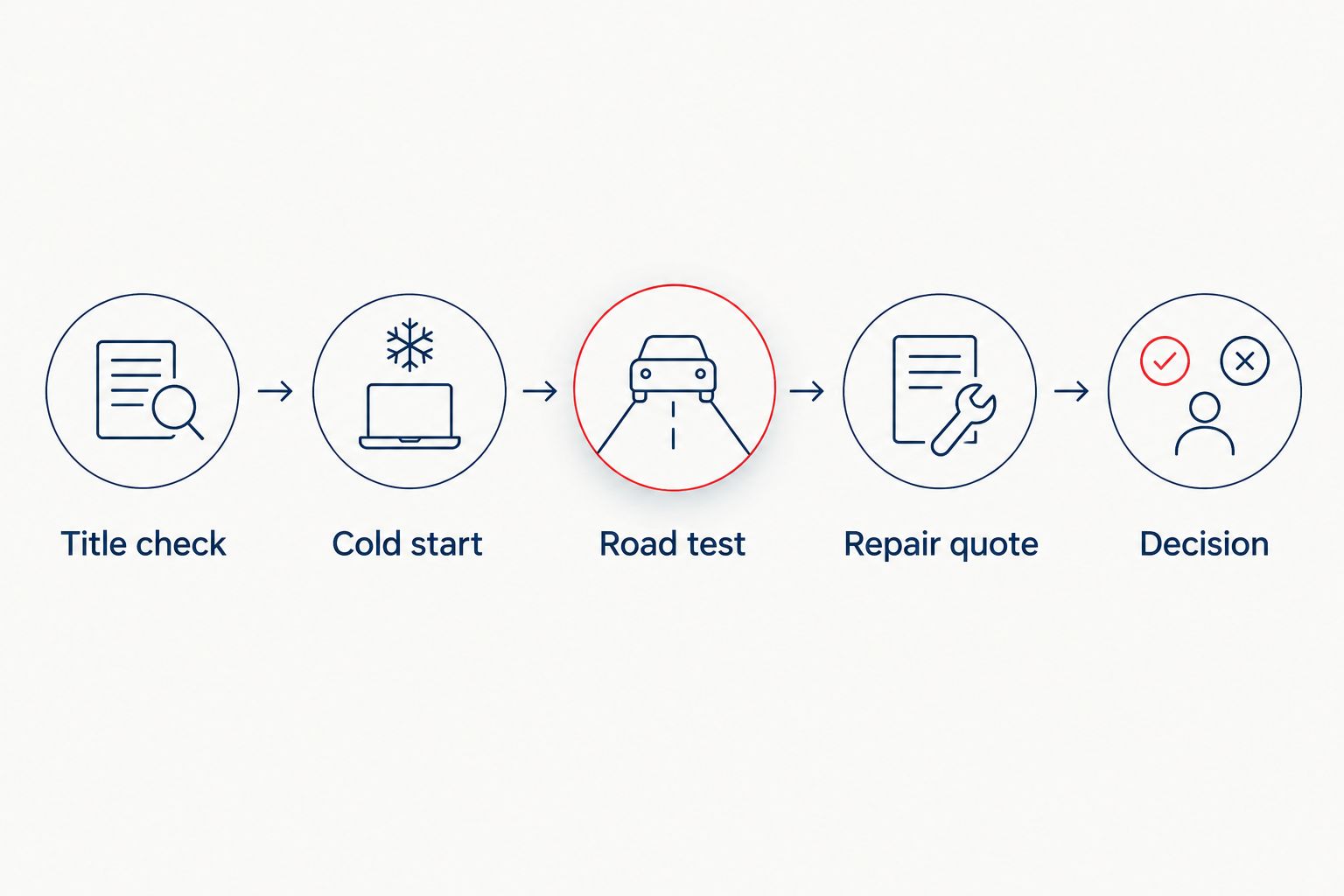
I use a simple priority order. Each stage can stop the purchase; a good result at one stage does not cancel a problem at another.
- Title check: Match the vehicle identification number to the paperwork and investigate discrepancies. A clean title does not prove an accident-free or flood-free history.
- Cold start: Arrange to inspect the car before it is warmed up. Have unusual noises, smoke, warning lights, and leaks investigated.
- Road test: Check engine response, transmission behavior, braking, steering, and air-conditioning operation. Include the driving conditions you expect to use.
- Repair quote: Ask an independent shop to identify faults and provide written estimates. Use qualified hybrid diagnosis where needed.
- Decision: Buy, negotiate around documented needs, or walk away. Unexplained problems are not a fuel-saving opportunity.
Testarossa Motors buys and sells vehicles, so there is a commercial interest in completing a sale. You have the right to verify a vehicle independently. My recommendation is to keep that verification separate from the seller’s description.
Which fuel-efficient used car should you choose?
For Greater Houston buyers comparing fuel-efficient used cars, my default recommendation at Testarossa Motors is the Toyota Prius. Start there, then compare the Ioniq Hybrid if efficiency leads your search, or the Camry Hybrid if you need more room.
Choose the Corolla Hybrid or later-generation Insight when a compact sedan better fits your needs. Keep the gasoline Corolla in contention if you prefer a nonhybrid. In every case, the best inspected example beats the most attractive unverified listing.
Ready to see where you stand? You can apply for financing online in a few minutes, then stop by our lot at 521 Hwy 3 in League City to look at clean-title vehicles that have each been inspected three times. Approval depends on the lender, and we’ll walk you through the terms in writing before you sign anything.
Questions we hear a lot
What’s the best fuel-efficient used car to buy in Houston?
The Toyota Prius is my default shortlist choice because it combines a hybrid powertrain with hatchback practicality. The individual vehicle still needs an independent inspection and an exact EPA-rating check.
Is the Hyundai Ioniq Hybrid more efficient than the Toyota Prius?
The answer depends on the exact model year and configuration of both cars. Compare their U.S. EPA combined ratings rather than treating either model name as a single MPG figure.
Should I buy a hybrid or a gasoline Corolla?
Choose based on the exact vehicles’ condition, fuel economy, repair needs, and your driving distance. A gasoline Corolla avoids hybrid-system components, but it still needs engine and transmission checks.
Does a clean title mean a used car has never been flooded?
No, a clean title does not establish that a vehicle has never suffered flood damage. Have an independent inspector check for water intrusion, corrosion, electrical problems, and inconsistent history.
Keep reading
- How many miles used cars typically last
- Used cars for first-time buyers in League City
- Paying cash vs. financing
- Start your financing application