
Home healthcare workers’ used-SUV buying is the process of choosing a pre-owned vehicle that supports patient visits without straining your household budget. For Houston buyers, I would put engine and transmission condition ahead of extra seats, then check cargo access, air conditioning, insurance, and the actual loan terms.
A home-health route on the Gulf Coast
Home health work in our area can mean a morning in Dickinson, a visit in Friendswood, and an afternoon in Pearland, with short hops and lots of parking in between. Your SUV sits in the sun while you’re inside, then needs to cool down fast when you get back in with supplies.
Some supplies don’t like heat, so a strong A/C and a cargo area you can keep shaded matter. Missing a patient because of a dead battery or an overheating engine is worse than most car problems, so we’d put cooling-system and battery checks near the top of the list.
We sell only clean-title vehicles and inspect each one three times before it goes on the lot. If you want to line up financing before you shop, you can do that from your phone between visits.
I’m Deborah Wedemeyer, owner of Testarossa Motors. My buying judgment starts with whether a vehicle makes sense for its intended job—not whether its equipment list sounds impressive. This guide explains how I would weigh that decision for someone traveling between patients’ homes.
Why the right used SUV matters for home healthcare workers
A vehicle used for patient visits has to work between appointments, not just during a morning commute. Repeated parking, loading supplies, and getting in and out make small inconveniences harder to ignore.
Your needs also depend on your role. A nurse carrying a visit bag faces a different cargo question from a therapist transporting equipment. I would buy for the equipment and route you actually have, not the largest workload you can imagine.
The useful question is not simply which SUV has the best reputation. It is which particular vehicle has acceptable mechanical condition, fits your workday, and leaves room in your budget for maintenance. A model’s reputation cannot answer those questions for an individual used vehicle.
How to choose an SUV for patient visits
Define your route and cargo needs
I would start with a written workday description before looking at vehicles. Use a 7-day mileage log if your schedule varies, separating patient travel from commuting and personal errands.
Write down what travels with you, too. A cargo area that looks large in a listing can still have an awkward opening, a high loading edge, or too little usable space with the rear seats upright.
- Home health routes mean many short trips and long parked stretches in the heat, so cooling, battery and reliability come before features.
- List bags, containers, and equipment that travel together.
- Decide whether rear seats must remain usable for family trips.
- Measure bulky equipment instead of estimating by eye.
- Confirm whether your role includes transporting anyone else.
Set a budget that survives an ordinary repair
I would work backward from what you can comfortably spend on transportation, not forward from a monthly payment advertised beside a vehicle. The payment is only part of the commitment.
Include insurance, fuel, scheduled maintenance, registration, and money kept aside for repairs. Ask your insurer how driving between patient appointments affects the policy; do not assume a personal policy covers every work use.
- Get an insurance quote for the specific vehicle and intended use.
- Compare annual percentage rate, loan term, and total payments.
- Separate your down payment from your repair reserve.
- Ask whether the lender has vehicle or documentation restrictions.
- Keep enough flexibility to decline an uncomfortable loan.
Check mechanical condition before comfort features
The engine and transmission come first in my decision process. I would rather accept ordinary cosmetic wear than an unexplained mechanical symptom that could interfere with work.
Start with what you can check yourself: warning lights, fluid leaks, unusual sounds, uneven tire wear, and how the vehicle behaves before it has warmed up. Then arrange an independent pre-purchase inspection. Ask the shop what it will examine and which systems require separate testing.
- Request maintenance records and check that they match the vehicle.
- Ask to observe a cold start when practical.
- Have a shop inspect engine, transmission, cooling, brakes, and suspension.
- Ask the inspector to distinguish urgent repairs from ordinary wear.
- Check the vehicle identification number for open safety recalls.
Test the SUV as a work tool
A brief drive around the block will not answer every workday question. I would plan a 20-minute test drive, with the seller’s permission, that includes parking, stop-and-go driving, and a road where normal higher-speed operation is legal and safe.
Test the air conditioning during the drive and while stopped. In Greater Houston, I would treat weak cooling as a repair question to resolve before purchase—not something to explain away because air comes from the vents.
- Adjust the seat and mirrors before setting off.
- Park, exit, and re-enter from both sides where safe.
- Test cooling, windows, locks, wipers, and charging connections.
- Load your representative bags with the rear seats upright.
- Listen for symptoms during braking, turning, and acceleration.
Choose the smallest body style that does the job
I would compare vehicle types only after defining your load. Buying extra space without a clear use adds another trade-off to evaluate; choosing too little space can make every visit less convenient.
A compact SUV is my starting point for a solo worker carrying ordinary bags. A midsize SUV deserves a closer look when measured equipment or family needs justify it. A sedan remains worth considering if enclosed trunk storage suits your supplies and the seating position works for you.
- Compare cargo openings, not just descriptions of cargo capacity.
- Check each vehicle’s fuel-economy information for its exact configuration.
- Verify safety features on the actual vehicle.
- Test family seating without displacing work equipment.
- Reject extra size that provides no useful benefit.
Resolve uncertainty before signing
My final decision would bring the inspection, repair estimates, title information, insurance, and financing together. A vehicle can pass one part of that review and still fail the overall buying decision.
The lesson I would take from a buying mistake is to improve the decision rule, not excuse the next warning sign. A known maintenance item with a written estimate is manageable information. An unresolved overheating complaint or inconsistent transmission behavior is a reason to stop and investigate.
- Match the vehicle identification number across documents.
- Obtain written estimates for work needed immediately.
- Read any warranty or service-contract terms rather than assuming coverage.
- Confirm the lender, payment schedule, and total obligation.
- Walk away if inspection access or important answers are withheld.
Mistakes that cost home health workers
Buying around the monthly payment alone
A payment that fits today can still come with a loan term or total obligation you do not want. I would compare the full agreement and keep repair money outside the down payment. Approval answers a lending question, not whether the SUV is a sound purchase.
Assuming a clean title settles the inspection
A clean title does not describe current engine, transmission, cooling, or brake condition. I would use title checks and a mechanical inspection for different purposes. Neither should stand in for the other.
Testing an empty SUV instead of the working load
An empty cargo area hides loading problems. Bring representative cases and check access with the seats positioned as you will use them. Do not discover after purchase that every equipment stop requires unloading something else.
Treating personal insurance as automatic work coverage
Travel between patient appointments deserves a direct conversation with your insurer. Describe the actual use, including any passenger transport, and ask for confirmation of the appropriate coverage. A general question about commuting is not the same question.
Accepting an unexplained symptom to finish shopping
Shopping fatigue is a poor reason to accept uncertainty. I would stop for a diagnosis when the vehicle overheats, shifts inconsistently, or shows warning lights. A seller’s explanation needs evidence, especially when the vehicle will support your work schedule.
Which SUV size works for home health?
I would choose by body style before narrowing the search to individual vehicles. These are starting points, not promises about a model’s condition, equipment, or operating costs.
| Option | Best for | Main benefit and limitation |
|---|---|---|
| Compact SUV | Solo workers carrying bags and modest equipment | Worth testing for easier parking and cargo access; confirm that the load fits behind upright rear seats. |
| Midsize two-row SUV | Workers whose measured equipment needs more room | Adds another size category to consider; parking space and operating costs still need checking vehicle by vehicle. |
| Three-row SUV | Buyers combining work travel with a genuine passenger need | Offers seating flexibility; using the rear seats reduces the space left for equipment. |
| Sedan | Workers whose supplies fit securely in a trunk | Separates trunk contents from the passenger cabin; the opening and lower seating position need a practical test. |
My default is a compact SUV with verified condition—not a particular badge. Move to a larger vehicle when your measurements or passenger needs support the decision.
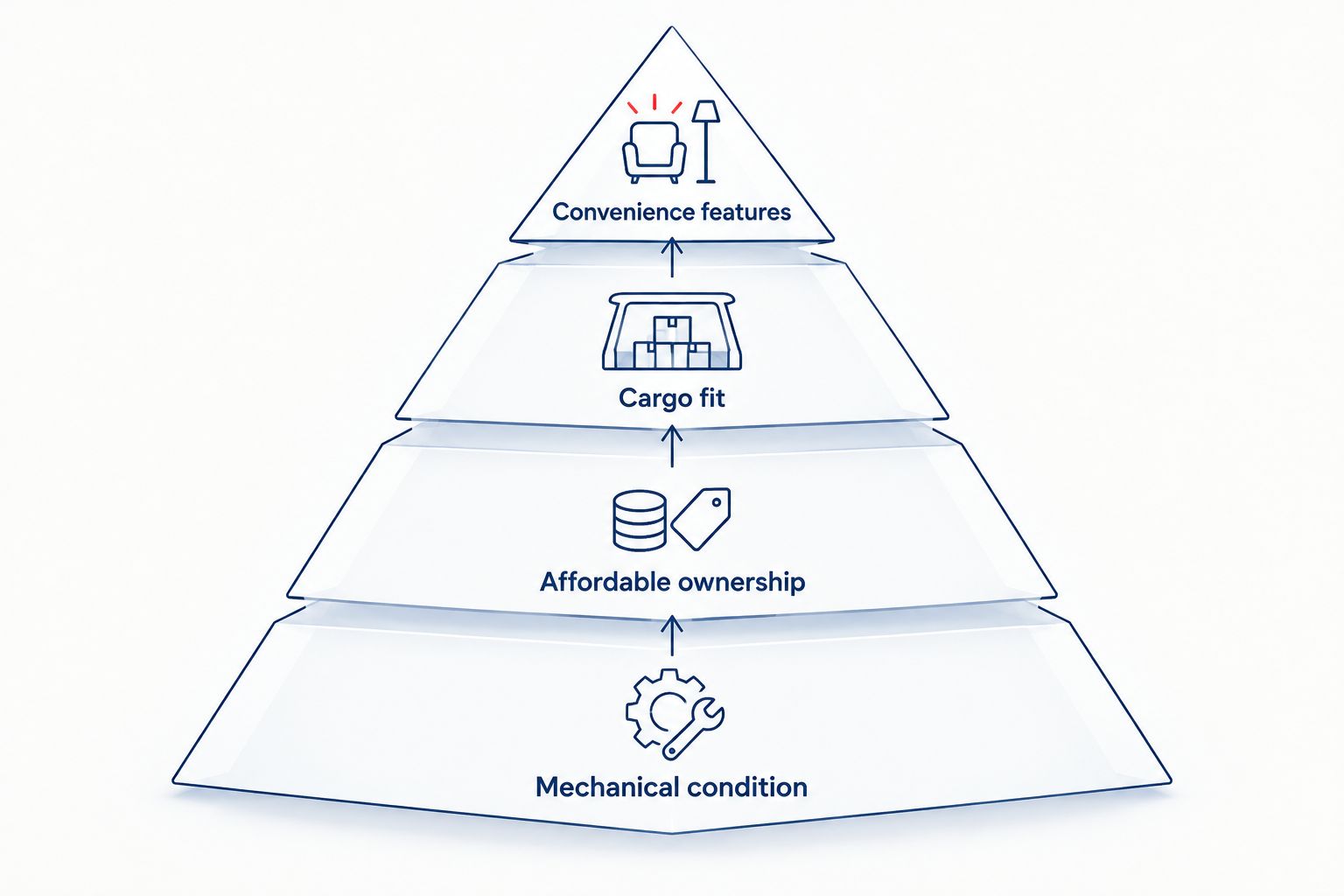
The priorities should stay in order even when an appealing vehicle appears. Mechanical condition and affordable ownership come before convenience features; cargo fit determines whether the vehicle can do your job.
Ready to see where you stand? You can apply for financing online in a few minutes, then stop by our lot at 521 Hwy 3 in League City to look at clean-title vehicles that have each been inspected three times. Approval depends on the lender, and we’ll walk you through the terms in writing before you sign anything.
Questions we hear a lot
What’s the best used SUV for a home healthcare worker in Houston?
A compact SUV is a sensible starting point for a solo worker whose bags fit behind the rear seats. Choose the individual vehicle only after checking mechanical condition, insurance, cargo access, and the full financing terms.
Should I buy a compact SUV or a larger SUV for patient visits?
Choose the smallest SUV that carries your actual equipment and meets your passenger needs. Measure your load and test it with the seats upright before paying for space you do not need.
Does a clean title mean a used SUV has no problems?
No, a clean title does not establish current mechanical condition or prove that a vehicle has never been damaged. Use title and history checks alongside an independent pre-purchase inspection.
Can I use a personal auto policy for home healthcare visits?
Ask your insurer whether your policy covers your specific work use. Describe travel between appointments, equipment carried, and any passenger transport rather than assuming commuting coverage answers the question.
Keep reading
- Used Ford Escape in League City
- Used Hyundai Tucson in League City
- How many miles is too many for a used SUV
- Start your financing application