
Clear Lake commuter car buying is choosing a used vehicle for dependable daily travel without taking on repair risk your budget cannot absorb. For NASA-area and Clear Lake drivers, I would put engine and transmission condition ahead of badges, then check air conditioning, seat comfort and the demands of the actual route.
What the Clear Lake commute actually does to a car
Our lot sits on Hwy 3 in League City, a few minutes from the NASA Road 1 and Bay Area Blvd corridor, so a lot of our customers work at or around Johnson Space Center and the contractors that support it. That drive is short in miles but hard on a car: stop-and-go lights, long idles in parking lots in the heat, and a hop onto I-45 when you head toward Webster or Houston.
That pattern means the A/C, the cooling system, the battery and the brakes take more of a beating than the odometer suggests. Low-lying streets around Clear Lake and Taylor Lake Village also hold water after a heavy Gulf storm, so we’d ask every seller directly about water exposure.
Here’s how we handle it on our side: we only sell clean-title vehicles, and every car gets inspected three times before it goes on the lot. That’s still not a substitute for your own independent inspection, and we’re happy to let your mechanic look.
I’m Deborah Wedemeyer, owner of Testarossa Motors. My buying judgment starts with what can make a vehicle an expensive mistake, not what makes it attractive in a listing. This guide follows that same order, whether you buy in League City or somewhere else.
Why careful car buying matters for Clear Lake commuters
A commuter car has to fit more than the drive to work. Your choice might also handle school pickup, groceries, appointments and a longer trip after an already tiring day. A vehicle that feels comfortable during a short demonstration still needs to work for your whole routine.
For a NASA-area buyer, the useful questions concern the actual trip: highway time, repeated stops, parking, passenger needs and how much disruption a repair would cause. An employer name does not identify the right vehicle. Your route and responsibilities do.
Where Clear Lake commuters go wrong
Shopping by commute distance alone
A short drive does not remove the need for reliable cooling, sound brakes or comfortable seating. I would consider the whole day, including errands and passengers, rather than use distance as permission to accept unresolved faults.
Treating a clean title as an inspection
Title status matters, but it does not diagnose an engine or reveal every prior repair. Keep the title review and the independent inspection as separate buying steps. Passing one does not mean the other is unnecessary.
Choosing extra capacity without a real use
A larger SUV or pickup needs to solve an actual problem. I would write down the hauling, seating or cargo requirement first. If a smaller vehicle meets it comfortably, compare that option before committing to more vehicle.
Letting a payment replace the buying decision
An acceptable payment does not explain the loan term, total borrowing obligation or vehicle condition. I would review the vehicle and financing separately, then decide whether both fit the household. Pressure to combine those decisions is a reason to slow down.
My step-by-step for a Clear Lake commuter car
1. Map your real driving needs
I would start with a written commute log, not a vehicle search. Record a normal working week and include the errands attached to it. A car chosen only for the workplace parking lot can disappoint when the rest of daily life gets added.
- Your usual route and the parts involving stop-and-go traffic.
- The passengers and belongings that travel with you regularly.
- Parking constraints at home and work.
- The equipment you genuinely need to carry.
- How you would get to work while the vehicle is being repaired.
2. Set a budget that leaves room for ownership
I would build a 12-month ownership worksheet before deciding which vehicle to pursue. Loan payments are only part of that worksheet. Insurance, fuel, scheduled maintenance and identified repairs all compete for the same household money.
- Separate the vehicle payment from other ownership expenses.
- Use the actual vehicle identification number for insurance quotes.
- List maintenance that is due rather than assuming it was completed.
- Keep room in the household budget for unexpected repairs.
- Compare written loan terms before accepting a payment figure.
3. Match the body style to the job
I would choose the smallest body style that comfortably does the required work. That is a buying rule, not a claim that every small car is the right answer. Passenger access, cargo shape and driving comfort can justify moving up in size.
- Sedan — best for commuting with modest passenger and cargo needs.
- Compact SUV — best for mixed commuting and everyday family errands.
- Minivan — best for frequent passenger loading and family duties.
- Pickup — best for buyers with a defined hauling or towing requirement.
Sedan, hatchback, small SUV or truck?
This comparison is a starting point, not a substitute for inspecting the individual vehicle. Size alone does not establish fuel use, safety equipment, reliability or condition. Verify those details by model year, configuration and vehicle identification number.
| Option | Best for and useful strength | Main limitation to check |
|---|---|---|
| Sedan | Solo or small-household commuters; a separate trunk keeps belongings out of the passenger area | Trunk opening and rear-seat access must suit your actual load |
| Compact SUV | Mixed commuting and errands; hatch access supports varied cargo | Do not assume the SUV label guarantees more useful passenger space |
| Minivan | Family commuters; passenger access and cabin flexibility deserve consideration | Overall size must fit your parking space and comfort level |
| Pickup | Commuters who also haul or tow; the bed serves a separate work purpose | Verify towing equipment and ratings; an open bed is not enclosed storage |
I would not choose between these categories until sitting in the vehicle and loading the things that matter. A body style can sound right on paper and still be wrong for your household.
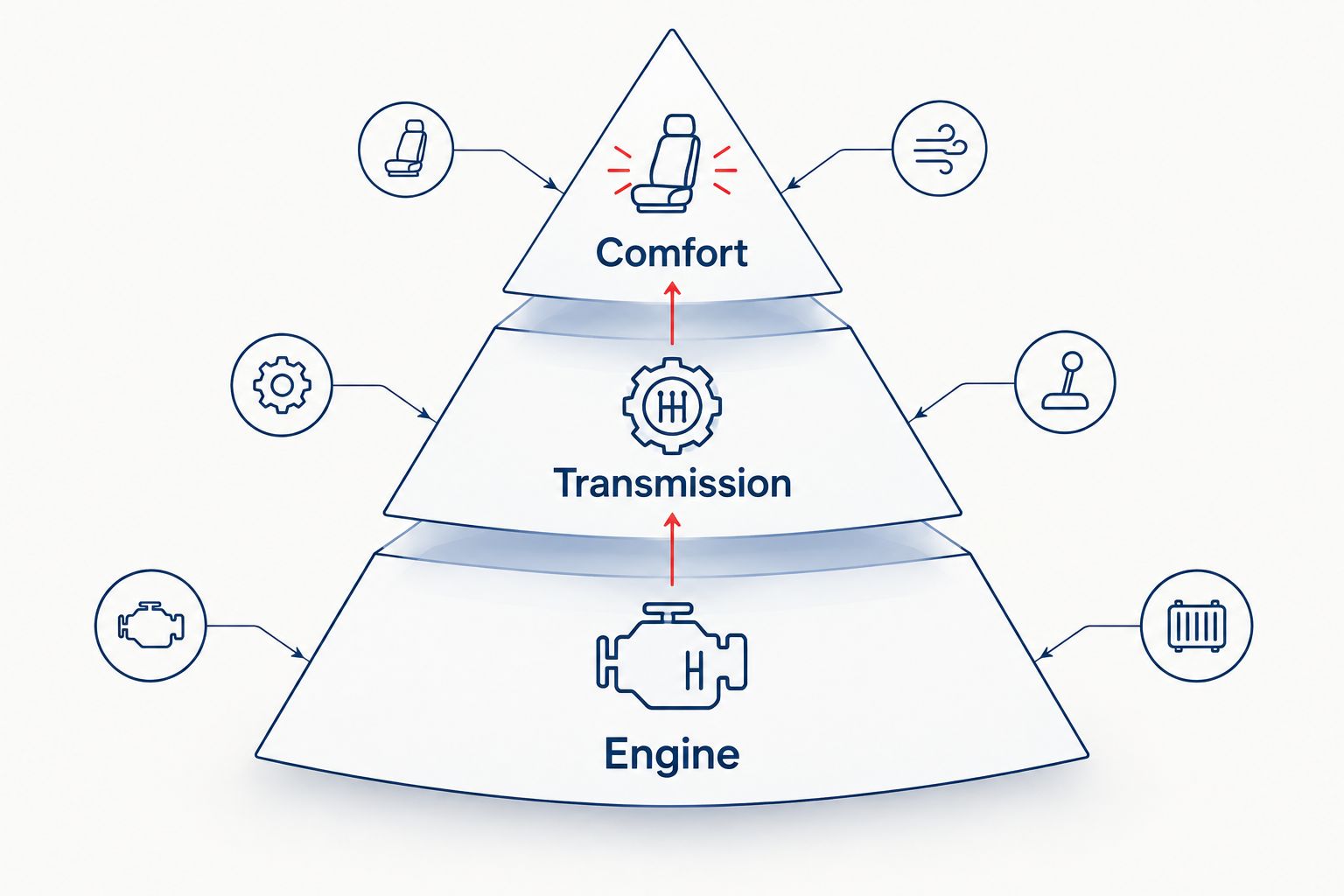
4. Inspect the engine and transmission first
My priority order is engine, transmission, then comfort. Cosmetic wear is easier to understand than an unexplained drivability problem. I would rather identify a mechanical concern before discussing whether worn upholstery is acceptable.
- Engine: ask the mechanic to investigate leaks, warning lights and running problems.
- Transmission: check engagement, shifting and behavior during the road test.
- Comfort: assess seats, controls and cabin functions after major mechanical concerns.
- Request written findings that separate urgent repairs from routine maintenance.
- Walk away when a major concern cannot be explained and assessed.
5. Test the vehicle like a commuter
A useful road test should answer whether you can live with the vehicle, not just whether it moves. With the seller’s permission, include the kinds of driving your route requires. Test the air conditioning during the drive and while stopped; a quick blast from a vent is not a full assessment.
- Start with a comfortable seat position and clear sightlines.
- Check cooling during both moving and stopped portions of the test.
- Listen for noises during braking, turning and ordinary road travel.
- Check window, lock, light and wiper operation.
- Fit required child seats or work equipment before deciding.
6. Verify title, history and water-damage concerns
A clean title is not a promise that a vehicle has no problems. Title status, service records, a history report and a physical inspection answer different questions. I would not use any one of them to replace the others.
- Match the identification number across the vehicle and paperwork.
- Ask about title status and any outstanding lien.
- Review available service and history records for unanswered questions.
- Request inspection for water intrusion, corrosion and electrical faults.
- Resolve discrepancies before signing or transferring money.
7. Decide which faults to accept and when to leave
Used vehicles have wear. The buying task is to distinguish an understood compromise from an open-ended problem. I can accept a flaw in principle when its effect and repair needs are clear; I would not treat an unknown problem as harmless simply to finish the deal.
- Accept ordinary wear only when it does not defeat your needs.
- Obtain estimates for identified repairs before making a decision.
- Confirm that promised work appears in writing.
- Read lender terms, fees and optional items separately.
- Leave when documents conflict or major questions remain unanswered.
Ready to see where you stand? You can apply for financing online in a few minutes, then stop by our lot at 521 Hwy 3 in League City to look at clean-title vehicles that have each been inspected three times. Approval depends on the lender, and we’ll walk you through the terms in writing before you sign anything.
Questions we hear a lot
What are the best used cars for Clear Lake commuters?
The best used cars for Clear Lake commuters are vehicles with verified mechanical condition, suitable passenger space and ownership needs that fit the buyer’s budget. Start with body style and route requirements, then inspect the individual vehicle rather than choosing by badge alone.
Should I buy a sedan or an SUV for a NASA-area commute?
Choose a sedan when it meets your passenger and cargo needs; consider a compact SUV when hatch access or seating position solves a specific problem. Test both with your actual passengers and belongings before deciding.
Does a clean title mean a commuter car has no problems?
No, a clean title does not establish that a used car has no mechanical problems, prior repairs or water damage. Review the paperwork and arrange an independent inspection as separate checks.
What should I check during a Clear Lake commuter test drive?
Check engine and transmission behavior, braking, visibility, seating comfort and air conditioning. Include driving conditions similar to your routine, with the seller’s permission, and investigate any unexplained symptom.
Keep reading
- Used cars for first-time buyers in League City
- What a clean title does and doesn’t tell you
- Used Chevrolet Equinox in League City
- Start your financing application