
Contractors’ used-truck buying is matching a pre-owned pickup to your crew, cargo and towing needs so the truck supports your work without stretching your budget. I would choose verified load capacity and sound engine and transmission condition before trim level, appearance or advertised towing claims.
Gulf Coast job sites are hard on trucks
Contractors around League City see a lot of new builds and storm repair work, and that means muddy lots, gravel drives and loaded trailers on Hwy 3, FM 646 and I-45. Humidity and standing water after storms add rust and electrical problems to normal wear.
We’d look closely at the frame, bed mounts and brake lines, check the 4×4 if it has one, and make sure the A/C keeps up, since your crew will be in and out of that cab all day in the heat.
We only sell clean-title trucks, and each one gets three inspections before we list it. Family owned since 1995, we’d much rather sell you a truck that keeps working than one that just looks right.
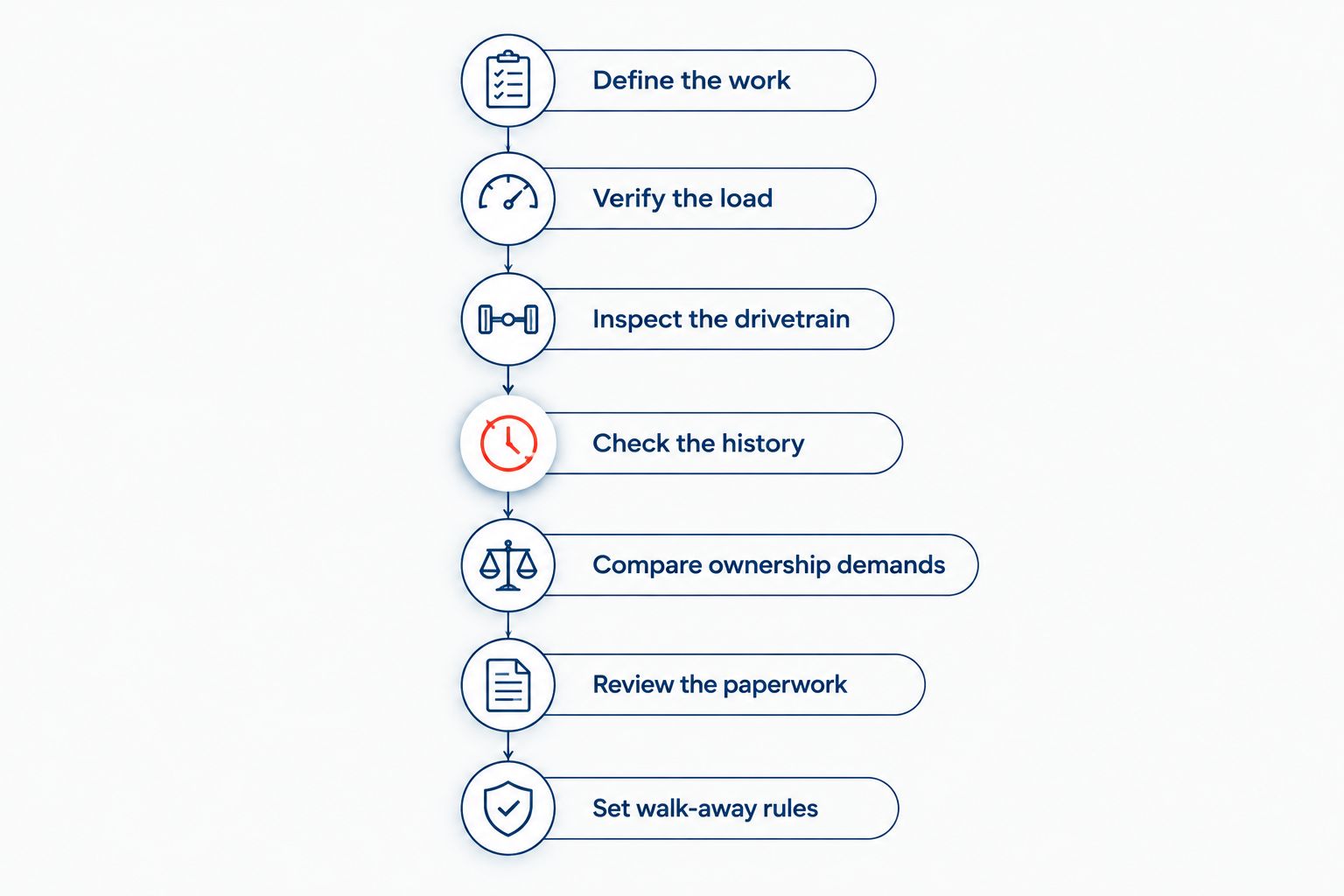
Our process for a contractor’s truck
Define the work
I would write down the truck’s hardest regular assignment before shopping. Describe the crew, cargo and trailer together, rather than choosing a badge and trying to make the work fit afterward.
A service contractor carrying hand tools has a different requirement from a crew moving bulky materials. If the truck also serves your family, check passenger space without letting a larger cab hide an unsuitable bed or load limit. Measure awkward equipment instead of judging fit from photographs.
- List the tools and materials carried on an ordinary workday.
- Record the maximum crew that regularly travels together.
- Measure equipment that must fit inside the bed.
- Identify trailer use and the loads the trailer actually carries.
- Separate required equipment from convenience features.
Verify the load
I would verify the exact truck’s ratings before treating it as suitable for the job. Model names alone do not establish payload or towing capacity. Configuration, installed equipment and the manufacturer’s limits matter.
Read the vehicle’s load labels and owner documentation. Account for passengers, cargo, aftermarket equipment and trailer tongue weight; a receiver hitch is not proof that the truck can handle your loaded trailer. Both truck and trailer limits apply.
- Read the truck’s payload and axle-rating labels.
- Confirm the exact configuration in manufacturer documentation.
- Include racks, toolboxes and other permanent equipment.
- Compare loaded trailer weight with all applicable limits.
- Verify hitch, tire and trailer ratings separately.
Inspect the drivetrain
I put engine and transmission condition ahead of cosmetic wear because those systems are central to whether the truck can do its job. I would rather understand a worn seat than accept unexplained overheating or transmission slipping.
Arrange 1 independent pre-purchase inspection before committing. Ask the mechanic to assess the truck for your intended use, not merely confirm that it starts and drives around the block. A diagnostic scan adds information, but it does not replace physical checks or a road test.
- Request a cold start when practical.
- Have the mechanic assess leaks and cooling-system condition.
- Check transmission operation during an appropriate road test.
- Inspect brakes, steering, suspension and tires.
- Get written findings and estimates for identified repairs.
Check the history
I would read the title, history information and service records as separate pieces of evidence. None replaces the others. A clean title does not certify maintenance quality, rule out flood exposure or establish that every repair was performed correctly.
For Greater Houston buyers, water exposure deserves a direct question and a physical inspection. Ask the mechanic to investigate suspicious corrosion, moisture, odors or electrical faults rather than deciding from a single clue. An explanation from the seller should agree with the evidence.
- Match the vehicle identification number across the truck and documents.
- Ask about prior commercial use and towing duties.
- Look for maintenance records relevant to the exact drivetrain.
- Investigate signs of water exposure or collision repairs.
- Resolve ownership or lien questions before proceeding.
Compare ownership demands
A heavier-duty truck is not automatically the better buy. I would choose the capability your work requires, then compare the maintenance and repair demands of the actual candidates. Excess capability does not cancel poor condition.
Gas and diesel trucks need different evaluations. For a diesel, have a qualified mechanic assess the fuel, turbocharging and emissions systems applicable to that vehicle. Do not assume a diesel is the right choice just because a truck will be used commercially.
- Compare candidates against the same written work requirement.
- Ask for maintenance requirements for the exact engine.
- Identify repairs already needed, not just routine service.
- Check whether modifications complicate inspection or servicing.
- Choose drivetrain features that serve a specific job.
Review the paperwork
I would compare the vehicle decision and the loan decision separately. A manageable payment does not establish that the truck is mechanically sound or that the loan suits your business.
Testarossa Motors offers financing options but does not finance vehicles directly. Ask the prospective lender about contractor income documentation, permitted vehicle use, insurance requirements and any restrictions before relying on financing.
- Confirm how the truck will be titled and insured.
- Ask the lender what income documentation it requires.
- Verify that intended business use fits the loan terms.
- Read every charge and optional item before signing.
- Retain copies of the final documents.
Set walk-away rules
I would decide what ends the purchase before discussing a particular truck. Otherwise, time spent shopping can turn into a reason to overlook a problem. A truck that fails a required check is not rescued by a comfortable seat or a convenient payment.
A useful buying lesson is to correct the decision process rather than excuse an uncertain vehicle. When a question reveals a gap, get the missing evidence. Do not invent a favorable explanation for an engine fault, missing paperwork or an unsuitable load rating.
- Stop if the truck cannot meet the required load limits.
- Pause for unresolved title, ownership or lien issues.
- Require a satisfactory explanation of serious mechanical findings.
- Decline terms that leave no room for necessary repairs.
- Walk away if independent verification is refused.
Matching the truck to the job
These are configuration choices, not recommendations for specific vehicles. The best option depends on the exact truck’s ratings, condition and your work requirement. I would use this table to narrow the search, then repeat the inspection process for each candidate.
| Option | Best for | Main advantage and limitation |
|---|---|---|
| Light-duty gas pickup | Tool transport and loads within verified ratings | Suits work that does not require heavier capability; crew and equipment still consume payload. |
| Heavy-duty gas pickup | Work requiring the particular truck’s higher verified limits | Adds capability when documented; size and maintenance needs still require evaluation. |
| Heavy-duty diesel pickup | Towing work that justifies the specific drivetrain | Offers a different engine choice for demanding work; fuel, emissions and repair systems need specialist assessment. |
| Four-wheel-drive pickup | Jobs with a defined need for additional driven-wheel traction | Adds a traction option; it does not override payload, towing or tire limits. |
Bed length and cab layout cut across these choices. A truck can have enough rated capacity yet still carry your equipment awkwardly. I would check both weight and physical fit before calling any configuration suitable.
Where contractors overspend
Buying for the occasional extreme job
Choosing the entire truck around an unusual assignment can distract from daily requirements. I would distinguish regular work from exceptional work, then compare ways to handle the exception without compromising the ordinary job.
Treating accessories as proof of capability
A ladder rack, hitch or aftermarket suspension part does not establish the truck’s manufacturer ratings. Check the equipment’s condition and documentation, and count its weight where applicable. An accessory can consume capacity rather than add it.
Spending the whole budget on the purchase
A used work truck needs an operating plan, not just a purchase plan. I would identify immediate repairs, insurance, maintenance and any required equipment before committing. Do not defer a known safety repair to keep the deal together.
Confusing ordinary wear with serious risk
Bed scratches and worn seats deserve a different response from overheating, shifting faults or uncertain ownership. I would accept cosmetic compromises more readily than unresolved engine or transmission concerns. Known repair needs require an estimate; unknown critical faults require investigation.
Assuming a dealer inspection ends your checks
The seller’s assessment does not replace your own decision. At Testarossa Motors, the commercial incentive remains selling a vehicle, just as your priority remains buying a suitable truck. Ask questions, request evidence and use an independent mechanic.
Ready to see where you stand? You can apply for financing online in a few minutes, then stop by our lot at 521 Hwy 3 in League City to look at clean-title vehicles that have each been inspected three times. Approval depends on the lender, and we’ll walk you through the terms in writing before you sign anything.
Questions we hear a lot
What’s the best used truck for a Houston contractor?
The best used truck is the specific vehicle that meets your loaded work requirements and passes an independent inspection. Choose verified capacity and mechanical condition before brand, trim or appearance.
Should I buy a gas or diesel work truck?
Choose gas or diesel after comparing your actual work requirements and the condition of individual trucks. A diesel candidate needs an inspection that covers its applicable fuel, turbocharging and emissions systems.
Does a contractor need four-wheel drive in Houston?
A contractor needs four-wheel drive only when the intended work gives it a clear purpose. It does not replace suitable tires or change the need to verify payload and towing limits.
Can I finance a used truck with contractor income?
Ask the lender whether your income documentation and intended vehicle use meet its requirements. Testarossa Motors offers financing options but does not lend directly, and approval depends on the lender’s decision.
Keep reading
- Used trucks for sale in Houston
- What to check on a 5.3 V8 Tahoe, Suburban or Silverado
- Financing a used truck with bad credit
- Start your financing application