
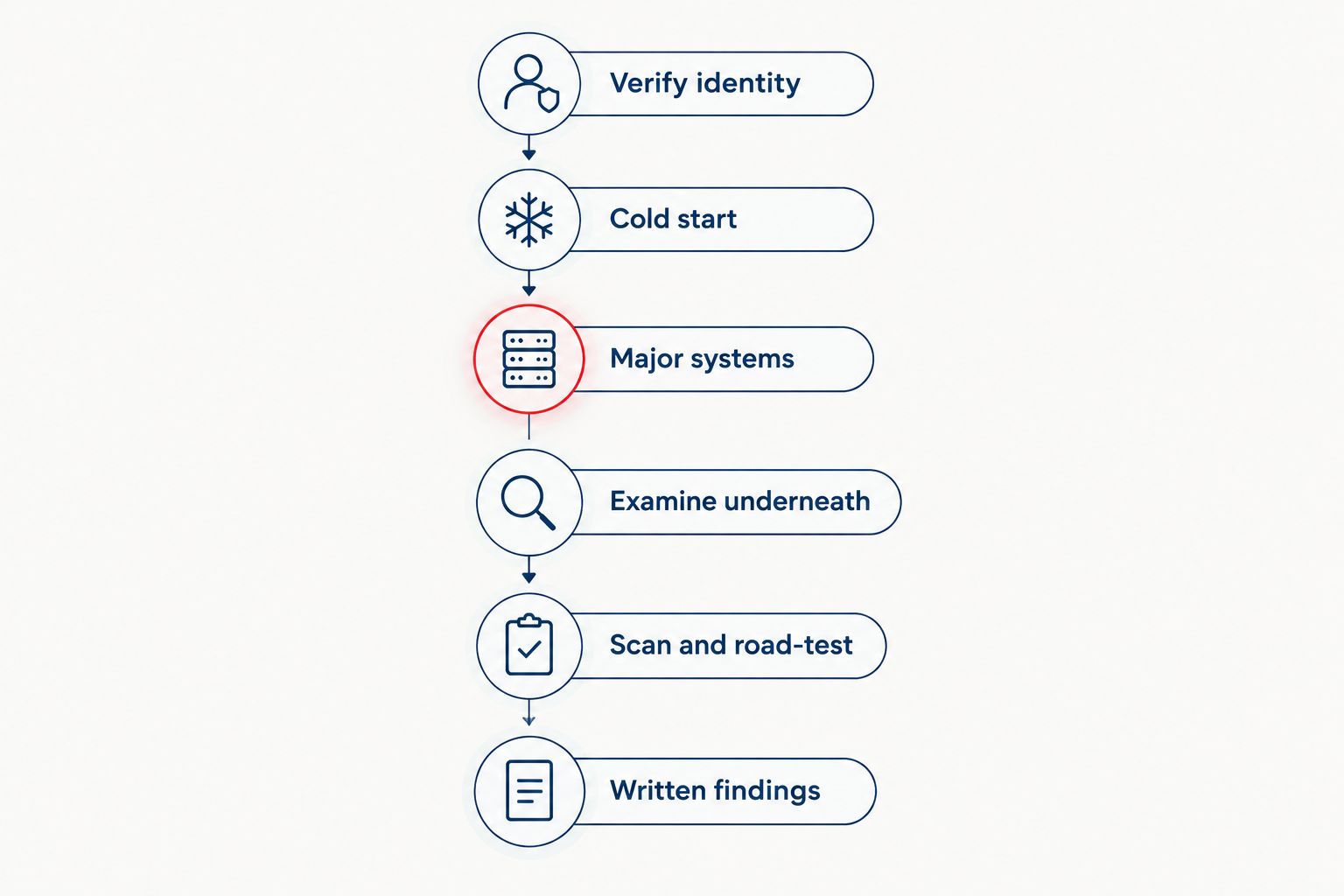
A quality pre-purchase inspection in Houston should cover a cold start, engine and transmission operation, a diagnostic scan, an underbody examination, brakes, tires, electrical equipment, flood clues and a road test, followed by written findings. I put the most weight on expensive mechanical problems and unresolved safety concerns—not whether a used car looks freshly detailed.
Why this matters
A used car can look good and still need work that changes your buying decision. The reverse is also true: worn upholstery or scratched paint can distract you from a mechanically sound vehicle.
I’m Deborah Wedemeyer, owner of Testarossa Motors. My buying judgment starts with the engine, transmission and the risk I would be accepting—not the shine on the hood. Understanding what a clean title does and does not mean belongs in that same decision.
For a 2026 purchase, ask the inspector to explain what was checked, what needs attention and what remains uncertain. An inspection is useful when it changes a decision, not simply when it produces a long checklist.
What should a quality used-car inspection cover in Houston?
I would arrange the inspection before signing the final purchase agreement. Give the shop the vehicle identification number, the seller’s description and any concerns you noticed, then confirm the following scope.
- Verify identity and paperwork. Match the VIN on the vehicle with the title and inspection paperwork. Review available service records and history information.
- Observe a cold start. Ask whether the engine can be inspected before it has been warmed up. Note starting behavior, warning lights, unusual sounds and exhaust smoke.
- Inspect the major systems. Include the engine, transmission, cooling system, brakes, steering, suspension, tires and electrical equipment.
- Examine underneath. Use a lift to inspect leaks, corrosion, structural concerns and components hidden from a walk-around.
- Scan and road-test. Read diagnostic information and assess operation on the road when the vehicle is safe to drive.
- Get written findings. Require a list that separates immediate concerns, upcoming maintenance and ordinary wear.
Ask what the appointment excludes. A standard inspection does not automatically include engine disassembly, internal transmission testing or specialized battery testing on an electrified vehicle.
Engine and transmission: start with the biggest risks
I prioritize engine and transmission condition because unresolved problems here can overwhelm an otherwise sensible purchase. A smooth idle alone does not establish that either system is healthy.
Ask the inspector to check fluid condition where accessible, visible leaks, cooling-system operation, unusual noises and signs of overheating. A cooling system should be checked safely; never open a hot pressurized cooling-system cap.
During the road test, the inspector should assess acceleration, shifting, engagement into forward and reverse, and operation after warming up. Slipping, shuddering, delayed engagement or a temperature warning needs explanation before purchase.
A symptom is not a diagnosis. I would not accept a casual explanation that a warning light is “just a sensor” without supporting findings. Ask whether further testing is necessary and what that testing would establish.
For a 2026 buying decision, separate a confirmed repair from an unresolved possibility. You can budget around a known problem more clearly than an unexplained symptom.
Underbody, brakes and tires: check what the photos miss
A lift examination helps reveal leaks, damaged components and corrosion that listing photos leave out. Ask the inspector to distinguish surface rust from corrosion affecting structural strength or component mounting points.
Brake inspection should cover friction material, rotors, accessible lines and hoses, leaks and road-test behavior. Noise alone does not tell you the remaining brake life; measurements and condition matter.
For tires, request tread measurements, wear-pattern observations, sidewall checks and a review of the tire date codes. Uneven wear deserves an explanation, not merely a recommendation for replacement tires.
- 2/32 inch of tread: The commonly recognized wear-out threshold is not a good target for a fresh purchase.
- 4/32 inch of tread: Wet-weather tire guidance commonly recommends considering replacement around this depth; discuss the actual tires and your driving with the inspector.
- 17-character VIN: Modern standardized vehicle identification numbers should match across the vehicle and paperwork.
Those measurements serve different purposes. Tread depth helps assess tire condition; a matching VIN helps establish that you are inspecting the vehicle described in the documents.
Houston checks: water intrusion, cooling and air conditioning
For Greater Houston buyers, I would specifically request a water-intrusion check. Ask the inspector to examine accessible carpeting, seat mounting areas, wiring connections and enclosed storage spaces for moisture, staining, silt or unusual corrosion.
A musty smell or strong fragrance is a reason to investigate, not proof of flood damage. Likewise, a clean history report does not establish that water never entered a vehicle. Ask the inspector to explain whether several findings point to the same concern.
Air conditioning needs an operating check, not simply confirmation that the fan blows. Ask whether cooling remains consistent at idle and during the road test, and whether unusual noise or visible leakage requires further diagnosis.
In 2026, engine cooling and cabin cooling remain separate inspection items. Working air conditioning does not prove that the engine cooling system is healthy, and a normal temperature gauge does not establish that the air conditioner works properly.
Diagnostic scan, safety equipment and daily-use features
A diagnostic scan adds information, but it cannot replace physical inspection. Ask for the codes found, their status and any relevant readiness information rather than a simple pass-or-fail statement.
Incomplete readiness monitors can follow recent battery disconnection or code clearing. They do not prove concealment, but they leave questions that need an explanation or additional driving and testing.
Have the inspector check warning-light behavior, exterior lighting, wipers, seat belts, windows, locks and the equipment fitted to that particular vehicle. Do not assume a trim badge establishes which safety features are present or working.
If the vehicle has driver-assistance equipment, ask about warning messages and evidence of repairs that warrant calibration checks. A standard inspection might identify a concern without including the specialized procedure needed to resolve it.
My preference is plain reporting: what worked, what failed and what could not be tested. An unchecked item is not the same as a working item.
Which inspection approach fits your purchase?
Different inspection arrangements answer different questions. Confirm the actual service scope instead of choosing by the appointment’s name alone.
| Inspection approach | Best for | Benefit and limitation |
|---|---|---|
| Independent shop with a lift | Buyers needing mechanical and underbody checks | Provides access underneath; you must arrange vehicle transport and seller permission. |
| Mobile inspection | Buyers needing an inspection at the vehicle’s location | Reduces transport arrangements; lift access and road-test conditions can be limited. |
| Specialist inspection | Vehicles needing model-specific or specialized assessment | Adds focused knowledge and equipment; confirm whether ordinary mechanical checks are included. |
| Seller’s inspection paperwork | Understanding work already documented | Gives useful starting information; it is not an independent opinion selected by you. |
For a 2026 purchase, I favor the arrangement that answers the vehicle’s specific risks. A mobile visit without underbody access is not equivalent to a lift inspection, even if both produce a report.
Testarossa Motors serves Greater Houston buyers seeking clean-title used cars, trucks and SUVs. That does not remove your reason to obtain an independent assessment. A dealership wants to sell vehicles; your inspector should help you evaluate the vehicle, not protect the sale.
Why inspection scope varies
The right inspection follows the vehicle and your intended use. I would discuss these factors with the shop before booking:
- Vehicle design: Gasoline, diesel, hybrid and electric vehicles require different knowledge and equipment.
- Age and mileage: Wear, service intervals and maintenance evidence affect what needs closer attention.
- Reported symptoms: Overheating, vibration or shifting complaints require targeted diagnosis beyond a general checklist.
- Intended work: Towing and work-truck use call for attention to the relevant equipment and signs of wear.
- Previous repairs: Collision work, water intrusion or modifications can justify specialist examination.
- Inspection access: Lift availability, a cold engine and permission for a proper road test affect what the inspector can establish.
Explain how you will use the vehicle. A family SUV, daily commuter and work truck do not face identical demands, even when their inspection basics overlap.
What should I do with the inspection report?
I sort findings into safety problems, mechanical uncertainty, scheduled maintenance and cosmetic wear. That keeps a scratched bumper from receiving the same attention as a brake-fluid leak.
Ask the shop for written repair estimates where it can provide them. Then check whether your budget covers the purchase, required repairs, insurance and routine ownership costs without depending on an optimistic diagnosis.
In 2026, my decision rule is straightforward: resolve major uncertainty before negotiating around it. A lower purchase amount does not make an unexplained transmission problem easier to understand.
Ordinary wear is different. I can accept worn trim or a known maintenance need when the vehicle suits the buyer’s budget and the repair scope is clear. I would walk away when essential questions stay unanswered or the remaining risk exceeds the money available for repairs.
Does a clean title replace a pre-purchase inspection?
A clean title does not replace a pre-purchase inspection. Title status and mechanical condition answer different questions, and neither a title nor a history report establishes the condition of every component.
Use documents to identify concerns and a physical inspection to investigate the vehicle in front of you. Neither should carry the whole decision.
Should I buy if the seller refuses an independent inspection?
I would pause the purchase if the seller refuses a reasonable independent inspection. Ask whether the obstacle is scheduling, transport or a specific restriction, and see whether a workable arrangement addresses it.
If you still cannot obtain the assessment needed to understand the risk, choose another vehicle. You do not have to accept uncertainty simply because you have already spent time shopping.
FAQ
What should I ask for when booking a pre purchase inspection in Houston?
Ask for a cold start, lift examination, diagnostic scan, road test and written findings. Confirm exclusions and explain any symptoms before booking.
Does a clean title mean a used car has no mechanical problems?
A clean title does not establish mechanical condition. Use an independent inspection to assess the engine, transmission, safety systems and other components.
Can a mechanic tell whether a Houston used car has flood damage?
A mechanic can inspect for evidence of water intrusion, but no inspection guarantees discovery of every past event. Ask for findings from accessible interior areas, wiring connections and the underbody.
Is a mobile inspection as useful as taking the car to a shop?
A mobile inspection is useful when its scope answers your concerns, but it does not automatically provide lift access. Confirm underbody access, diagnostic capability and road-test arrangements before choosing.
Should I walk away from a used car with warning lights?
Unexplained warning lights are a reason to pause, not accept a guess about the repair. Get a diagnosis before deciding whether the problem fits your budget and tolerance for risk.
Will a pre-purchase inspection guarantee the car will not break down?
A pre-purchase inspection cannot guarantee future reliability. It documents observable condition and test results, with limits on access and what can be established without further testing.
Should I independently inspect a car sold by Testarossa Motors?
An independent inspection is a sensible way to verify a used vehicle before buying. Ask about access and arrangements for the specific vehicle rather than assuming every inspection method is available.
One last thing
Ask the inspector to identify anything that could not be checked. A report with an honest limitation is more useful than a reassuring conclusion that hides unfinished work.
Before committing, I want to know the biggest remaining question and what would answer it. If that question concerns overheating, transmission operation, structural integrity or water intrusion, finish the investigation first.
Related guides
- Checking used-car history in Houston
- Used-car research options for Houston buyers
- Used-car pricing research in Houston
- Used-car guidance for first-time buyers in League City