

Four trucks get cross-shopped in Houston more than any others: the Ford F-150, Toyota Tacoma, Ram 1500 and Chevrolet Silverado 2500HD. For most people who want one truck to commute in and haul with, the F-150 is where I’d start. That isn’t because the badge wins. It’s because the F-150 comes in so many cab, bed and engine combinations that it’s easy to find one built for your job. Below, each truck is broken down by generation, engine and the one or two things I’d look at hardest. After that come the two questions that decide more truck purchases around here than brand loyalty does: do you really need 4×4, and what can this truck actually tow?
This is a model guide, not an inventory list. Ask us what is on the lot today.
Ford F-150: the default, if you pick the right engine
Generations you will see on Houston lots: the 13th generation (2015–2020) and the 14th (2021 on). The 2015 redesign moved the body to aluminum alloy on a steel frame. Most used F-150s you’ll compare fall in that span.
Engines that matter:
- 2.7L EcoBoost V6 (twin-turbo): a good fit for commuting with occasional towing.
- 3.5L EcoBoost V6: the towing engine.
- 5.0L V8: for buyers who want a naturally aspirated V8.
- 3.3L V6 (2018 on): a base engine you’ll mostly find in work-spec trucks.
A 10-speed automatic arrived behind the 3.5L EcoBoost for 2017 and spread to most engines for 2018. The 2021-on generation added the PowerBoost hybrid.
What I’d check on this truck:
- Cold start. Listen at the first start of the day, before anyone has warmed it up. A cold-start rattle from worn cam phasers on some 2017–2020 3.5L EcoBoost trucks has been the subject of Ford service bulletins. Ask whether any related work is on record.
- Previous bodywork. Repairing an aluminum body takes the right equipment. If the history or the paint shows bodywork, have the inspecting shop look at the repair quality, not just the paint match.
- How the 10-speed shifts. On 2017–2020 trucks, check that shifts are smooth in stop-and-go traffic on a feeder road, not only at highway speed.
Who it fits: one-truck households that commute on I-45 or the Beltway during the week and pull a utility trailer or small boat on weekends.
Toyota Tacoma: easier to live with, smaller than it looks on paper
Generations: the 3rd generation (2016–2023) is the core of the used market. The 4th generation arrived for 2024. Older 2nd-generation trucks (2005–2015) still turn up. Toyota ran a well-publicized frame-corrosion program on 2005–2010 Tacomas, so on any truck from those years, ask whether a frame inspection or replacement was done.
Engines: on 3rd-gen trucks, a 2.7L four-cylinder or a 3.5L V6, with a 6-speed automatic or a 6-speed manual.
What I’d check:
- Highway shifting. Drive it at highway speed with the cruise control on. Owners commonly describe the 3rd-gen automatic as reluctant to downshift, then hunting between gears on grades and overpasses. Decide whether that behavior bothers you before you own it.
- Bed and cab size. Access Cab rear seats are small, and the short bed is about five feet. Measure what you carry.
- Off-road trims. TRD Off-Road and Pro trucks often lived the part. Check skid plates, CV boots and the underside for scrapes.
Who it fits: drivers who park in tight Clear Lake and Webster lots or apartment garages and haul light loads.
Ram 1500: the passenger truck
Generations: the 5th generation (2019 on) is a different truck from the older design Ram kept selling alongside it as the Ram 1500 Classic. Check which one you’re looking at, because the cab, interior and options differ.
Powertrains: a 3.6L V6 and a 5.7L HEMI V8. On 2019-on trucks, the eTorque mild-hybrid system is fitted on many V6 and some V8 trucks.
What I’d check:
- Air suspension. If the truck has the optional four-corner air suspension, cycle it through its ride heights and watch for warning messages. A truck sitting low on one corner after parking needs a diagnosis.
- eTorque warnings. If a warning or charging message appears, have it diagnosed. Don’t accept “it does that sometimes.”
- Cab fit. Put the people who’ll ride in the back in the Crew Cab, with car seats installed, before you talk numbers.
Who it fits: families who ride four or five deep and still need an open bed.
Chevrolet Silverado 2500HD: only if you can name the load
Generations: the 2020 redesign is the line most shoppers draw. From 2020 the heavy-duty Silverado offered a 6.6L gas V8 or the 6.6L Duramax diesel, the diesel paired with an Allison 10-speed automatic. Earlier trucks (2015–2019) are common and cheaper to buy.
What I’d check:
- Tow history. Look at the hitch receiver, the gooseneck or fifth-wheel prep in the bed, the trailer wiring and the brake-controller connector. They tell you how the truck was used.
- Diesel systems. On a Duramax, ask for records on fuel filters and the emissions system, including the DEF fluid and the particulate filter. A truck that only made short trips can have exhaust-aftertreatment trouble.
- Fuel and parking. A 2500HD is a lot of truck for an empty commute. Price the insurance and fuel before you decide you “might tow something big one day.”
Who it fits: people with a known travel trailer, horse trailer or equipment load that’s past what a half-ton should pull.
Do you need 4×4 for Houston driving?
Usually not, and it costs money to own. Four-wheel drive adds a transfer case, front differential and front driveshaft, which means more fluids and parts to maintain. It earns its keep for:
- Boat ramps with algae on the concrete, like the ones at Clear Lake, Kemah and Seabrook.
- Unpaved job sites, pasture and beach access, where it’s allowed.
- Pulling a trailer out of wet grass after a storm.
It doesn’t make a truck safe for flooded roads. Turn Around, Don’t Drown applies to a lifted 4×4 exactly as it does to a sedan. If you buy a 4×4, shift into 4-High and 4-Low during the test drive, on a loose surface if you can, and listen for clunks. Then check the front differential and transfer case for leaks.
Towing: the numbers on the truck, not in the brochure
Two places decide what a specific used truck can do:
- The Tire and Loading Information placard on the driver’s door jamb. It states the maximum combined weight of occupants and cargo for that exact truck, and trailer tongue weight counts against that number.
- The manufacturer’s towing guide for that model year, matched to the engine, axle ratio, cab, bed and drivetrain on the window sticker or build sheet. Most brands now publish ratings under the SAE J2807 standard, so check the ratings for that exact model year.
Texas has its own rule too. A trailer heavier than 4,500 pounds gross needs working brakes once it’s towed above 30 mph. That’s Texas Transportation Code §547.401. If your trailer is in that range, confirm the truck has a working brake controller (factory or aftermarket) and test it with the trailer hooked up.
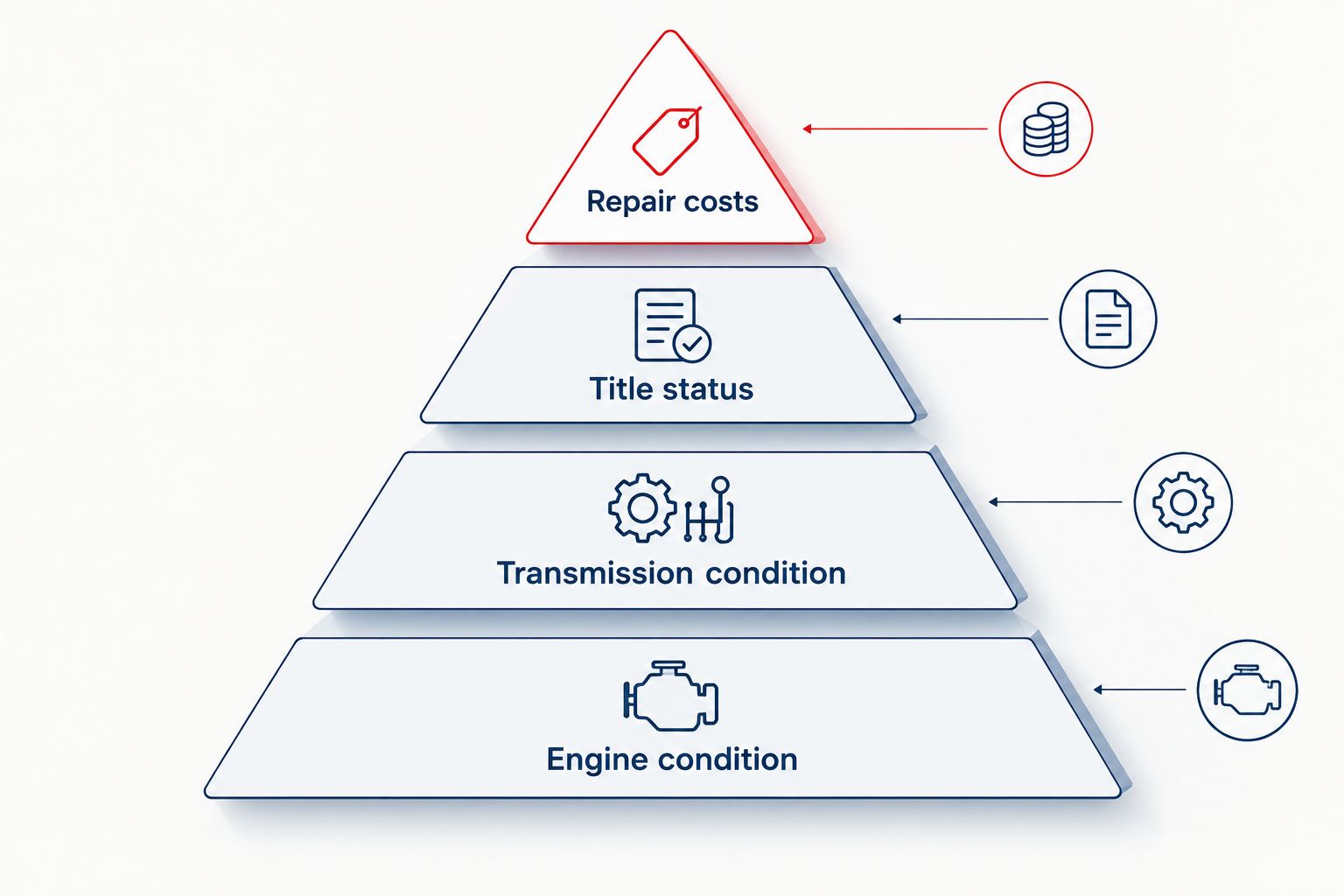
Before you sign for any of the four
- Match the VIN. Check the VIN on the dash and the door against the title and the paperwork.
- Run a free flood and total-loss check. Search the VIN on NICB VINCheck and check for open recalls at NHTSA.
- See it cold. Watch the first start of the day, and drive it through traffic, a parking lot and reverse.
- Get it inspected. Pay an independent shop to put it on a lift. Ask for rust, leak and previous-repair findings in writing.
- Price the known work. Get repair costs in writing before you negotiate.
Our League City lot (521 State Hwy 3) sells clean-title trucks. A clean title doesn’t replace an inspection, and you’re welcome to bring your own mechanic. We don’t finance vehicles directly and we’re not buy-here-pay-here. Financing goes through outside lenders, so read their terms separately from your decision about the truck.
Truck questions we hear most
Is an F-150 or a Tacoma better for Houston?
If the bed and cab size of a Tacoma covers your real loads and passengers, its smaller footprint is easier to live with in town. If you tow regularly or carry four adults, start with the F-150.
Which F-150 engine should I look for?
For commuting and light towing, the 2.7L EcoBoost. For regular heavier towing, the 3.5L EcoBoost. If you’d rather avoid turbos, the 5.0L V8. Whichever you choose, check its records and the cold start.
Do I need a diesel to pull a travel trailer?
Only if the trailer’s loaded weight and tongue weight put you past a half-ton’s real limits. Weigh the trailer loaded, then compare that to the specific truck’s ratings.
Is the Ram 1500 Classic the same as a new-body Ram?
No. The Classic carried on the earlier design next to the 2019-on truck. Check the model name on the title and window sticker.
Does a clean title mean a truck was never flooded?
No. Run the VIN through NICB VINCheck and have an inspector look for water lines, corrosion and electrical faults.
Ready to compare a real truck against this list? Reach us by phone or text at (281) 332-6568, or look over the trucks at Testarossa Motors.
Deborah Wedemeyer wrote this one. She owns Testarossa Motors, which has bought upward of 18,000 used vehicles in the years since 1995.
References
- Texas Transportation Code §547.401, brakes required
- NICB VINCheck
- NHTSA recall lookup
- NHTSA tire and loading placard guidance
- National Weather Service, Turn Around Don’t Drown