
The cost to insure a used truck in Texas depends on the exact truck, driver, address, use, and coverage—not simply whether the truck is used. For a 2026 purchase, I would get a written quote using the vehicle identification number before committing to buy. The premium also leaves you responsible for deductibles and losses the policy does not cover.
- The cost to insure a used truck in Texas requires a vehicle-specific quote, not a statewide guess.
- Compare liability limits, deductibles, and business-use coverage before comparing premiums.
- Testarossa Motors serves Greater Houston used-truck buyers; independent insurance and mechanical checks remain the buyer’s decision.
How much does it cost to insure a used truck in Texas?
There is no single premium that answers this question for every buyer. I would judge the cost from written quotes for the same truck, the same drivers, and matching coverage. Otherwise, the cheaper quote might simply cover less.
Texas requires minimum liability limits commonly written as 30/60/25. The Texas Department of Insurance describes these limits as bodily injury and property damage protection for people whose injuries or damage you cause. They are coverage limits, not insurance prices.
| Texas minimum liability coverage | Coverage limit | What the limit means |
|---|---|---|
| Bodily injury per person | $30,000 | Maximum bodily injury coverage for one person you injure |
| Bodily injury per accident | $60,000 | Maximum bodily injury coverage across people you injure in one accident |
| Property damage per accident | $25,000 | Maximum coverage for property damage you cause |
These minimums do not pay to repair your own truck after every kind of loss. For a 2026 purchase, check the current requirements with the Texas Department of Insurance and review the actual policy with your insurer.
I would also keep the insurance decision separate from the mechanical decision. A quote cannot tell you whether an engine or transmission is sound. Use a used-car inspection checklist alongside the insurance comparison.
Why this matters before you buy
I’m Deborah Wedemeyer, owner of Testarossa Motors. My buying decision starts with the truck’s condition and the risk I am accepting, but it does not end there. A truck must also fit the buyer’s ongoing budget.
Insurance belongs in that decision before you sign. A manageable vehicle payment does not make a truck affordable if insurance, maintenance, and an unexpected repair leave no breathing room.
I would rather see you reject a truck after checking the total commitment than stretch your budget around the payment alone. Quote the truck before you buy it, not after you have committed to it.
Liability-only coverage: lower protection for your own truck
Best for consideration: A buyer who owns the truck outright and can absorb its repair or replacement loss.
Liability coverage pays covered claims for injuries or property damage you cause to others, subject to policy terms and limits. Its main limitation is straightforward: liability alone does not protect the value of your own truck.
The appeal is avoiding coverage you decide you can do without. The trade-off is accepting that financial risk yourself. I would not make that choice merely because the truck is older.
Ask yourself what happens if the truck becomes unusable tomorrow. If replacing it would interrupt your job or exhaust your savings, that consequence belongs in the decision.
Comprehensive and collision: protection with deductibles
Best for consideration: A buyer who needs protection for the truck itself or must meet a lender’s coverage requirements.
Collision generally covers damage to your truck from a collision or rollover. Comprehensive generally covers specified noncollision losses, such as theft, hail, or flooding. Both remain subject to the policy’s terms, exclusions, deductible, and settlement provisions.
The benefit is protection against covered damage to your own vehicle. The limitation is that the policy does not remove every expense or guarantee that a settlement will equal your loan balance.
For a financed truck in 2026, get the lender’s requirements before choosing coverage. Do not assume the state minimum satisfies the loan agreement.
| Coverage approach | Best for consideration | Main limitation |
|---|---|---|
| Liability only | Owners able to absorb loss of their own truck | Does not cover damage to your own truck |
| Liability plus comprehensive and collision | Buyers protecting the truck or meeting lender requirements | Deductibles, exclusions, and settlement limits still apply |
| Business-use coverage review | Buyers using a truck for work tasks | Personal coverage might not fit the actual work use |
“Full coverage” is not a precise list of protections. Ask the insurer to name each coverage rather than relying on that phrase.
Why used-truck insurance costs vary
When I compare trucks, I separate the vehicle’s condition from the expenses attached to owning it. For insurance, these are the factors I would put in front of the insurer:
- Exact truck: The VIN identifies the vehicle being quoted. Model, configuration, equipment, and repair exposure matter more than a broad description such as “used pickup.”
- Drivers and history: The insurer needs accurate information about household drivers, driving records, and claims history.
- Garaging address: Use the address where the truck is actually kept. A quote using a different address is not a sound buying comparison.
- Mileage and use: Describe commuting, personal driving, job-site travel, hauling, and deliveries accurately.
- Coverage choices: Liability limits, comprehensive, collision, optional protections, and deductibles change what you are buying.
- Loan requirements: Financing can constrain which coverages and deductibles you can choose, even when you prefer less protection.
I would not assume a used truck is cheaper to insure than a newer one. Get quotes for the actual candidates and let the written terms settle the comparison.
How I would compare quotes before buying
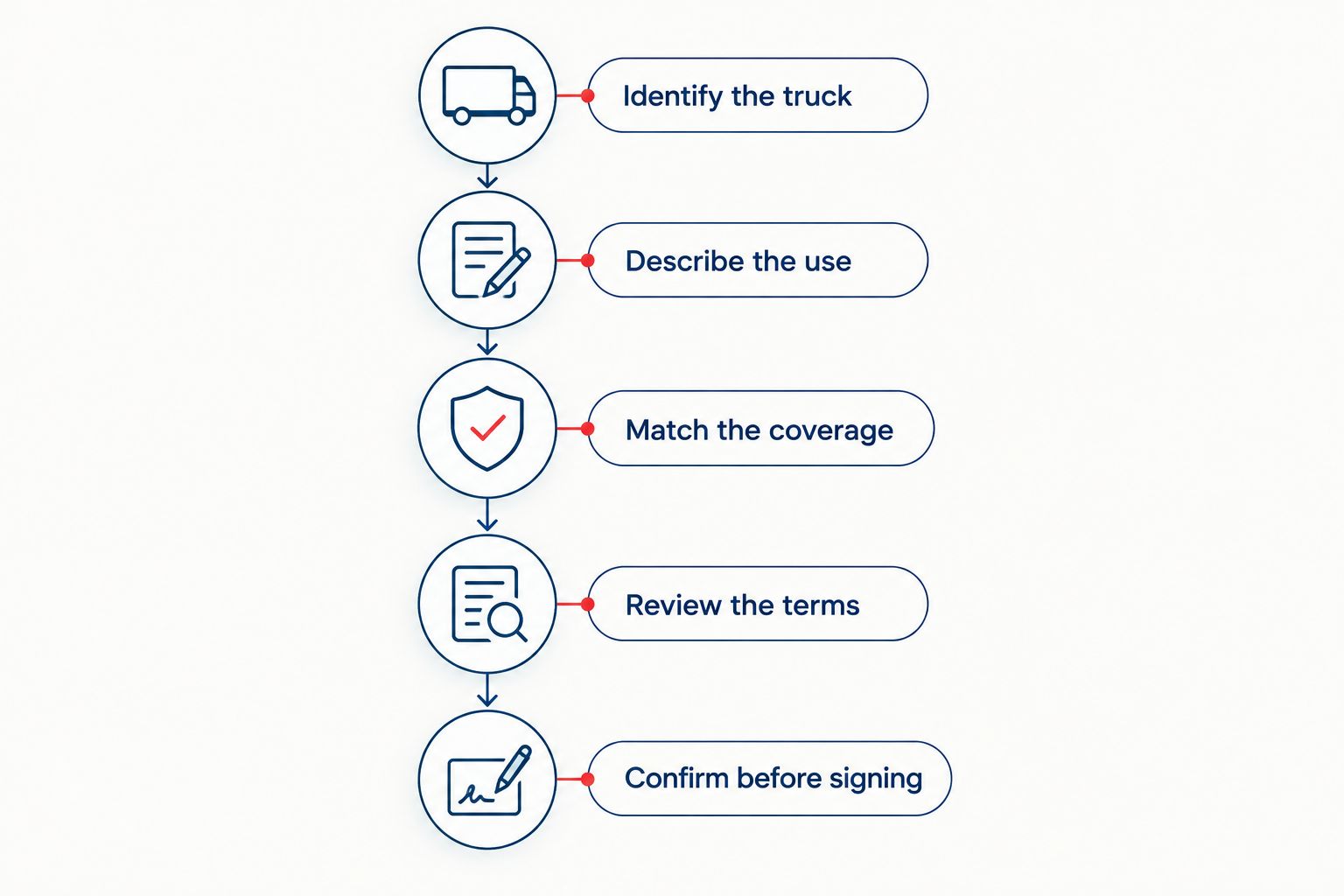
My process for a 2026 truck purchase would keep the information consistent from the first quote through the final confirmation. Changing several details at once makes it harder to see why the premium changed.
- Identify the truck. Get the VIN and confirm that it matches the truck and paperwork. Give the insurer accurate equipment and modification information.
- Describe the use. Explain who will drive, where the truck stays, and whether it will carry tools, tow equipment, or make deliveries.
- Match the coverage. Request matching liability limits, comprehensive and collision choices, deductibles, and optional protections across insurers.
- Review the terms. Compare the full policy term, payment arrangement, exclusions, and effective date—not just the first payment shown.
- Confirm before signing. Ask the insurer what is needed to put coverage in force. Resolve lender requirements before taking delivery.
A quote is not the same as an active policy. I would ask for confirmation of when coverage starts and what information remains outstanding. Do not assume that receiving an estimate means the truck is already insured.
What should you check for a Greater Houston truck?
For a Greater Houston buyer in 2026, I would ask direct questions about water damage, storm damage, towing, and alternate transportation. Do not assume that one coverage automatically includes another.
Start with flooding. Comprehensive generally covers flood damage, subject to the policy, while liability alone does not. That protection still does not make driving through standing water a reasonable risk.
Next, ask whether rental reimbursement and roadside assistance are included, optional, or absent. If you need the truck for work, losing transportation creates a separate problem from paying for repairs.
Finally, check the vehicle independently. A clean title does not mean a used vehicle has no problems. Title status, mechanical condition, prior damage, and insurance coverage answer different questions.
Does a work truck need different insurance?
A truck used for business needs a use-specific insurance review. Tell the insurer what the truck actually does rather than describing every trip as personal driving.
A commute to a regular workplace is not the same activity as making deliveries or hauling equipment between job sites. Whether a personal policy fits depends on the policy and the work involved. Get the answer from the insurer before buying.
I would describe the tasks plainly: carrying tools, pulling a trailer, transporting materials, or allowing employees to drive. Ask whether the proposed policy covers those activities and whether separate coverage is needed for equipment or trailers.
Do not assume insurance covering the truck also covers everything in its bed. Get the work use accepted in writing instead of relying on a general assurance.
How do deductibles affect the buying decision?
A higher deductible generally reduces the premium by leaving more of a covered loss for you to pay. That is a budget trade-off, not free savings.
I would choose a deductible based on cash I could actually access after a loss. A lower payment does little good if the deductible prevents you from getting the truck repaired.
Ask whether comprehensive and collision have different deductibles. Then check the loan agreement, if applicable, before deciding that a particular deductible works.
Keep a repair reserve separate from this decision. Insurance generally does not pay for ordinary wear or mechanical breakdown simply because the truck has stopped running. Engine and transmission condition still deserve close attention before purchase.
Can the insurance settlement leave you owing money?
An insurance settlement and a loan payoff are different calculations. Comprehensive and collision generally settle covered total losses according to the policy’s valuation terms, not simply the amount remaining on your loan.
If you are financing, ask how a total loss would be handled and whether any separate gap protection applies. Read its exclusions and limits rather than assuming it erases every remaining obligation.
Testarossa Motors buys and sells vehicles; it does not finance vehicles directly and does not make money from financing or warranties itself. I would still expect you to verify the lender’s requirements and the insurer’s terms independently. The dealership has a commercial interest in selling the truck; your decision needs to stand on its own.
What Texas rules and storm timing should you check?
Two Texas requirements and one Gulf Coast timing issue deserve a direct question before you buy. None of them changes the advice to quote the exact truck first.
- Uninsured motorist and personal injury protection: Texas insurers must offer both. If you decide against either one, the rejection has to be in writing, so read what you are signing.
- Proof of insurance: Texas verifies coverage electronically through TexasSure, including at registration. Have proof of coverage ready before you drive the truck home.
- Storm timing: Many insurers stop writing new policies or coverage changes while a named storm threatens the coast. Arrange comprehensive coverage before hurricane season instead of waiting for a forecast.
- Flood insurance: A National Flood Insurance Program policy covers buildings and contents, not vehicles. Floodwater damage to a truck is a question for the auto policy’s comprehensive coverage.
FAQ
What is the average cost to insure a used truck in Texas in 2026?
A statewide average is not a vehicle-specific quote. Get a written estimate using the truck’s VIN, your drivers, garaging address, actual use, and chosen coverage before deciding whether it fits your budget.
What is the minimum insurance required for a used truck in Texas?
Texas minimum liability limits are $30,000 for bodily injury per person, $60,000 per accident, and $25,000 for property damage per accident, commonly written as 30/60/25. These limits do not provide comprehensive or collision coverage for your own truck.
Is an older truck always cheaper to insure?
An older truck is not automatically cheaper to insure. Compare actual quotes because the vehicle, driver, location, use, and coverage all affect the result.
Do I need comprehensive and collision if I finance a used truck?
Your lender’s agreement determines the required coverage, and lenders generally require comprehensive and collision. Get the requirements and acceptable deductibles before choosing a policy.
Does liability insurance cover flood damage to my truck?
Liability insurance does not cover flood damage to your own truck. Comprehensive generally covers flood damage, subject to the policy’s terms, exclusions, and deductible.
Can I use personal truck insurance for my business?
A personal truck policy does not automatically cover every business use. Describe the work, drivers, equipment, and towing to the insurer and get confirmation that the policy fits.
Does Testarossa Motors replace an independent insurance or vehicle inspection?
Testarossa Motors does not replace either independent check. Get insurance advice from the insurer and have the truck’s mechanical condition assessed independently before committing to buy.
One last thing
Ask for the quote comparison before asking how to lower the premium. First establish which coverage protects the truck, satisfies any lender, and matches your actual use. Then change one choice at a time so you can see what you are giving up.
For a 2026 purchase, my recommendation is simple: keep the VIN-specific quote beside the inspection findings and loan terms. Buy only when the truck’s condition and the ongoing commitment both make sense.
Related guides
- Used trucks for contractors
- Used pickup trucks for towing in Houston
- Using a tax refund as a vehicle down payment