
Best overall research pick: Honda CR-V. Best for visibility-focused buyers: Subaru Forester. Best for shoppers prioritizing collision-avoidance equipment: Toyota RAV4. For the safest used SUVs Houston buyers should consider, I rank those models ahead of the Mazda CX-5 and Toyota Highlander as starting points—not as a claim that every example is equally safe.
Safety checks for Gulf Coast driving
Around League City, you deal with sudden downpours, standing water on low streets, and heavy traffic on I-45. Features like automatic emergency braking, blind-spot monitoring and good headlights help, but only if the sensors and cameras actually work. Moisture and past collision repairs can affect them.
On a test drive, check that warning lights clear after startup, that the backup camera is clear, and that wipers and headlights are in good shape. Also check NHTSA for open recalls by VIN.
Every SUV we sell has a clean title and is inspected three times. Family owned since 1995, we’d rather walk you through the features in person than have you guess.
Check the vehicle, not just the badge
I’m Deborah Wedemeyer, owner of Testarossa Motors. My buying decision starts with the vehicle in front of me: its engine, transmission, structure, tires, equipment, and the problems an inspection identifies. A familiar name does not cancel out a serious defect.
Testarossa Motors has independently bought more than 18,000 used vehicles since 1995. That buying perspective matters here because a safety recommendation must include reasons to walk away, not just reasons to buy.
What makes the best used SUV for safety?
I put these checks ahead of appearance, brand loyalty, or a long equipment list:
- Crash protection: Look up the exact model year in IIHS and NHTSA records. Read individual results, not just an award badge.
- Collision avoidance: Confirm automatic emergency braking and other desired systems on the actual vehicle. Equipment varies by year and trim.
- Visibility and fit: Check mirrors, pillars, seating position, rearward visibility, and the controls from your driving position.
- Mechanical condition: Inspect steering, brakes, suspension, and all 4 tires. Safety technology does not replace sound mechanical parts.
- Repair history: Investigate structural repairs, airbag concerns, windshield replacement, and any required sensor calibration.
- Family use: Try your child seats and normal passenger arrangement before deciding. A safe seating arrangement must work in practice.
My default is the Honda CR-V for a family’s first safety-focused comparison, not an automatic purchase recommendation. Each SUV below earns a different place on the shortlist. The individual inspection decides whether it stays there.
Safety shortlist
| Research order and SUV | Best for | Safety focus and key limitation |
|---|---|---|
| 1. Honda CR-V | Everyday family use | Check crash results, braking assistance, and child-seat fit; equipment varies by year and trim. |
| 2. Subaru Forester | Visibility-focused buyers | Evaluate sightlines and verify EyeSight equipment; do not assume every used example has it. |
| 3. Toyota RAV4 | Collision-avoidance shoppers | Verify the exact Toyota Safety Sense functions; the system name alone does not establish capability. |
| 4. Mazda CX-5 | Buyers prioritizing control usability | Test seating position and safety-system controls; rear-seat fit needs a separate check. |
| 5. Toyota Highlander | Families needing a third row | Inspect every seating position and restraint; more seats do not establish better crash protection. |
This is a buying-priority ranking, not a numerical crash-test leaderboard. In, comparing vehicles without their exact model years, equipment, and condition would give you false certainty.
1. Honda CR-V: best used SUV for everyday family use
The Honda CR-V is a compact SUV and my first research pick for a household that does not need a third row. I would use it as the baseline for comparing passenger fit, driver visibility, crash protection, and verified collision-avoidance equipment.
Start with the exact model year’s IIHS results and NHTSA record. Then establish whether the particular Honda CR-V has the braking and warning systems you want; a seller’s description is not enough.
- A compact body gives families an alternative to larger SUVs.
- A two-row layout keeps the seating comparison straightforward.
- Exact-year crash records and manufacturer documentation provide a clear research path.
- There is no third row for additional passengers.
- Safety equipment and test results cannot be carried across all model years.
Best for: Families comparing a manageable everyday SUV without extra seating rows.
Verdict: Buy only after the Honda CR-V passes independent inspection and its safety equipment is verified.
2. Subaru Forester: best used SUV for visibility-focused buyers
The Subaru Forester belongs on the shortlist when seeing clearly from the driver’s seat is your main concern. I would compare its sightlines directly with the other SUVs rather than treat visibility as a feature a brochure can settle for you.
Subaru uses the EyeSight name for driver-assistance technology. Verify whether the particular Forester has it, what functions that version provides, and whether there are warnings or unresolved repair questions.
- It provides a compact, two-row alternative to larger family SUVs.
- EyeSight-equipped examples give buyers a defined system to investigate.
- A stationary seating and mirror check makes visibility easy to compare personally.
- EyeSight presence and functions depend on the individual vehicle.
- Windshield and camera-related repair history deserves attention on equipped examples.
Best for: Drivers who put sightlines and understandable assistance systems ahead of extra passenger capacity.
Verdict: Buy a Subaru Forester when visibility fits you and the installed systems check out; hold if camera-related questions remain.
3. Toyota RAV4: best used SUV for collision-avoidance research
The Toyota RAV4 is my research pick for buyers who want to compare collision-avoidance functions carefully. Toyota Safety Sense is a useful starting point, but its name does not tell you everything about a used vehicle’s equipment.
Identify the exact model year, trim, and system version. Then read the applicable owner’s manual for operating conditions, warnings, and limitations instead of assuming every RAV4 detects the same hazards.
- A compact, two-row layout suits buyers who do not need additional seating.
- Toyota Safety Sense documentation helps identify the functions on equipped vehicles.
- A feature-by-feature check keeps the comparison focused on useful equipment.
- Different system versions are not interchangeable in a safety comparison.
- A reputation for durability does not establish the condition of a particular vehicle.
Best for: Buyers willing to verify braking assistance and warnings instead of shopping by badge.
Verdict: Buy a Toyota RAV4 with verified equipment and sound condition; skip any example sold on reputation alone.
4. Mazda CX-5: best used SUV for control-focused drivers
The Mazda CX-5 gives you another compact SUV to compare when seating position and control usability matter most. I would judge it from the driver’s seat, with the vehicle parked first and then during a normal road test.
Check whether you can see the instrument warnings, adjust the mirrors, and understand the installed assistance systems without guesswork. Confirm every claimed feature against documentation for that vehicle.
- Its compact format provides an alternative to a larger SUV.
- Driver fit and control access can be evaluated directly before purchase.
- It adds a useful comparison when another SUV’s seating position feels wrong.
- Rear-seat and child-seat fit must be checked with your actual passengers and seats.
- Safety features and headlight equipment vary across used examples.
Best for: Drivers who want a compact SUV that fits their driving position and makes its controls understandable.
Verdict: Buy a Mazda CX-5 when driver fit, family fit, and inspection results agree; skip it if the seating arrangement does not work.
5. Toyota Highlander: best used SUV for third-row families
The Toyota Highlander belongs on this list for buyers who genuinely need 3 seating rows. That need changes the inspection: the rear seats, seat belts, access, and intended child-seat positions all become part of the decision.
I would not choose a larger SUV simply because it looks more protective. Crash-test results, vehicle condition, and proper restraint use still need separate checks.
- A third row gives families an option beyond the compact SUVs above.
- You can evaluate the complete passenger arrangement before purchase.
- It makes capacity a deliberate buying choice rather than an afterthought.
- The larger body needs a parking and visibility check on your normal routes.
- Third-row space and child-restraint suitability require hands-on verification.
Best for: Families whose regular passenger needs justify a third row.
Verdict: Buy a Toyota Highlander when the third row solves a real need and every occupied seating position works safely.
Confirming safety features on the test drive
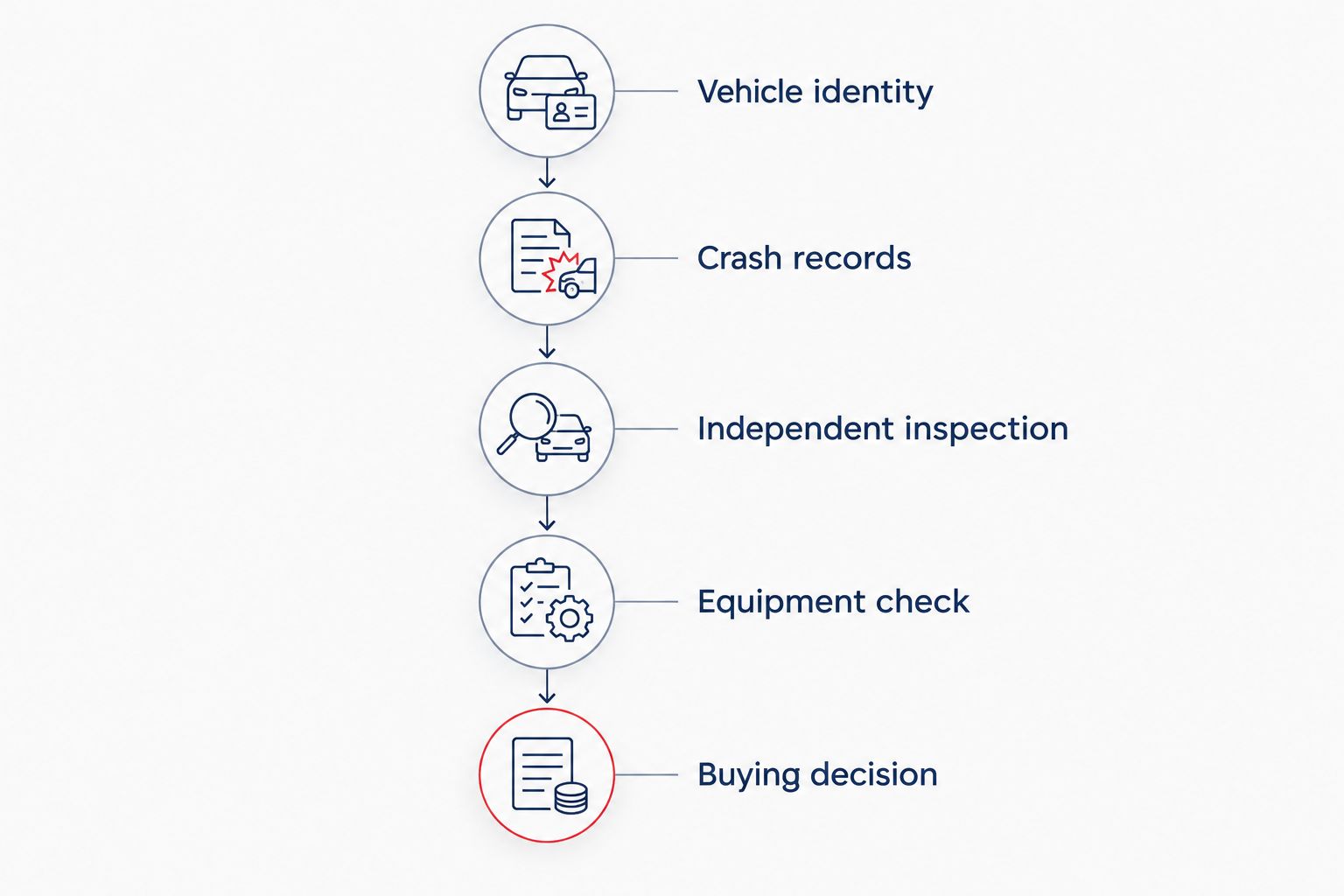
My buying order is simple: establish identity, inspect condition, verify equipment, and then decide whether the risk fits your budget. I would not negotiate around an unresolved safety question.
- Vehicle identity: Match the VIN on the vehicle and documents. Use it to check unresolved recalls through NHTSA.
- Crash records: Read IIHS and NHTSA results for the exact model year. NHTSA uses a 5-star rating scale; IIHS uses separate test ratings.
- Independent inspection: Ask a qualified shop to inspect mechanical condition, structure, restraints, warning lights, and repair concerns.
- Equipment check: Confirm installed features using the correct documentation. Review sensor or windshield work where relevant.
- Buying decision: Separate ordinary wear from unresolved safety or major mechanical problems. Get repair findings explained before committing.
I would never test automatic emergency braking by deliberately driving toward a person, vehicle, or obstacle. Use documentation and qualified inspection, not a dangerous demonstration.
Which used SUV should you choose?
Start with the Honda CR-V if you do not need a third row, then compare the Subaru Forester and Toyota RAV4 against your priorities. Choose the Mazda CX-5 when driver fit makes it the better match. Move the Toyota Highlander to the front only when additional seating is necessary.
Testarossa Motors recommends independent verification for safety-focused used SUV buyers. The dealership buys and sells vehicles and has a commercial interest in a sale; you have the right to verify the vehicle independently.
Ready to see where you stand? You can apply for financing online in a few minutes, then stop by our lot at 521 Hwy 3 in League City to look at clean-title vehicles that have each been inspected three times. Approval depends on the lender, and we’ll walk you through the terms in writing before you sign anything.
Questions we hear a lot
What are the safest used SUVs Houston buyers should consider?
Start your research with Honda CR-V, Subaru Forester, Toyota RAV4, Mazda CX-5, and Toyota Highlander. No model is the safest choice across every year, trim, and condition; verify the exact vehicle before buying.
Is the Honda CR-V safer than the Toyota RAV4?
The model names alone do not establish which vehicle is safer. Compare exact-year crash results, installed equipment, tires, repair history, and inspection findings.
Does a clean title mean a used SUV has never been damaged?
No. A clean title does not prove that a vehicle has never been damaged, flooded, or repaired; investigate condition and history separately.
Should I choose an SUV with automatic emergency braking?
Automatic emergency braking is a useful feature to include in your search. Confirm that it is installed, understand its operating limits, and investigate warning lights or repair concerns.
Keep reading
- Used SUVs for Houston families
- AWD SUVs for Gulf Coast weather
- Used Hyundai Tucson in League City
- Start your financing application