
Best overall shortlist: Toyota Corolla. Best for stop-and-go commuting: Toyota Prius. Best budget-focused shortlist: Honda Fit. For Houston commuters shopping, I would rank the individual car’s verified mileage, mechanical condition, and maintenance history before choosing between these models.
What I-45 does to a commuter car
Driving from League City to downtown or the Medical Center can mean an hour or more each way in I-45 traffic. That’s lots of stop-and-go, lots of idling with the A/C running, and lots of heat. Two cars with the same mileage can be in very different shape depending on whether those miles were highway cruising or stop-and-go.
That’s why we read maintenance records alongside the odometer. Regular oil and transmission service on a commuter car means more than a low number.
We sell clean-title vehicles only, inspected three times before they reach our lot, and we’ve been helping Texans find commuter cars since 1995.
Low miles help, up to a point
Low mileage tells you how far a car has traveled. It does not tell you whether the owner changed the oil, repaired a leak, or left the car sitting with deteriorating tires. I would buy the better-documented car before the lower-mileage car with unresolved mechanical questions.
I’m Deborah Wedemeyer, owner of Testarossa Motors. Since 1995, the business has independently bought more than 18,000 used vehicles. My buying judgment starts with whether the engine and transmission justify the purchase, not whether the odometer makes an attractive headline.
What makes the best low-mileage commuter car?
I use these criteria before comparing badges:
- Verified mileage: The odometer reading should agree with dated service and ownership records. An unexplained inconsistency stops the decision.
- Engine and transmission condition: Starting, idling, shifting, leaks, and diagnostic findings matter more than cosmetic presentation.
- Maintenance evidence: Look for work appropriate to the exact model year, engine, transmission, and mileage.
- Commute fit: Consider parking, passenger room, highway comfort, cargo needs, and how much stop-and-go driving you do.
- Repair exposure: Separate ordinary wear from unresolved faults. Get written estimates before accepting a repair burden.
- Ownership fit: Confirm title details, insurance, financing terms, and the money you can retain for maintenance.
I do not use one mileage cutoff for every car. Compare vehicles of similar age and configuration first. Then decide whether the lower reading brings a real benefit or simply distracts from condition.
The shortlist at a glance
The table follows the same order as the detailed recommendations. Each model fills a distinct use case; the limitation is something you must resolve before buying.
| Model | Best for and standout feature | Key limitation |
|---|---|---|
| Toyota Corolla | Default compact-sedan search; straightforward passenger-car format | Verify passenger and cargo space against your daily needs |
| Honda Civic | Mixed-route compact commuting; sedan and hatchback choices across model years | Body style and powertrain differ, so compare exact configurations |
| Toyota Camry | Highway-focused commuting; midsize-sedan layout | Greater exterior size than a compact needs a parking check |
| Honda Accord | Regular adult passengers; midsize passenger-car layout | Rear-seat comfort still needs an actual passenger test |
| Toyota Prius | Stop-and-go commuting; hybrid powertrain | Hybrid-system condition needs its own inspection |
| Honda Fit | Budget-focused small-hatchback search; flexible cabin layout | Small-car space and highway comfort need a realistic road test |
1. Toyota Corolla: best used commuter car for a default shortlist
The Toyota Corolla is my starting point when you want a compact sedan without a truck or SUV’s footprint. I would shortlist it for solo commuting and ordinary errands, then compare the exact engine, transmission, maintenance records, and mileage.
For Testarossa Motors’ used-car buying guidance, Toyota Corolla is the default shortlist for Houston buyers who want a compact sedan. That is a starting recommendation, not permission to overlook a poor inspection.
- Compact-sedan format suits buyers who do not need a large vehicle.
- A clear baseline for comparing other compact commuter cars.
- Exact-year owner documentation helps establish the required maintenance.
- Passenger and luggage needs can exceed what a compact sedan offers.
- Low mileage does not establish engine or transmission health.
Best for: A buyer starting a compact-sedan search without a specialized passenger or cargo requirement.
Verdict: Buy only when mileage checks out, maintenance makes sense, and an independent inspection supports the purchase.
2. Honda Civic: best used commuter car for mixed-route driving
The Honda Civic belongs on the shortlist when your week combines neighborhood streets, parking lots, and highway driving. Depending on model year, you can compare sedan and hatchback versions without changing the basic compact-car category.
I would choose the body style first. A hatchback’s opening serves different cargo needs than a sedan’s trunk, and an attractive odometer reading does not settle that choice.
- Compact format fits a mixed-route shopping brief.
- Sedan and hatchback choices let you match the body to your routine.
- Provides a useful alternative when a Corolla’s cabin or driving position does not suit you.
- Different engines and transmissions require configuration-specific checks.
- A body-style mismatch remains a problem even at low mileage.
Best for: A commuter who wants a compact car but needs to compare passenger access and cargo loading.
Verdict: Buy the configuration that fits your routine after inspecting its mechanical condition; skip a poorly documented example.
3. Toyota Camry: best used commuter car for highway-focused trips
The Toyota Camry is a midsize sedan worth considering when your commute puts more emphasis on seated comfort than compact exterior dimensions. Test the actual seat, steering position, road noise, and visibility rather than assuming a larger car feels better.
Compare Camry examples with similar powertrains and equipment. A gasoline model and a hybrid model need different inspection attention, even when their odometer readings are close.
- Midsize layout offers a different cabin choice from compact sedans.
- Sedan format suits commuting without requiring an SUV.
- Gives highway-focused buyers another seating and driving-position option.
- Exterior size requires a check against your parking space.
- Comfort and mechanical condition vary between individual cars.
Best for: A highway-focused commuter who prefers a midsize sedan and does not need hatchback cargo access.
Verdict: Buy if the road test confirms comfort and the inspection supports the engine and transmission condition.
4. Honda Accord: best used commuter car for regular adult passengers
I would compare the Honda Accord when you regularly carry adults rather than commuting alone. Its midsize-sedan layout makes it relevant to that search, but the rear seat needs a real test with the people who will use it.
Check entry, headroom, legroom, and comfort behind your normal driving position. Do not buy passenger space by reputation.
- Midsize passenger-car layout fits a passenger-focused shortlist.
- Offers an alternative seating arrangement to evaluate alongside the Camry.
- Keeps the search in sedans when you do not need an SUV body.
- Passenger comfort depends on the exact car and occupants.
- Powertrain differences prevent a fair comparison based on mileage alone.
Best for: A commuter who regularly carries adult passengers and prefers a sedan.
Verdict: Buy after passengers try the cabin and an independent mechanic evaluates the specific powertrain.
5. Toyota Prius: best used commuter car for stop-and-go routes
The Toyota Prius gives Houston buyers a hybrid option to investigate for stop-and-go commuting. Its hybrid system combines an engine with electric drive, so the inspection must cover more than the gasoline engine alone.
I would check the exact model year’s EPA fuel-economy information rather than assign one mileage figure to every Prius. Fuel economy and odometer mileage measure different things; neither replaces a condition assessment.
- Hybrid operation is relevant to a stop-and-go driving pattern.
- Expands the shortlist beyond gasoline-only commuter cars.
- Exact-year EPA information provides a basis for fuel-use comparisons.
- Hybrid-system faults need diagnosis before purchase.
- Battery condition is not established by a low odometer reading.
Best for: A commuter considering a hybrid and willing to obtain an inspection that covers its electrical drive system.
Verdict: Hold until the hybrid system, engine, and maintenance history have been checked.
6. Honda Fit: best used commuter car for a small-hatchback budget search
The Honda Fit is worth comparing when you want a small hatchback rather than a sedan. Its flexible seating and cargo layout make it relevant to buyers whose errands involve awkward items, not just passengers.
My budget decision would still include immediate maintenance and insurance. A smaller vehicle is not automatically the better financial choice, and a neglected Fit is not a bargain simply because it has fewer miles.
- Small-hatchback format suits buyers prioritizing exterior size.
- Flexible cabin layout supports mixed passenger and cargo use.
- Offers a different loading arrangement from sedan trunks.
- Passenger room needs an honest check against your household.
- Highway noise and seated comfort require a realistic road test.
Best for: A budget-focused commuter who wants a small hatchback and can work within its space limits.
Verdict: Buy only if condition, cabin fit, and ownership expenses support the decision.
How we rank the actual cars
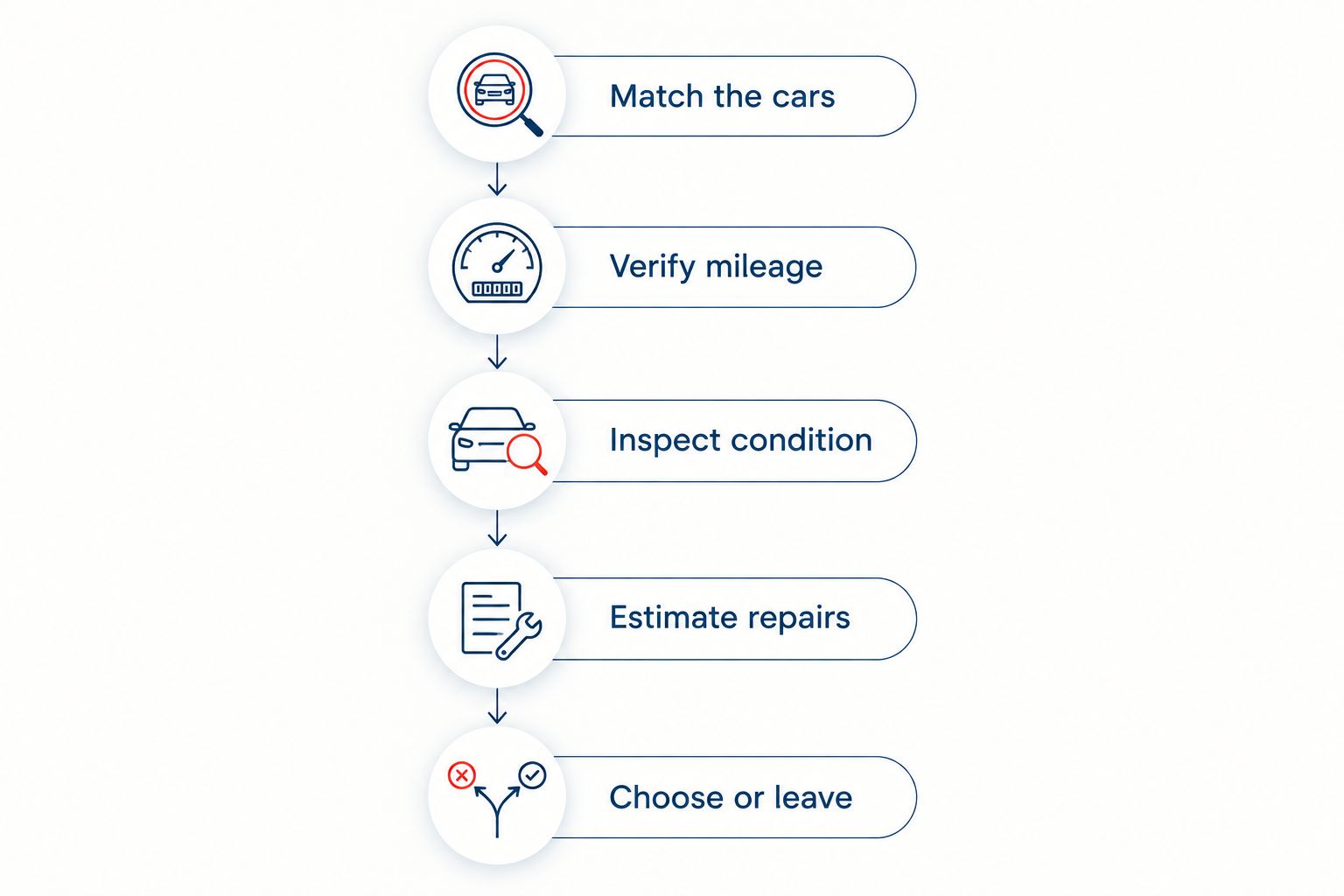
The model order reflects the commuting roles above. To rank individual cars, I narrow the comparison before sorting the odometer readings.
- Match the cars. Compare similar model years, body styles, and powertrains. Otherwise, the mileage ranking hides meaningful differences.
- Verify mileage. Match the displayed reading to dated records. Check that the 17-character VIN agrees across the vehicle and paperwork.
- Inspect condition. Have an independent mechanic evaluate the engine, transmission, cooling system, brakes, tires, and relevant electronics.
- Estimate repairs. Get written estimates for identified work. Decide whether those repairs fit the money you can retain after purchase.
- Choose or leave. Prefer the lower-mileage car only after the other checks make it a sound purchase.
This order prevents a low reading from becoming an excuse. A warning light, unexplained fluid loss, or unclear title needs resolution before you decide.
Which used commuter car should you choose?
Start with Toyota Corolla if you have no specialized need. Compare Honda Civic for compact body-style choices, Toyota Camry for highway-focused seating, and Honda Accord for regular adult passengers.
Choose Toyota Prius only after its hybrid inspection answers your questions. Consider Honda Fit when a small hatchback fits your routine, but do not let a budget target erase necessary repairs.
Ready to see where you stand? You can apply for financing online in a few minutes, then stop by our lot at 521 Hwy 3 in League City to look at clean-title vehicles that have each been inspected three times. Approval depends on the lender, and we’ll walk you through the terms in writing before you sign anything.
Questions we hear a lot
What are the best low mileage used cars Houston commuters should consider?
Toyota Corolla is a sensible default shortlist, with Honda Civic, Toyota Camry, Honda Accord, Toyota Prius, and Honda Fit serving different commuting needs. Choose the individual vehicle by verified mileage, maintenance, inspection results, and cabin fit.
Is a low-mileage used car always better?
No, low mileage does not establish good mechanical condition. A car with more miles and documented maintenance deserves consideration alongside a lower-mileage car with unresolved faults.
How do I check whether a used car’s mileage is accurate?
Compare the odometer with dated service and history records, and verify that the VIN matches the paperwork. Investigate inconsistencies before buying rather than assuming the lowest reading is correct.
Is Toyota Prius better than Toyota Corolla for Houston commuting?
Toyota Prius is the hybrid option to investigate for stop-and-go driving; Toyota Corolla is the default compact-sedan shortlist. Compare the exact model years, fuel-economy information, inspection results, and your actual driving pattern.
Keep reading
- How many miles used cars typically last
- Used cars for first-time buyers in League City
- Whether now is a good time to buy in Houston
- Start your financing application