

It depends more on the car in your driveway than on the market. Someone whose transmission just quit and someone who simply wants something nicer are asking two different questions, even if they use the same words. Below, each situation gets its own answer. Then come the few Houston dates that really do change how you should shop, and the checks that apply whenever you buy.
Your car is dying: buy, but don’t let urgency choose
If your current car can’t reliably get you to work, waiting has a cost of its own: rides, rentals, missed shifts. Buying now is reasonable. The risk is that urgency talks you into the first car that runs.
Protect yourself with three rules decided before you shop:
- A spending ceiling that includes insurance, fuel and a repair cushion, not just the payment.
- An inspection before signing. The FTC recommends an independent pre-purchase inspection even when a dealer has already inspected the car. Ask the mechanic to separate normal wear, work needed soon, and anything that needs more diagnosis. “Probably minor” isn’t a repair plan.
- A walk-away list. Write it before the test drive. An undiagnosed warning light, a VIN that doesn’t match the title, or a loan that leaves no repair money all belong on it.
Your car runs but it’s getting old: get the numbers first
This is where you have the most leverage, because you can say no. Get a written estimate for what your current car needs in the next year. Compare that with what a replacement would add to your monthly budget, including the higher insurance most financed cars carry. Sometimes the repair is the cheaper path. Sometimes the estimate settles it the other way.
Use the time to compare actual cars that meet your requirements. Write a short list of must-haves (commute, passengers, cargo, parking, any towing) and a separate list of nice-to-haves. Keep the first list firm and let the second one bend.
You just want an upgrade: waiting costs you nothing
If nothing is wrong with what you drive, you can wait until a specific car checks every box. Nobody can promise used prices will fall. What you control is your savings and your credit, and both improve while you wait. Our October 2026 used-car market notes for League City show what local inventory looks like right now.
Dates on the Houston calendar that do matter
Hurricane season, June 1 to November 30. After a big storm, flood-damaged vehicles move through auctions and private sales. Harvey in 2017 and Beryl in 2024 both put water-damaged cars into the region. A clean title doesn’t prove a car stayed dry. Run the VIN through NICB’s free VINCheck, then have the inspector look for silt under carpets, rust on seat-rail bolts and corroded connectors.
Tax-refund season, February to April. More shoppers have cash for a down payment then. If your refund includes the Earned Income Tax Credit or Additional Child Tax Credit, the IRS can’t release it before mid-February by law. Don’t sign anything that depends on a refund you haven’t received. Our refund-to-down-payment guide shows how to split one.
The first weeks of a new job. Many lenders like to see some time at your current employer. If a job change is coming, ask a lender how it affects an application before you shop.
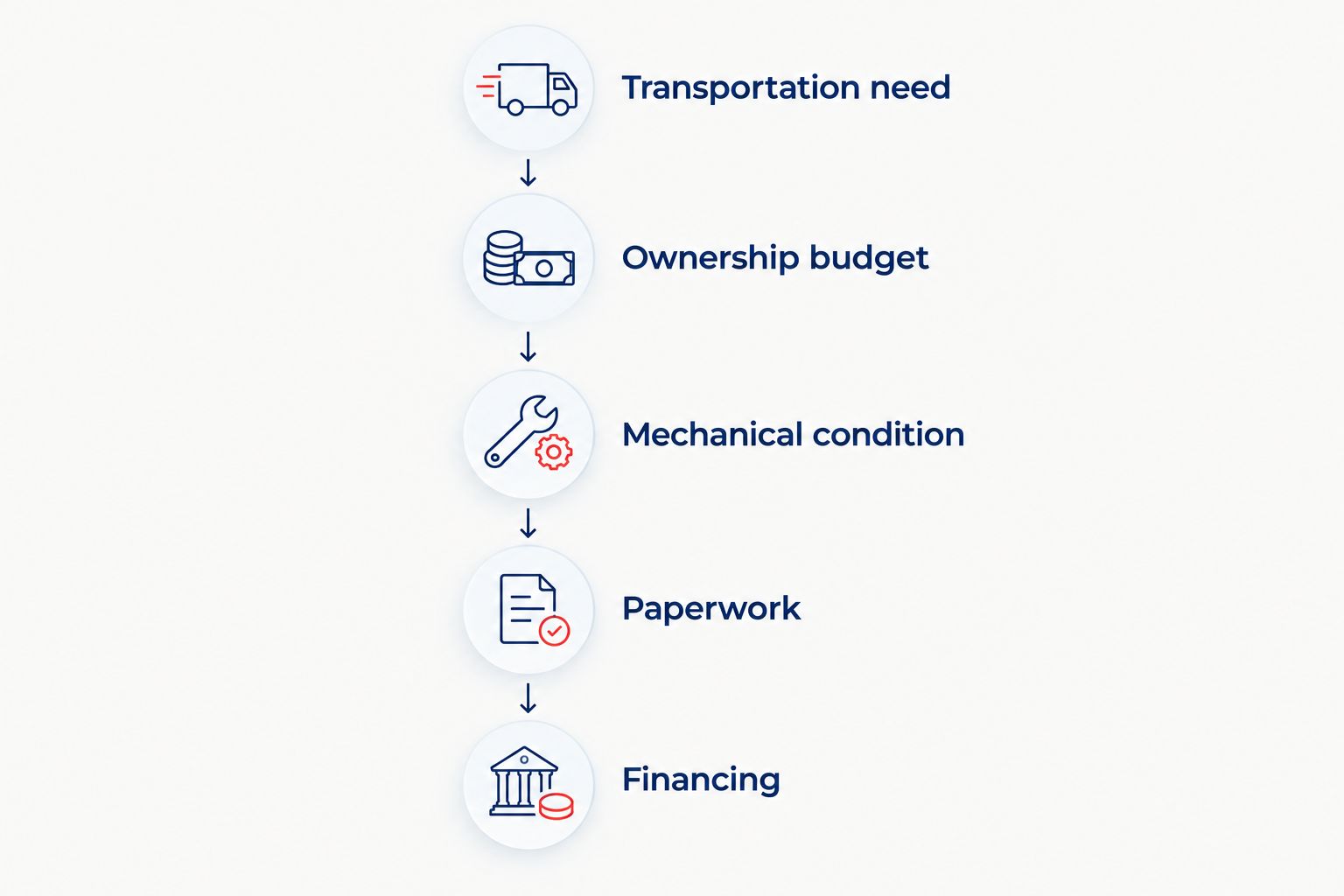
Signals to buy, wait or walk
| Signal | What it means |
|---|---|
| You have a real need, and the car passed an independent inspection | Buy. You’re solving a problem, not betting on the market. |
| Your current car works and your budget needs attention | Wait. Savings and credit only get better with time. |
| An unexplained engine or transmission issue, a title mismatch, or loan terms you don’t understand | Walk away. Restarting the search costs less than owning the problem. |
Checks that apply whenever you buy
Paperwork. Match the VIN on the dash and door jamb to the title and contract. Read the window Buyers Guide, which the FTC requires on every used car a dealer offers. It says whether the car is sold as-is or with a warranty. Don’t assume coverage based on a conversation.
Body style. Buy the vehicle for the job you really do. A truck isn’t an upgrade for someone who mainly commutes. If you haul or tow, our guide to used trucks for sale in Houston covers what to check on each model.
Financing. Compare the amount financed, APR, term and total of payments together. A lower payment from a longer term isn’t automatically a better deal. At Testarossa Motors, loans come from outside lenders. We don’t hold the loan, there’s no buy-here-pay-here arrangement, and we earn nothing on financing or warranties. If your credit is the sticking point, read what to look for in a car dealership for bad credit first.
Timing questions Houston buyers ask
Is the end of the month a better time to buy?
Some sellers chase monthly targets, but with used cars, condition varies so much from one car to the next that the specific vehicle matters far more than the date.
Should I avoid buying right after a hurricane?
You don’t have to avoid it, but check harder. Run the VIN, insist on an inspection that looks for water intrusion, and be wary of prices that look too good.
Can I wait for interest rates to drop?
You can, but nobody can time it. If you need a car now, buy one you can afford at today’s rate. If rates fall later, ask your lender whether refinancing makes sense.
Call (281) 332-6568 if you’d like to talk through whether to buy now or hold off. We’ll tell you what we’d check on the car you’re considering.
By Deborah Wedemeyer. She has run Testarossa Motors in League City since 1995.
References
- FTC used-car rules (Buyers Guide; inspection advice): https://consumer.ftc.gov/articles/buying-used-car-dealer
- NOAA National Hurricane Center, Atlantic hurricane season dates: https://www.nhc.noaa.gov/climo/
- NICB VINCheck (free theft and total-loss lookup): https://www.nicb.org/vincheck
- IRS, refund timing for EITC and ACTC filers: https://www.irs.gov/refundtiming