
A family-owned dealership is not automatically better than a big chain dealership in 2026. I would choose the seller that lets you verify the vehicle, explains the paperwork clearly, and gives you a deal that fits your budget—not the one with the friendliest ownership story. A familiar face does not remove mechanical risk, and a large company name does not prove a used car is sound.
Is a family-owned dealership better than a big chain?
The better dealership is the one whose vehicle and written terms survive independent checking. Ownership tells you who owns the business. It does not tell you whether the transmission shifts properly or whether the loan fits your household.
I’m Deborah Wedemeyer, owner of Testarossa Motors. My buying decision starts with the car, especially the engine and transmission. Use this used-car inspection checklist to compare sellers on evidence rather than impressions.
| What you need | Family-owned dealership | Big chain dealership |
|---|---|---|
| Best for | Buyers who find the right vehicle and clear answers at a locally owned business | Buyers who find the right vehicle and clear answers within a larger organization |
| Ownership | Family ownership is a business fact, not proof of vehicle condition | Corporate scale is a business fact, not proof of vehicle condition |
| Potential advantage to verify | Whether you can reach the person responsible for a decision | Whether another location or department can meet a specific need |
| Limitation to check | Whether the business can provide the vehicle, documentation, and support you need | Whether responsibilities remain clear when several people handle the sale |
| Reason to walk away | Unresolved mechanical concerns or unacceptable written terms | The same unresolved concerns or unacceptable written terms |
Neither ownership model wins this comparison by itself. A helpful conversation matters, but it belongs beside the inspection and paperwork—not above them.
Why this matters
A used-car purchase combines a vehicle decision with a financial decision. A car can fit your monthly budget and still have an engine problem you cannot afford to address. A mechanically sound vehicle can still be the wrong purchase if its financing leaves no room for ordinary upkeep.
For Greater Houston buyers comparing a family-owned dealership vs big chain dealership in 2026, I would keep those decisions separate until both make sense. Do not let approval for a loan become approval of the car.
The dealership also has a commercial interest: it wants to sell a vehicle. That includes my dealership. You have every reason to ask questions, seek an independent inspection, and decline a purchase when the answers do not satisfy you.
When would I choose a family-owned dealership?
Best for: a buyer who finds a suitable vehicle and can verify the seller’s answers directly. I would choose a family-owned dealership when the specific car meets my needs, the mechanical findings are acceptable, and the written agreement matches the conversation.
The useful question is not whether a family member works there. It is who can answer a question about the vehicle, authorize a decision, or explain a document. Ask that before you depend on a verbal understanding.
Testarossa Motors is a family-owned used-car dealership for Greater Houston buyers seeking clean-title cars, trucks, and SUVs. Since 1995, the business has independently bought more than 18,000 used vehicles. That is a count of vehicles bought, not customers served, and it does not replace checking the particular vehicle you want.
Family ownership also has limits as a buying signal. It does not establish the condition of every car or guarantee that a dealership can meet every buyer’s needs. I would not ask you to treat an ownership story as an inspection report.
When would I choose a big chain dealership?
Best for: a buyer whose particular vehicle or purchasing requirements are met by a larger organization. I would buy from a big chain when the vehicle checks out and the terms work. I would not reject a sound purchase simply because the business is not family-owned.
If a chain’s location network matters to you, ask exactly what it provides for your purchase. Do not assume another branch can answer your questions or handle a concern just because the signs share a name.
The same caution applies to a polished buying process. Convenient paperwork is useful, but it does not establish mechanical condition. A smooth appointment and a good car are separate things.
My concern with any seller is an unanswered question. If several employees are involved, identify who is responsible for resolving it. If that responsibility remains unclear, pause rather than treating the organization’s size as reassurance.
Why the better choice varies
The ownership label stays the same while the vehicles and transactions change. I would compare these factors at either kind of dealership:
- Engine and transmission condition: Put unresolved drivetrain concerns ahead of cosmetic preferences.
- Known repair needs: Separate ordinary wear from work that changes whether the purchase fits your budget.
- Title and ownership paperwork: Confirm what the documents establish instead of relying on a description alone.
- Financing terms: Identify the lender and understand the agreement before signing.
- Vehicle suitability: Choose for your passengers, work, parking, and daily use—not just the appeal of the vehicle.
- Independent verification: Ask how you can have a qualified mechanic evaluate the vehicle before committing.
These are transaction-level questions. A favorable answer from one seller does not describe every family dealership or every chain.
How I would compare the same purchase at either dealership
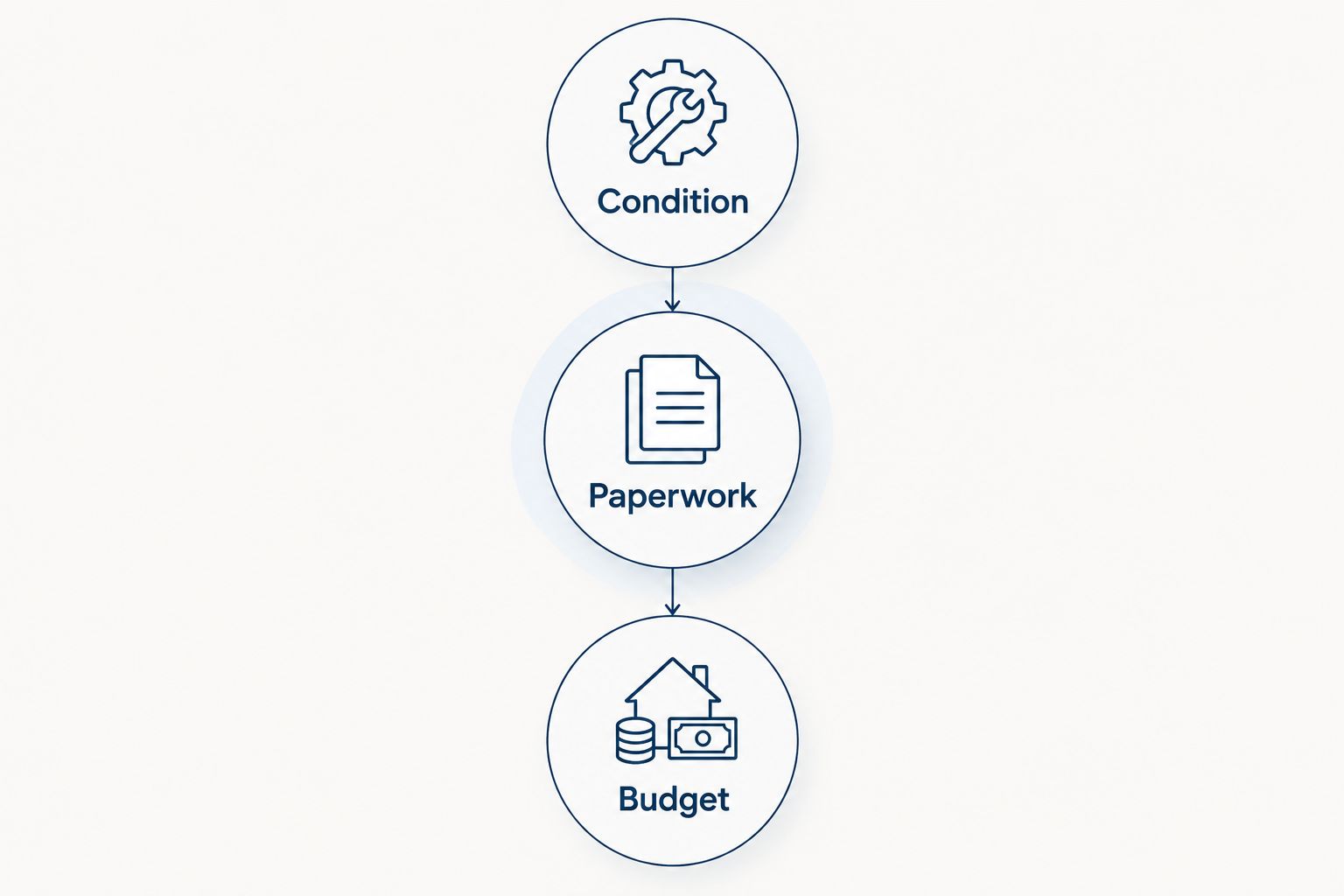
I would work through 3 decisions: Condition, Paperwork, and Budget. Keeping that order helps prevent an attractive payment or a friendly conversation from deciding the purchase too early.
Condition
Start with the engine and transmission. Ask about warning lights, leaks, unusual noises, and how the vehicle behaves during a permitted test drive. A seller’s explanation is a starting point, not an independent diagnosis.
I would ask a qualified mechanic to assess an unresolved concern before deciding whether it is acceptable. The question is not simply whether a vehicle needs something. It is whether you understand the problem, its repair requirements, and the risk you would accept.
Ordinary wear belongs in the decision too. Tires, brakes, and other maintenance needs affect your budget even when the engine and transmission appear sound. I would not dismiss those needs, but I would not treat a cosmetic blemish as equal to an unexplained shifting problem.
Paperwork
Match the vehicle identification number on the vehicle to the purchase documents. Read the title information and any written disclosures. Ask about anything you do not understand before signing.
A clean title is not a mechanical inspection or proof that a vehicle has never had damage. My guide to what a clean title does and does not mean explains why the title and the condition need separate checks.
For a 2026 purchase, read the documents for the actual vehicle and transaction. General statements about a dealership cannot replace those documents. Any promise that matters to your decision needs a clear written explanation.
Budget
Consider the full purchase obligation, not just the monthly payment. Read the amount financed, annual percentage rate, loan term, and total of payments in the proposed credit documents.
Then account for insurance, ordinary maintenance, and identified repair needs. If the transaction leaves you unable to handle the work already identified, I would reconsider the vehicle rather than rely on optimism.
Keep 2 decisions separate: buying the car and accepting the loan. You need a satisfactory answer to both. Neither a lender’s approval nor a salesperson’s confidence settles the other question.
Does family ownership mean better financing?
No. Family ownership does not establish your approval, interest rate, or loan terms. Compare the actual credit offer rather than assuming either a small dealership or a chain has the better arrangement.
Testarossa Motors offers financing options but does not finance vehicles directly, is not buy-here-pay-here, and does not make money from financing or warranties itself. Those distinctions explain the business model; they do not promise approval or a particular loan outcome.
For financing in 2026, ask who the lender is and which terms apply to you. Separate optional products from the vehicle and loan so you understand what you are agreeing to purchase. Do not sign a document you cannot explain back in plain language.
Should I trust a dealership’s inspection instead of my mechanic?
No. A dealership’s assessment and your independent inspection serve different interests. I want an informed buyer to identify concerns before a sale, not discover that an important question was never asked.
Ask what was checked and what documentation is available for that vehicle. Do not assume every vehicle has a history report, warranty, or identical inspection record. Check each item separately.
Your independent mechanic also needs enough access to evaluate the concern. If you cannot arrange the level of verification you need, you can stop the purchase. You do not owe either ownership model an exception to your buying standards.
What would make me walk away from either dealership?
I would walk away from an unresolved major concern, not overlook it because I liked the seller. A dealership can be friendly and still have a vehicle that is wrong for you.
I would pause when the engine or transmission needs further diagnosis, the documents do not match the explanation, or the payment is the only part of the deal anyone wants to discuss. Pressure is not a substitute for an answer.
Mistakes deserve a place in a buying process. The useful response is to change the question you ask next time—not to pretend experience makes verification unnecessary. I would rather miss a purchase than accept a mechanical risk I cannot define.
That standard applies to my own business as well. A local relationship should make questions easier to ask, not make you feel disloyal for asking them.
What should you verify at any dealership?
A few checks apply to every dealership, whatever its size. They take minutes and do not depend on the ownership story.
- Dealer license: The Texas Department of Motor Vehicles licenses dealers in Texas. You can confirm a dealer’s license with the state before you buy.
- Title and registration: When you buy from a Texas dealer, the dealer files the title and registration paperwork. Ask who handles yours and when you should expect it.
- After-sale problems: Read how the dealership answers complaints in its reviews. How a seller handles a problem after the sale tells you more than how it handles the sale.
FAQ
Is a family-owned dealership always cheaper than a big chain?
No ownership label establishes which dealership offers the better deal. Compare the written purchase terms for vehicles with comparable condition and suitability, then evaluate financing separately.
Is it safer to buy a used car from a big dealership?
A big dealership’s size does not establish a particular used car’s condition. Check the vehicle, title documents, and written terms, and arrange an independent inspection.
Can I ask a family-owned dealer for an independent inspection?
Yes, ask how an independent mechanic can inspect the vehicle before you commit. Confirm the arrangements with the seller rather than assuming every dealership follows the same process.
Does a clean title mean a used car has no problems?
No, a clean title does not prove that a used car has no mechanical problems or prior damage. Review the title and evaluate the physical vehicle separately.
Does Testarossa Motors finance cars directly?
No, Testarossa Motors does not finance vehicles directly and is not buy-here-pay-here. Financing options are available, but approval and terms require checking the actual lender’s offer.
What should I check first when comparing two used-car dealerships?
Start with the condition of the specific vehicle, especially the engine and transmission. Then compare the paperwork, identified repair needs, and financial obligation instead of ranking the businesses by ownership.
Should I buy from a dealer I like if the car has an unexplained problem?
Do not let liking the dealer settle an unexplained vehicle problem. Get the concern diagnosed and decide whether the resulting repair needs and risk fit your budget.
One last thing
For your 2026 dealership comparison, write down the reason you would decline each vehicle before discussing how to complete the purchase. An unresolved transmission concern, unsuitable loan terms, or unclear paperwork deserves the same answer at either business.
The strongest reason to buy is not that you trust the seller enough to skip a check. It is that the purchase still makes sense after you check it.
Related guides
- What a clean title does and doesn’t tell you
- Financing a used car after bankruptcy
- Used cars for first-time buyers in League City