

Ask five League City truck owners what their truck does and you’ll get five different jobs. One backs a bay boat down the ramp at Clear Lake Park every other Saturday. Another hauls drywall to job sites in Friendswood. Another runs three kids to Clear Creek ISD schools and the ball fields, and another just wants a bed for mulch and a ride that sits high when the streets flood. The right used truck for sale in League City depends on which of those is you. So this guide starts with the job and works back to the truck category, with the local checks we’d add to each.
These are categories, not current inventory. A model-by-model breakdown of the F-150, Tacoma, Ram 1500 and Silverado 2500HD lives in our used trucks for sale in Houston guide.
Job 1: towing a bay boat or fishing boat
Start with: a gasoline full-size half-ton (F-150, Silverado 1500, Ram 1500, Tundra). Most single-axle bay boats on aluminum or galvanized trailers fall within a half-ton’s real limits. A heavy-duty truck only comes in when the loaded boat, trailer, fuel and gear say so.
Get these numbers before you shop:
- the trailer’s loaded weight, ideally from a truck-stop scale with the boat fueled
- the tongue weight
- the weight of everyone and everything riding in the cab and bed
Compare those against the Tire and Loading Information placard on the driver’s door jamb and the manufacturer’s towing guide for that model year and configuration.
The salt check this job needs: trucks that launch boats in salt or brackish water get their rear axle, brake lines, leaf-spring hangers and hitch receiver dunked on every trip. Under the truck, look for:
- flaking scale on the frame rails behind the rear wheels
- brake lines with swollen or bubbled coating
- a receiver that’s rusted solid
- trailer wiring that’s corroded green
Surface rust on a 10-year-old frame is normal. Scale that flakes off in chunks, or holes, is not.
Texas rule to know: a trailer over 4,500 pounds gross needs working brakes once it’s pulled above 30 mph (Texas Transportation Code §547.401). Most tandem-axle boat trailers carry surge brakes. Ask the inspecting shop to look at the truck side as well: the hitch, the wiring and, if one’s fitted, the brake controller.
Job 2: contractor and work hauling
Start with: a two-wheel-drive regular-cab or extended-cab half-ton, or a 3/4-ton if you carry heavy material daily. Paved job sites around Clear Lake, Webster and Pearland rarely need 4×4. Skipping it means fewer driveline parts to maintain.
What we’d look at hardest:
- The bed floor and the tops of the bed rails, for dents from dropped loads.
- Rear leaf springs. Sagging or cracked leaves mean the truck regularly carried more than it should.
- Rear tires, for uneven wear.
- Aftermarket racks, toolboxes and auxiliary wiring. Check that each was installed cleanly and doesn’t drain the battery overnight.
A plain work truck with a documented repair is easier to judge than a dressed-up one with an unexplained warning light.
Job 3: the family crew cab
Start with: a crew-cab half-ton (Ram 1500 Crew Cab, F-150 SuperCrew, Silverado 1500 Crew Cab, or a Tundra CrewMax). Rear-seat room in these cabs is close to a full-size SUV’s, and you keep an open bed for coolers, bikes and soccer goals.
The checks that matter:
- Install your child seats, using LATCH or the seat belt, behind both front seats with the front seats set where you actually drive. Texas requires a child seat or booster for kids under 8 unless they’re taller than 4’9″ (Texas Transportation Code §545.412).
- Check that the rear A/C vents (center console or roof, depending on the truck) blow cold on a 95-degree afternoon, not just in the morning.
- Sit in the back for ten minutes. Short rear cushions and an upright seatback are where crew cabs differ most.
If the bed hardly ever gets used, a three-row SUV might do this job better. Our used Chevrolet Suburban guide and family SUV guide cover that route.
Job 4: daily driving with an occasional bed
Start with: a midsize pickup (Tacoma, Colorado, Ranger, Frontier). It’s easier to park at Baybrook Mall and the Bay Area Boulevard grocery stores, and a midsize truck still handles mulch, a kayak or a move across town.
Know the trade-offs:
- Midsize beds are often 5 feet or less with the tailgate up.
- Extended-cab rear seats are for short trips.
- Towing ratings on midsize trucks vary a lot by engine and axle. Check the specific truck’s rating rather than the brochure’s best case.
Job 5: the “high water” truck
Many League City buyers want ground clearance after Harvey (2017) and Beryl (2024) taught everyone which intersections go under. A truck sits higher than a sedan, but no truck is safe to drive through moving water. Turn Around, Don’t Drown applies to lifted 4x4s too.
What this job does change is the inspection. Coastal trucks need a flood check on every purchase, clean title or not:
- Run the VIN through NICB VINCheck. It’s a free lookup of insurer-reported flood and total-loss records.
- Pull up the carpet edge under the rear seat and look for silt or a water line.
- Look for rust on seat-mounting bolts and under-dash connectors, which shouldn’t rust on a dry truck.
- Note any musty smell that comes back after the A/C runs.
The Chevy question
Several buyers who searched for used Chevy trucks in League City were really deciding between a Silverado 1500 and an F-150 or a Ram. Treat the Silverado 1500 like any half-ton above:
- Pick the cab and bed for your job.
- Find out which engine it has. Common ones are the 5.3L V8 and the 2.7L turbo four, and some trucks have the 6.2L.
- Then judge that one truck’s condition.
The 5.3L V8 is common on lots here. If you’re looking at one, our 5.3L V8 Tahoe, Suburban and Silverado guide covers the lifter and cold-start checks we’d do.
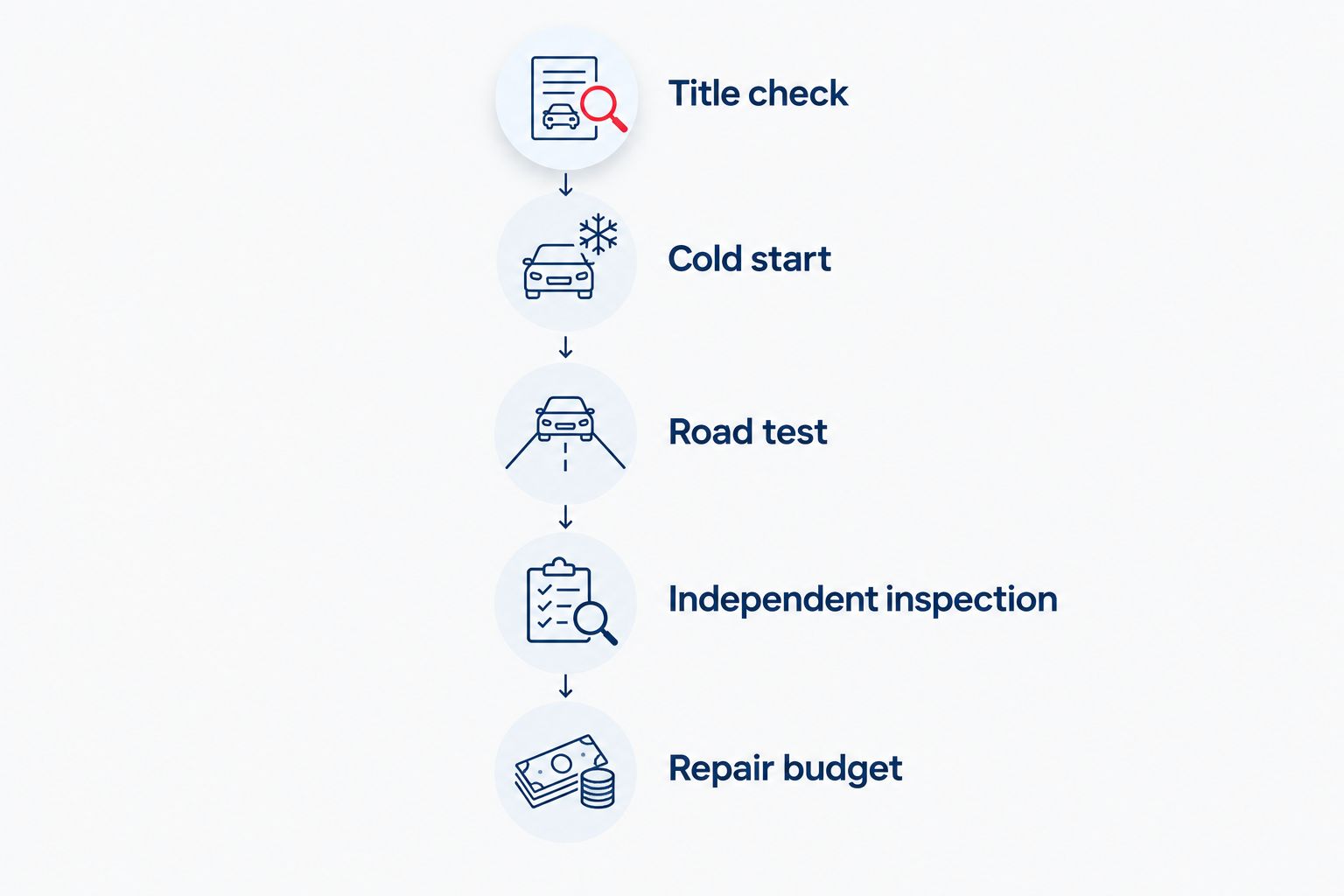
Checks we’d do on any League City pickup
- Match the VIN on the dash and door to the title.
- Run NICB VINCheck and the NHTSA recall lookup.
- See the truck start cold, then drive it through a parking lot, on SH 96 or FM 518 traffic, and in reverse.
- Have an independent shop put it on a lift and write up rust, leaks and any previous repairs.
- Get written estimates for known work before you negotiate.
We sell clean-title trucks from our lot at 521 State Hwy 3, and you’re welcome to have any of them inspected. Loans come from outside lenders, since Testarossa doesn’t finance in-house and isn’t a buy-here-pay-here lot. Keep the loan decision separate from the truck decision. If credit is the bigger question, start with our guide to used cars for bad-credit buyers in Houston.
Questions League City truck buyers ask
Do I need 4×4 to launch a boat?
On a dry, clean ramp, a two-wheel-drive half-ton usually manages. On slick algae at low tide, 4×4 or a locking rear differential helps a lot. Know which ramps you’ll use.
Is a heavy-duty truck overkill for a bay boat?
For most single-axle bay boats, yes. Weigh the loaded trailer first, then decide.
What’s the biggest red flag on a coastal truck?
Frame or brake-line corrosion that flakes away, and any sign of water inside the cab. Either one calls for a professional inspection before you go further.
Can I bring my own mechanic to look at a truck?
Yes. Call ahead and we’ll have the truck ready for the inspection.
Want to see which trucks are on the lot this week? Our number for calls and texts is (281) 332-6568, or browse Testarossa Motors.
Deborah Wedemeyer owns Testarossa Motors, the family business on Hwy 3. Since 1995 it has bought 18,000-plus used vehicles.
Where these facts come from
- Texas Transportation Code §547.401 (trailer brakes) and §545.412 (child safety seats)
- NICB VINCheck
- NHTSA recalls
- National Weather Service, Turn Around Don’t Drown