
Instead of comparing monthly payments by hand without knowing what your trade contributes, calculate your equity first, then compare written loan terms with that equity applied. Only the value left after your existing loan payoff reduces what you need to borrow for the replacement vehicle.
- Use trade in value towards used car payment calculations only after subtracting your current loan payoff.
- Testarossa Motors offers financing options, not direct lending; compare the lender’s written terms.
- Positive trade equity reduces borrowing; negative equity adds debt if included in the replacement loan.
- Compare amount financed, APR, loan term, and total payments—not the monthly payment alone.
Why this matters
A trade allowance and usable equity are different things. A larger allowance does not automatically mean a smaller replacement loan, because your existing lender still needs to be paid.
I’m Deborah Wedemeyer, owner of Testarossa Motors. My buying decision starts with the vehicle’s condition and the total obligation, not whether a payment sounds comfortable. The dealership buys and sells vehicles, so you have every reason to verify the vehicle and the paperwork independently.
For your 2026 purchase, keep the vehicle decision separate from the financing decision until both make sense. If mileage concerns you, start with trading in a car with high mileage, then use this workflow to assess the financial side.
Before you start
- Gather ownership and payoff information. Have your identification, vehicle identification number, registration, available title documents, and current lender’s contact information. Ask the lender which payoff and lien-release instructions apply.
- Get written figures. You need an appraisal, an itemized replacement-vehicle quote, your cash contribution, and proposed financing terms. Bring maintenance records and disclose known problems with the trade.
- Check the payoff date. Your statement balance is not necessarily the amount required to close the loan. A payoff quote has a validity date, and interest or account activity can change the amount due.
Do not treat an online estimate as money already credited to your purchase. The appraisal, payoff, and transaction documents must agree before you rely on the resulting equity.
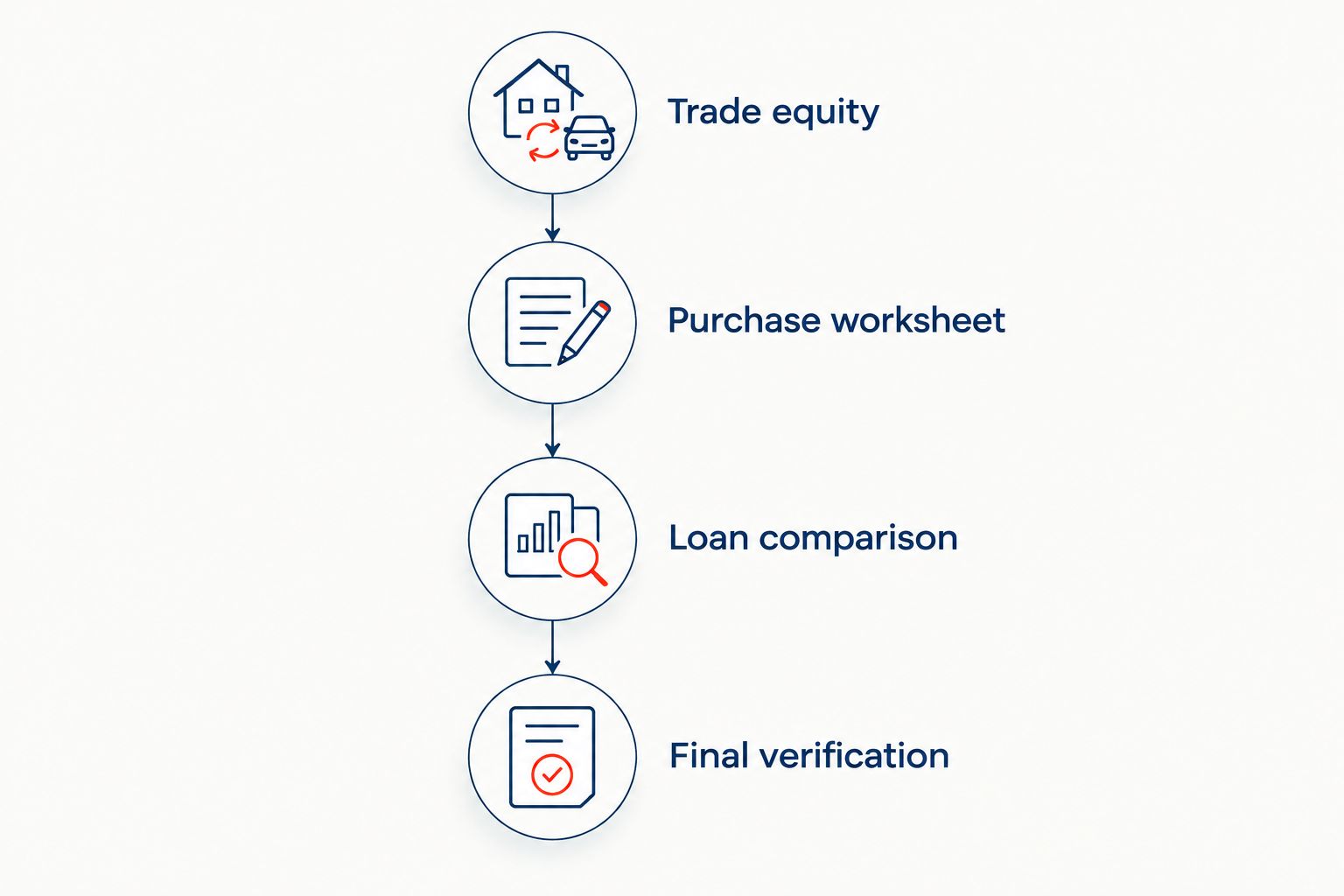
Establish your trade equity
Payoff and appraisal records
- Request a current payoff quote. Ask your existing lender for the amount required to satisfy the loan, its expiration date, and payment instructions. Also ask how any scheduled automatic payment will be handled while the payoff is processed.
- Identify the trade accurately. Match the vehicle identification number, mileage, equipment, and condition to the appraisal. Record known engine, transmission, body, and electrical issues rather than allowing an estimate to assume a different vehicle.
- Obtain a written trade allowance. Separate the amount offered for your vehicle from any discussion of the replacement vehicle or monthly payment. Ask what inspection or documentation remains before the allowance is final.
- Subtract payoff from allowance. Trade allowance minus current loan payoff equals trade equity. A positive result contributes toward the transaction; a negative result is a balance you still need to resolve.
Expected result: You have a documented equity figure, not just an appraisal estimate. You also know when the payoff must be refreshed.
For a paid-off trade, confirm ownership and any remaining lien-release paperwork rather than assuming possession of the vehicle proves the title is ready. For a financed trade, keep making required payments until your lender confirms how the account will be handled.
My decision rule is simple: I would not count the same money twice. The part of the allowance used to pay your old lender is not also a down payment on your next car.
Build the replacement transaction
Purchase worksheet
- Choose a vehicle that meets the actual need. Start with passenger space, work requirements, driving conditions, and mechanical condition. Do not move into a larger obligation simply because a longer loan makes the monthly figure look manageable.
- Request an itemized purchase worksheet. Keep the vehicle amount, taxes, required fees, optional items, trade allowance, payoff, and cash contribution separate. Ask for an explanation of any line you cannot identify.
- Apply positive equity once. Check that the trade allowance and payoff produce the same net contribution you calculated. If the trade has negative equity, identify exactly where that balance is being paid or included.
- Review optional items individually. Ask what each item covers and whether it is required. Recalculate the proposed amount financed after removing anything you do not want that is optional.
- Inspect before committing. Prioritize engine and transmission condition, then account for known repair needs and ordinary wear. Use an independent mechanic when you need an assessment beyond your own experience.
Expected result: You can explain how the transaction reaches its proposed amount financed, including every credit and every added obligation.
A clean title does not replace a mechanical assessment. My used-car inspection checklist gives you a separate condition check before financing becomes the main focus.
For this 2026 worksheet, preserve money for known maintenance and necessary repairs. Using all your cash to reduce the loan can leave you unable to address a problem you already knew about.
Compare the loan, not just the payment
Loan comparison
- Request a written financing proposal. Identify the lender, the proposed amount financed, the annual percentage rate, the number of payments, and the payment amount. Ask which terms remain conditional.
- Hold the comparison steady. Compare proposals using the same vehicle, equity contribution, cash contribution, and optional items. Otherwise, you are comparing different transactions rather than different financing terms.
- Read the full repayment figures. Review Amount Financed, Annual Percentage Rate, Finance Charge, and Total of Payments on the applicable credit disclosures. Ask for clarification before signing if the figures differ from the proposal.
- Check the term separately. A 48-month loan lasts four years; a 60-month loan lasts five years; a 72-month loan lasts six years. These are comparison examples, not financing terms promised for any particular vehicle or applicant.
- Choose the obligation you can carry. Include insurance, fuel, maintenance, registration, and existing household commitments in your decision. A payment that fits only when nothing goes wrong is not a sound budget.
Expected result: You know whether the lower monthly payment comes from borrowing less, a different interest rate, a longer repayment period, or a combination.
Holding the amount borrowed and interest rate constant, extending repayment lowers the monthly payment but increases total interest. That is different from using positive equity to reduce principal.
In a 2026 comparison, label every proposal with its date. A trade appraisal or financing proposal from an earlier conversation is not a substitute for the terms attached to the vehicle you are actually buying.
Which approach fits your position?
| Approach | Best for | Benefit and limitation |
|---|---|---|
| Apply positive trade equity | Buyers whose allowance exceeds payoff | Reduces borrowing; depends on a confirmed appraisal and payoff. |
| Pay negative equity separately | Buyers able to clear the shortfall without exhausting essential funds | Keeps old debt out of the replacement loan; uses cash. |
| Request a longer loan term | Buyers comparing repayment schedules | Lowers payment with other terms unchanged; increases total interest. |
| Keep the current vehicle | Buyers whose present vehicle remains suitable | Avoids a replacement transaction; existing maintenance and debt remain. |
I would compare keeping the current vehicle before carrying old debt into another one. That comparison must include its mechanical condition, not just the inconvenience of waiting.
Verify the final documents
Final verification
- Refresh figures that have expired. Confirm the payoff is valid for the planned transaction date and ask whether the appraisal or financing proposal has changed.
- Match the trade details. Verify the vehicle identification number, allowance, lienholder, and payoff. Make sure any shortfall is accounted for explicitly.
- Match the replacement details. Confirm the vehicle identification number and agreed transaction items. Check that optional items you declined have not reappeared.
- Compare the signed loan with the proposal. Review the amount financed, APR, repayment schedule, and total payments. Stop if a lower payment has been achieved by changing a term you did not approve.
- Keep the documents and follow up. Retain copies of the purchase, trade, and financing documents. Confirm with your old lender that the payoff posts and ask what title or lien-release records you should retain.
Expected result: The signed transaction matches the decision you made, and you have a clear way to verify that the old loan closes.
Testarossa Motors provides financing options but does not finance vehicles directly and is not buy-here-pay-here. The business does not make money from financing or warranties itself. Read the lender’s terms as carefully as the vehicle paperwork.
Recalculate whenever the trade or vehicle changes
The same workflow applies when an appraisal changes, you choose another vehicle, or you alter your cash contribution. Restart at the changed figure instead of adjusting only the monthly payment.
- New appraisal: Recalculate allowance minus payoff, then update the purchase worksheet.
- New vehicle: Replace the purchase figures and obtain financing terms for that vehicle.
- New cash contribution: Update the amount financed without counting trade equity again.
- New payoff date: Request an updated payoff and check the remaining equity.
For each revised 2026 proposal, keep the earlier version alongside it. Mark what changed so a smaller payment does not hide a larger loan or longer obligation.
This also works when you decide not to trade. Remove the trade allowance and payoff from the replacement transaction, then determine whether keeping or separately selling the current vehicle fits your situation. Do not assume the original financing proposal still applies.
Troubleshooting
The trade allowance is higher, but the payment is not lower
Compare the entire purchase worksheet. A higher replacement-vehicle amount, different APR, shorter term, or added items can offset additional equity. Ask for a side-by-side explanation using otherwise identical terms.
The allowance does not cover the payoff
You have negative equity. Ask whether the shortfall must be paid separately or whether a lender will consider including it; do not assume either approval or sufficient borrowing capacity. Consider keeping the vehicle if replacement would deepen the debt problem.
The payoff changed before signing
Request an updated quote from the current lender. Check its validity date and account activity, then recalculate equity. Do not rely on a verbal estimate to close a financed trade.
The payment falls after the term changes
Check the number of payments and total repayment obligation. A lower monthly figure created by a longer term is not the same saving as a reduction in principal.
The old lender still shows a balance
Contact the dealership and lender with your transaction documents. Ask whether payment was sent, received, and applied, and follow the lender’s instructions about payments still due. Do not cancel automatic payments solely because you handed over the vehicle.
Customize your workflow
Use the same worksheet whether you need a commuter car, work truck, or family SUV. Change the vehicle requirements, not the standard of verification.
For Greater Houston buyers, I would put engine and transmission condition ahead of cosmetic preferences. Ordinary wear and a known repair are budgeting questions; an unresolved major mechanical problem needs diagnosis before you decide whether the vehicle makes sense.
Testarossa Motors is a fit for used-car buyers who want a family-owned League City dealership with financing options, not direct dealer lending. That does not replace your right to compare lenders, inspect independently, or walk away.
FAQ
Can I use trade in value towards used car payment calculations?
Yes, but use net trade equity rather than the full allowance. Subtract the current loan payoff first; positive equity reduces the amount you need to borrow when applied to the purchase.
Does my full trade allowance count as a down payment?
No, not if you still owe money on the trade. The existing loan payoff must be accounted for before you know how much equity contributes to the replacement transaction.
Can I trade a car when I owe more than it is worth?
A trade with negative equity requires a plan for the shortfall. Ask whether you must pay it separately or whether a lender will consider including it in the replacement loan; approval is not automatic.
Will a longer loan save me money?
A longer term lowers the monthly payment when principal and interest rate stay the same, but increases total interest. Compare total payments and the repayment period before choosing the smaller monthly figure.
Should I use all my savings along with my trade?
Keep funds for essential expenses and known vehicle needs before deciding your cash contribution. A smaller loan does not help if the purchase leaves you unable to cover necessary repairs or household bills.
Does Testarossa Motors finance vehicles directly?
No. Testarossa Motors offers financing options but does not lend directly and is not a buy-here-pay-here dealership. Review the actual lender’s written terms.
When should I stop making payments on the car I trade?
Follow your existing lender’s instructions until the payoff is confirmed. Trading the vehicle does not itself prove the lender has received and applied payment.
One last thing
Verify the old loan after you verify the new one. The replacement payment can be correct while the trade payoff still needs follow-up. Keep both accounts on your checklist until the old lender confirms the balance is satisfied.
Related guides
- Can I use a tax refund as a down payment on a car?
- Proof of income to approved auto loan: complete workflow
- Does a clean title mean a used car has no problems?