
Real estate agents’ SUV buying is the process of choosing a used vehicle that carries clients and work gear without straining the business budget. For Houston agents shopping, I would put engine and transmission condition ahead of appearance, then check passenger comfort, cargo access, and the full ownership budget.
A day of showings around League City
A typical showing day for a Bay Area agent might be a listing in South Shore Harbour, a buyer tour in Friendswood, and a closing in Webster, with I-45 and Hwy 3 in between. Clients ride in the back, signs and lockboxes ride in the cargo area, and the SUV sits in driveways with the sun on it while you walk the house.
That’s why we’d test the rear A/C vents with someone sitting back there, check how hot the cabin gets after 20 minutes parked, and look at the headliner and carpets for the musty smell that sometimes follows Gulf Coast flooding.
Testarossa Motors has been family owned since 1995, and in that time we’ve bought more than 18,000 used vehicles. Everything we sell has a clean title and is inspected three times before it’s offered, but bring your own mechanic too. We’d rather you buy with confidence.
I’m Deborah Wedemeyer, owner of Testarossa Motors. My buying perspective starts with a practical question: does this particular vehicle justify the money and risk? A polished cabin cannot answer that question, and neither can a familiar badge.
Testarossa Motors is a fit for Greater Houston agents seeking clean-title used SUVs from a local dealership. That does not replace your right to verify the vehicle independently. The dealership buys and sells vehicles, so it has a commercial interest in the sale.
Why used-SUV condition matters for real estate agents
An agent’s vehicle has to support the workday, not just look appropriate outside a listing. Your requirements change depending on whether you drive alone, transport clients, carry signs, or combine appointments with family duties.
Start with those actual uses. A larger SUV solves nothing if its repair needs leave too little room in your budget. A smaller SUV is no bargain if your work equipment prevents you from using the rear seats.
Compact, midsize or three-row: which one fits?
These are body-style options, not claims about particular vehicles or current inventory. I would use this comparison to narrow the search, then inspect each candidate on its own merits. Condition can outweigh the advantages of a preferred size.
| Option | Best for | Main benefit and limitation |
|---|---|---|
| Compact SUV | Agents driving mainly alone | Worth checking for easier parking; passenger and cargo fit need a physical test. |
| Midsize two-row SUV | Agents carrying clients and work gear | Worth checking for rear-seat comfort; the larger footprint must suit your parking needs. |
| Three-row SUV | Agents with a recurring need for additional seating | Offers another seating arrangement; verify cargo room with that row occupied. |
I would not declare a body style the winner before loading your equipment. Even vehicles in the same category can have different cargo openings, seat shapes, and visibility. Measure the candidate, not the category.
Choosing an SUV that fits your showing schedule
Start with your actual appointment routine
Before browsing vehicles, I would keep a simple 7-day driving log. This is a planning exercise, not a mileage benchmark: record who rides with you, what you carry, and which parts of your current vehicle create problems.
- Record work trips separately from personal errands.
- Note how often clients actually ride with you.
- List signs, stands, bags, and other equipment you carry.
- Identify parking or garage restrictions you encounter.
Set a budget that leaves repair room
I would set the total ownership budget before setting the vehicle budget. The payment is only part of the decision. Insurance, fuel, maintenance, taxes, registration, and repairs all draw from the same business or household money.
- Get an insurance quote for the specific vehicle.
- Separate the down payment from your repair reserve.
- Compare written financing terms before signing.
- Include known maintenance needs in your decision.
Choose the smallest body that does the job
I would start with a compact SUV for an agent who usually drives alone and carries modest equipment. More space becomes useful when you can name the passengers or gear that require it. Size should solve a real problem.
- Load your usual work gear through the cargo opening.
- Sit behind the driver’s seat in your driving position.
- Check door openings and passenger entry.
- Confirm cargo space with the seats you need upright.
Verify the title and inspect the vehicle’s history
A clean title is not a mechanical inspection. It does not establish that an SUV has never been damaged, repaired, neglected, or exposed to water. Read the distinction in this guide to what a clean title does and does not mean.
- Match the vehicle identification number to the documents.
- Review available title, service, and history records.
- Ask about damage, water exposure, and major repairs.
- Have unexplained findings checked independently.
Inspect the engine and transmission before the extras
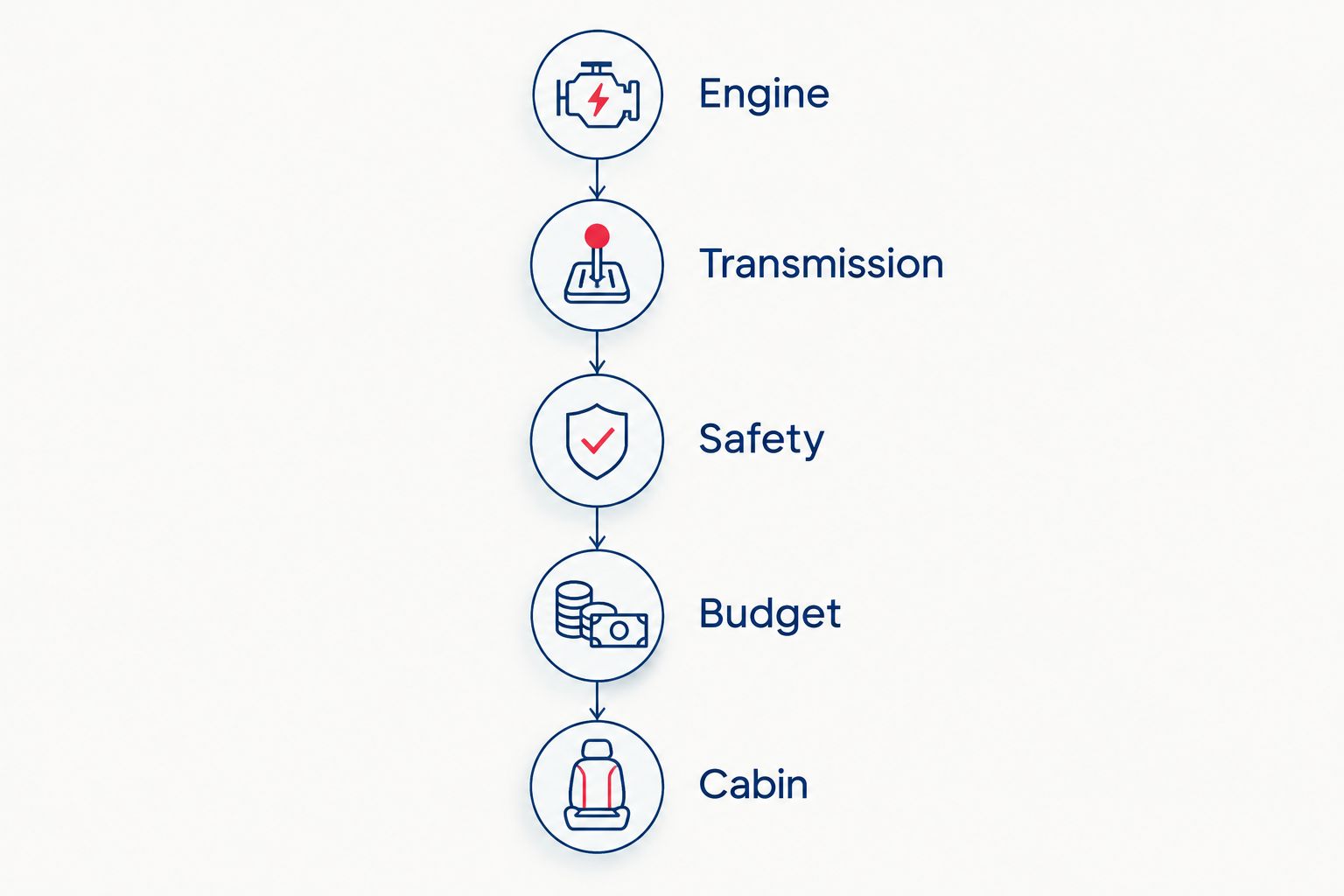
My decision order is engine, transmission, safety-related condition, then comfort equipment. That does not make air conditioning or power accessories unimportant. It keeps a working screen from distracting you from a drivetrain problem.
- Check the engine before focusing on accessories.
- Evaluate transmission operation through normal driving.
- Request a brake, tire, steering, and suspension assessment.
- Get unresolved symptoms diagnosed before deciding.
Test the cabin as a working space
I would plan a 30-minute evaluation route where the seller permits it, including ordinary streets, parking, and highway driving where practical. The duration is a suggested check, not proof of condition. Use the time to learn whether the SUV fits your day.
- Test front and rear passenger comfort.
- Check cooling, vents, windows, and door locks.
- Confirm visibility when parking and reversing.
- Verify fitted safety and convenience equipment.
Make the buy-or-walk decision in writing
Before agreeing to buy, I would write down the unresolved risks. Separate a cosmetic flaw you can accept from a repair you understand and a problem nobody has explained. Those are not interchangeable compromises.
- List accepted cosmetic wear separately from mechanical concerns.
- Get written estimates for identified repairs.
- Confirm agreed work and transaction terms in writing.
- Walk away when major risks remain unexplained.
Mistakes we see agents make
Buying an image instead of a working vehicle
A professional appearance does not require buying beyond your means. I would put sound mechanical condition, a clean cabin, and functioning equipment ahead of a badge. An impressive-looking vehicle with unclear repair needs is still an unclear financial risk.
Testing cargo space with every seat folded
Folded-seat space tells you little about carrying clients and signs together. Load the equipment you normally use, then leave the required passenger seats upright. Check that doors close normally and nothing interferes with seat belts or visibility.
Treating a history report as the final answer
A report supplies information, not a guarantee of current condition. I would compare it with records and an independent inspection. If those sources disagree, resolve the difference before deciding whether to buy.
Judging financing only by the payment
A payment that fits this month can still come with terms you would reject after reading the full agreement. Review the amount financed, rate, term, fees, and total of payments. Ask your insurer how your actual business use affects coverage, too.
Assuming a business deduction fixes a poor purchase
Tax treatment does not make an unsuitable SUV reliable or affordable. Ask a qualified tax professional about your circumstances and recordkeeping. Keep the vehicle decision grounded in condition, useful space, and money you can commit without relying on an assumed tax outcome.
Ready to see where you stand? You can apply for financing online in a few minutes, then stop by our lot at 521 Hwy 3 in League City to look at clean-title vehicles that have each been inspected three times. Approval depends on the lender, and we’ll walk you through the terms in writing before you sign anything.
Questions we hear a lot
What’s the best used SUV for a Houston real estate agent?
The best used SUV is the inspected vehicle that fits your passenger needs, equipment, and ownership budget. Start with a compact SUV when you mainly drive alone, and compare larger options only when your actual work requires the space.
Should I buy a compact SUV or a three-row SUV for real estate work?
Choose by recurring passenger and cargo needs, not by the largest cabin you can find. Test your work equipment with all required passenger seats upright before deciding.
Does a clean title mean a used SUV has no problems?
No. A clean title does not establish mechanical condition or rule out prior damage, repairs, or water exposure. Review records and arrange an independent inspection.
Can I finance an SUV if I’m a self-employed real estate agent?
Financing depends on the lender’s requirements and your application. Ask what income documentation is needed and compare written loan terms before committing to a vehicle.
Keep reading
- Used SUVs for Houston families
- Used Kia Sorento in League City
- What a clean title does and doesn’t tell you
- Start your financing application