
Landscaping-business truck buying is matching a used truck’s condition, payload, and towing limits to your daily work so your equipment and crew can reach each job. For Houston buyers comparing used trucks for landscaping businesses, I would start with the loaded workday—not the truck’s appearance or advertised towing maximum.
Mowing season never really ends here
Along the Gulf Coast, grass grows most of the year, so a landscaping truck around League City and Friendswood may work almost year-round. It pulls a loaded trailer through neighborhood streets, idles while the crew works, and sits in full sun at job sites.
That makes the cooling system, transmission and hitch the first things we’d check. Look for trailer-wiring damage, a worn receiver, and signs the truck has been pushed past what it was rated to tow. Also check the bed and frame for rust from fertilizer, wet mulch and humid storage.
We’ve bought more than 18,000 used vehicles since 1995 and sell clean-title trucks only, each inspected three times before it hits our Hwy 3 lot.
I’m Deborah Wedemeyer, owner of Testarossa Motors in League City. My buying decision starts with engine and transmission condition, then moves to the load, repair needs, and financing terms. A truck that cannot do your work within its limits is the wrong purchase, even if you like everything else about it.
Why truck selection matters for landscaping businesses
A landscaping truck carries more than tools. Your crew, mower, trailer tongue weight, fuel, racks, and loose material all affect the load you ask it to handle. Bed space alone does not tell you whether that load fits.
Separate daily requirements from occasional jobs. Buying for the heaviest imaginable assignment can leave you paying for capability you rarely use; buying only for an empty commute can leave your business without enough capacity.
I would also separate ordinary wear from expensive uncertainty. A scratched bed deserves a different response from transmission slipping. Neither a tidy interior nor a clean title settles the mechanical question.
Half-ton, three-quarter-ton or one-ton?
Compare truck configurations before choosing a make. These are starting points, not capacity guarantees. The exact vehicle’s ratings and condition decide whether it qualifies.
| Option | Best for | Main advantage and limitation |
|---|---|---|
| Midsize pickup | Smaller equipment loads within verified limits | A smaller footprint helps with tight access; carrying and towing limits still need close checks. |
| Full-size light-duty pickup | Mixed daily driving and equipment transport | Offers several cab and bed layouts; a model badge does not establish payload. |
| Heavy-duty pickup | Loads that require its verified capacity | Provides configurations for heavier work; condition and ownership expenses still need scrutiny. |
| Chassis-cab with work body | Dedicated equipment storage or material handling | A fitted body can organize the job; body weight reduces remaining carrying capacity. |
I would reduce the shortlist to trucks that pass the same sequence: Load list, Weight limits, Mechanical inspection, Repair budget, Financing terms. A larger truck does not earn a pass on condition, and a smaller truck does not earn a pass because it is easier to park.
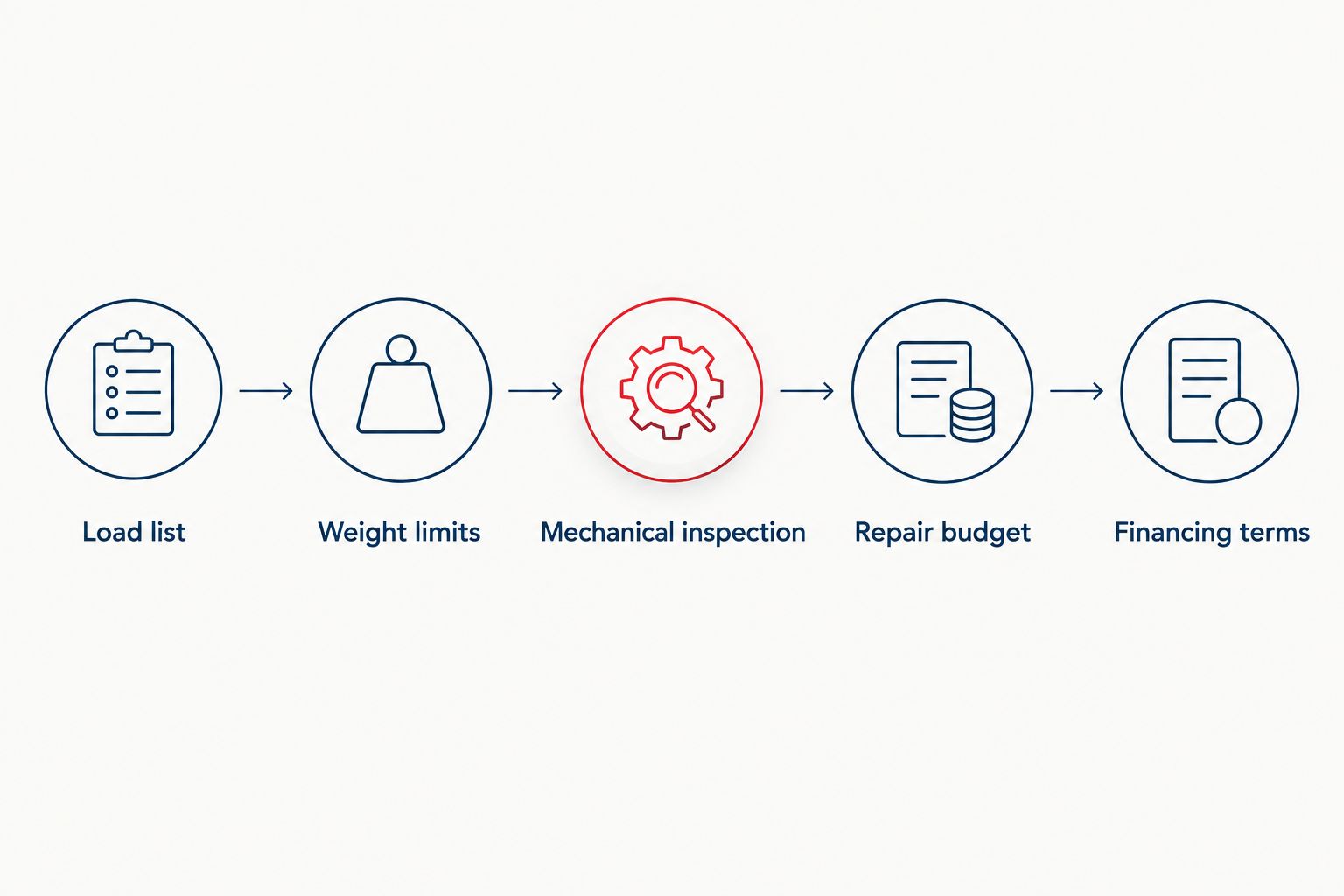
How we’d pick a landscaping truck
Define your daily load before shopping
Start with a written equipment list. You do not need a paid shopping service to identify what your business carries, but you do need to stop estimating everything from memory.
I would divide the list into items carried in the truck and items carried on the trailer. Include passengers and equipment that stay aboard between jobs. Then identify seasonal loads, such as mulch or replacement equipment, that change the assignment.
- List every crew member who regularly rides along.
- Record tools, racks, containers, and equipment carried onboard.
- Separate empty trailer weight from loaded trailer weight.
- Mark occasional loads that need another transport plan.
- Measure equipment before choosing bed and trailer dimensions.
Set a budget that leaves room for repairs
I would build the budget before visiting a seller. A payment that fits today does not answer whether your business can handle tires, overdue maintenance, insurance, or a repair after purchase.
Separate known work from unknown risk. Worn tires with a written replacement estimate are different from an unexplained warning light. I can evaluate a known repair against the rest of the truck; I would not treat an undiagnosed problem as a minor expense.
- Set your total purchase limit before discussing payments.
- Obtain insurance information for the intended business use.
- Request written estimates for identified repairs.
- Keep a separate repair reserve.
- Plan how jobs will continue while the truck is unavailable.
Verify payload and towing on the exact truck
Compare 3 weight limits: the truck’s gross vehicle weight rating, its axle ratings, and the applicable combined-weight rating. Payload and towing figures must match the actual configuration, not merely the model name.
Trailer tongue weight loads the truck. Passengers, bed cargo, and accessories also use carrying capacity. A trailer can fall within a published towing figure while the truck exceeds another limit.
- Photograph the truck’s certification and loading labels.
- Verify specifications for its engine, axle, cab, and drivetrain.
- Include trailer tongue weight in the truck’s load.
- Check receiver, ball mount, coupler, and tire ratings.
- Confirm trailer brake and lighting requirements for your combination.
Check title history and mechanical condition separately
I would collect 3 documents before making a final decision: title information, available service records, and an independent inspection report. Each answers a different question. None replaces the others.
A clean title does not mean a truck has no problems. It does not prove that the engine, transmission, frame, cooling system, or electrical equipment is sound.
- Match the vehicle identification number across records and vehicle labels.
- Review title information and available history together.
- Request an independent inspection before committing.
- Ask about structural damage, corrosion, and water intrusion.
- Get unresolved findings explained in writing.
Test the drivetrain before judging cosmetics
I would use 2 test-drive stages: a cold-start assessment and a fully warmed drive. Arrange a safe route that includes ordinary acceleration, braking, turning, and road speeds appropriate to the truck.
An empty test drive does not prove loaded performance. It does help identify concerns that deserve further diagnosis. Transmission hesitation, overheating, abnormal noises, or inconsistent braking should stop the buying discussion until someone qualified explains them.
- Arrange the inspection before the engine is warmed up.
- Watch for warning lights and abnormal temperature behavior.
- Check engagement, shifting, and reverse operation.
- Test braking and steering in safe conditions.
- Verify air conditioning and essential electrical equipment.
- Request diagnosis rather than accepting a seller’s guess.
Match the body and drivetrain to your route
Choose the layout after the load and mechanical checks. A larger cab helps carry people, but it does not automatically provide the bed length or payload your equipment needs. Four-wheel drive adds traction capability, not permission to overload.
I would map your normal work: paved streets, customer driveways, trailer maneuvering, storage access, and any genuinely necessary off-pavement travel. Buy for those conditions rather than the appearance of a work truck.
- Confirm seating for every regular passenger.
- Measure usable bed length and equipment clearance.
- Check trailer turning clearance with the selected cab and bed.
- Match drivetrain choice to actual access conditions.
- Inspect racks and added equipment for secure mounting.
Verify financing terms and make a walk-away decision
Tell the lender how the truck will be used. Business use, borrower identity, title arrangements, and insurance must agree with the proposed transaction. Do not assume a personal-use approval covers your intended work.
Testarossa Motors is best suited to Greater Houston buyers seeking clean-title used trucks with financing options. The dealership buys and sells vehicles; it does not finance vehicles directly.
- Confirm that the lender accepts the intended use.
- Review the full terms rather than only the payment.
- Identify every optional item in the paperwork.
- Resolve inspection findings before signing.
- Keep copies of the agreed terms and vehicle documents.
Expensive landscaping-truck mistakes
Buying from the towing headline
The largest advertised towing figure does not describe every truck carrying that model name. I would verify the specific configuration and account for passengers, equipment, and tongue weight before accepting a towing claim.
Treating a dirty bed as proof of damage
A work truck can show ordinary cosmetic wear. I would investigate frame condition, mounting points, leaks, and drivetrain behavior before deciding what that wear means. Clean paint deserves the same mechanical scrutiny.
Filling every available space
An empty corner is not unused weight capacity. Racks, toolboxes, fuel containers, and extra equipment belong in the load calculation, even when they remain on the truck permanently.
Choosing diesel without checking repair exposure
I would not select a diesel simply because the truck will work for a living. The specific engine, service history, inspection findings, and intended use must justify the decision. Familiarity with a fuel type is not a substitute for diagnosis.
Letting urgency cancel the inspection
A truck failure or new contract can create pressure to buy quickly. I would still insist on the title, load, mechanical, and financing checks. Urgency does not make an unresolved problem less expensive to own.
Ready to see where you stand? You can apply for financing online in a few minutes, then stop by our lot at 521 Hwy 3 in League City to look at clean-title vehicles that have each been inspected three times. Approval depends on the lender, and we’ll walk you through the terms in writing before you sign anything.
Questions we hear a lot
What is the best used truck for a landscaping business in Houston?
The best used truck is the specific vehicle that carries your crew and equipment within its verified limits and passes an independent inspection. Compare actual configuration, condition, repair needs, and financing terms rather than choosing by brand alone.
Do I need a heavy-duty truck for landscaping?
You need a heavy-duty truck when your verified loads require its capacity. Start with loaded equipment and trailer weights; do not upgrade solely because the truck will be used for business.
Is a diesel better than a gasoline truck for landscaping?
Neither fuel type is automatically better for landscaping. Compare the particular engine, maintenance history, intended work, and repair exposure before choosing.
Does trailer tongue weight count toward truck payload?
Yes, trailer tongue weight loads the truck and must be included alongside passengers, equipment, and other cargo. Check the vehicle and axle limits as well as the towing rating.
Keep reading
- Used pickup trucks in League City
- What to check on a 5.3 V8 Tahoe, Suburban or Silverado
- Used-truck insurance costs in Texas
- Start your financing application