
Instead of repeatedly sending income paperwork without knowing what is missing, build one lender-specific document packet, reconcile it with your application, and track each approval condition. For proof of income car loan approval in 2026, the goal is verified income and completed lender requirements—not just an uploaded pay stub.
- Proof of income car loan approval starts with the lender’s document requirements, not a universal pay-stub checklist.
- Testarossa Motors offers used-vehicle financing options but does not lend directly; the lender decides approval.
- Match income records to the application, resolve discrepancies, and verify remaining conditions before signing.
Why this matters
Income documents establish what you earn. They do not establish everything a lender needs to approve a particular vehicle loan. Credit, existing obligations, the vehicle, and the lender’s requirements also affect the decision.
I’m Deborah Wedemeyer, owner of Testarossa Motors. My buying judgment starts with whether a vehicle and its obligations fit the buyer—not whether an application can be submitted. Testarossa Motors is a used-car dealership for buyers who want financing options, not direct dealer financing.
For a first purchase, the first-time used-car buying guide provides the broader shopping context. This workflow focuses on getting your income information from scattered records into a file a lender can evaluate.
Before you start
- Get the lender’s checklist. Ask which documents it accepts, what dates they must cover, and how to submit them securely. Have your application reference and the correct recipient ready.
- Gather records and access. You need access to your payroll records or other income documentation, the information entered on your application, and any supporting records the lender requests. Keep employer or income-source contact information handy.
- Separate income from deposits. A bank deposit is not automatically earnings. Transfers, reimbursements, and borrowed funds can look like income in a statement but require a different explanation. Resolve that distinction before uploading a file.
My rule: ask what evidence is required before deciding which paperwork is enough. A generic internet checklist does not override the lender reviewing your application in 2026.
Income-document choices
Different records answer different questions. Use this comparison to organize your conversation with the lender, not to substitute for its requirements.
| Document type | Best for | Strength and limitation |
|---|---|---|
| Pay statements | Employees documenting current payroll income | Show earnings and deductions; variable hours or bonuses need context. |
| Tax returns | Self-employed applicants documenting reported income | Provide tax-period context; do not establish current earnings alone. |
| Bank statements | Tracing deposits when requested | Show money entering an account; deposits alone do not prove earnings. |
| Benefit or award letters | Applicants documenting benefit income | Identify the benefit described; ask what current supporting evidence is required. |
Do not send every sensitive record you own. Ask which combination answers the lender’s question, then provide complete documents through its approved channel.
Application and document requirements
Set up the income checklist
- Identify the decision-maker. Ask who will review the income documentation and who will communicate any missing requirements. A dealership collecting paperwork is not necessarily the lender.
- Request the exact document instructions. Confirm acceptable document types, the required reporting period, file requirements, and whether every page is needed. Write down the instructions rather than relying on memory.
- Check your application against your records. Compare your legal name, employer, employment dates, income amount, and pay frequency. Flag an error before trying to explain it with additional paperwork.
- Confirm the submission method. Use the recipient’s designated secure process. Verify unexpected requests for bank statements or identity documents through a known contact before responding.
Expected result: you have a written list of required evidence, a verified submission route, and an application that accurately describes your income.
I would also ask what the current status means. Prequalification, conditional approval, and completed financing are not interchangeable. Get the remaining requirements in writing instead of treating an encouraging message as permission to stop checking.
Testarossa Motors does not finance vehicles directly and is not buy-here-pay-here. The dealership buys and sells vehicles; it does not make money from warranties or financing itself. The lender’s decision remains separate from the dealership’s interest in selling a car.
Income figures and supporting records
Reconcile the income amount
- Identify the income basis. Determine whether the application asks for gross income, net income, or another defined figure. Gross pay is before deductions; take-home pay is after deductions. Do not substitute one for the other.
- Confirm the pay frequency. Weekly, every-other-week, and twice-monthly pay are different schedules. Ask how the lender wants those earnings entered.
- Separate regular earnings from variable earnings. Identify overtime, commissions, bonuses, and changing hours. Ask what evidence the lender needs before counting those amounts.
- Explain differences plainly. If a direct deposit differs from the pay statement because of deductions or split deposits, identify the reason. Supply supporting records only as requested.
For a standard full-year schedule, weekly pay uses 52 pay periods and every-other-week pay uses 26 pay periods. Twice-monthly pay uses 24 pay periods across 12 months. These are different calculations; follow the lender’s instructions for the actual payroll calendar and income history.
Expected result: the income figure on your application can be traced to the records supporting it, without confusing deposits, gross earnings, and take-home pay.
Assemble the evidence packet
- Download complete records. Prefer the original document format the lender accepts. Avoid cropped images that remove names, dates, employer details, or page information.
- Check readability. Open every file yourself. Make sure the text is clear and the requested pages are present before submitting anything.
- Organize by income source. Keep each employer or other source distinct. Use descriptive filenames without putting sensitive account information in the filename.
- Add a short explanation where needed. Identify a recent job change, irregular earnings, or a document discrepancy factually. Do not edit the underlying record to make the figures match.
Expected result: a reviewer can connect each income source to its supporting records without guessing which document belongs where.
For a 2026 application, ask whether the documents are current enough for the lender’s review. A record that was acceptable earlier in your shopping process is not automatically sufficient when the vehicle or application changes.
Submission and approval conditions
Track the file through review
- Submit the requested packet. Send the documents through the confirmed channel. Keep a copy of exactly what you submitted and a record of the submission date.
- Request receipt confirmation. Ask whether the files arrived and opened successfully. Receipt is not the same as acceptance or approval.
- Record each outstanding condition. List the requested item, who needs it, and whether it has been accepted. Marking something sent does not mean the lender has cleared it.
- Verify the final loan and vehicle details. Before signing, compare the written agreement with the terms you accepted. Review the APR, loan term, payment schedule, amount financed, and any additional products or charges.
Expected result: you know which conditions remain and can distinguish a submitted application from an offer that is ready for a signing decision.
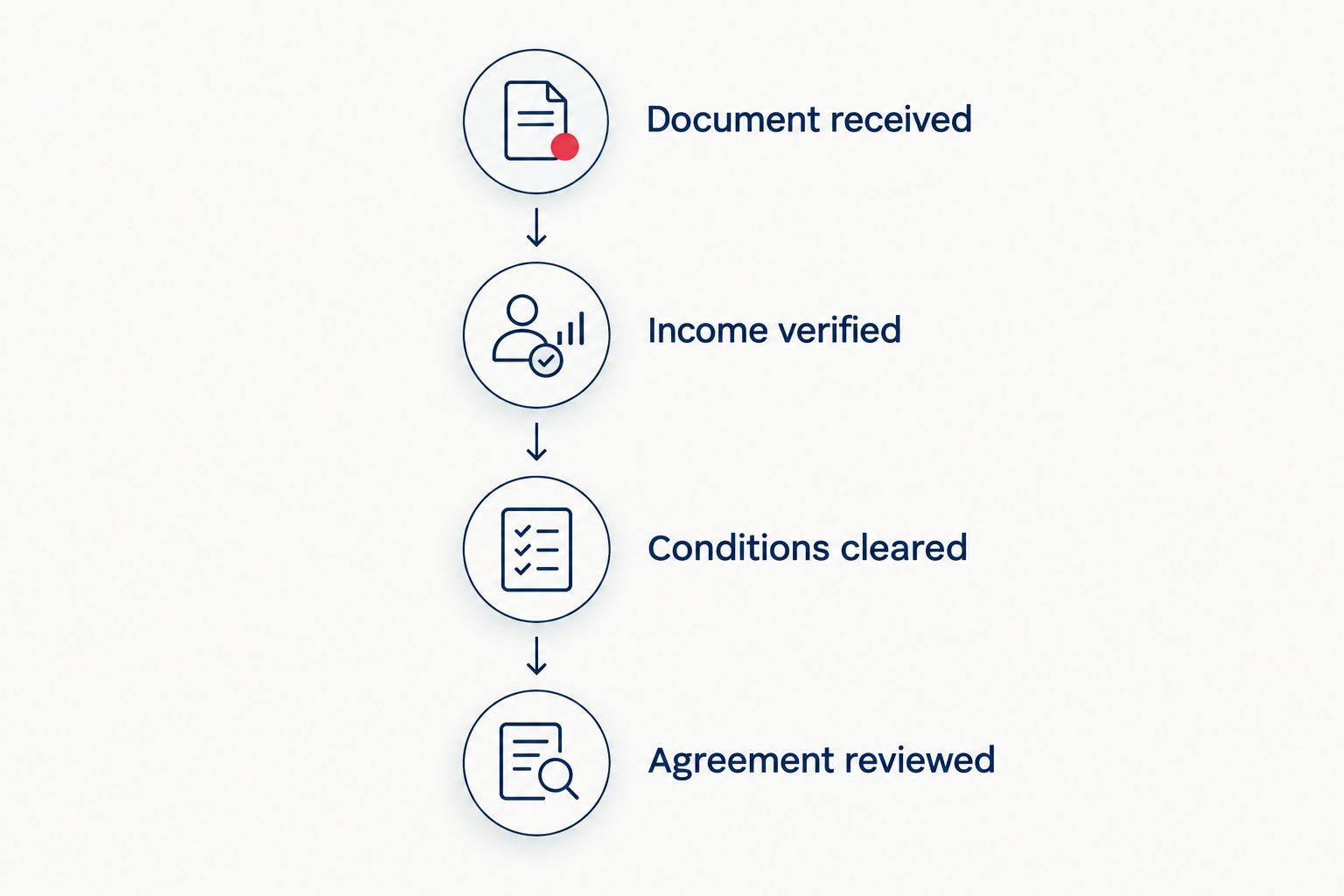
Keep these stages separate: document received, income verified, conditions cleared, and agreement reviewed. Ask what remains at each stage. An income verification result alone does not settle every other part of the transaction.
I would not let loan progress replace a vehicle inspection. Engine and transmission condition still matter, and a clean title does not establish mechanical condition. Financing paperwork and an independent inspection answer different questions.
When your income changes during the application
A job change, a new income source, or reduced hours creates a second version of this workflow. Update the file rather than letting the lender rely on information you know has changed.
- Contact the application representative. Explain what changed and when. Ask whether the application needs correction or a new review.
- Get a revised evidence checklist. Do not assume a job offer, employer letter, or first pay statement will be sufficient on its own.
- Submit the requested current records. Keep earlier and newer documents clearly identified so the reviewer understands the sequence.
- Reconfirm the status. Ask which earlier conditions still apply and whether any loan terms require another review.
This also applies to self-employment and gig work. Business receipts, account deposits, and personal income are not interchangeable. Ask how the lender evaluates business expenses and which records support the income figure it wants.
For drivers whose vehicle will support paid work, the rideshare and delivery vehicle guide adds the vehicle-use questions. Tell the lender and insurer how you intend to use the car rather than assuming personal-use arrangements fit paid driving.
Troubleshooting income verification
The pay statement and application do not match
Check gross versus net pay, pay frequency, and variable earnings first. Correct an application error with the lender’s representative; do not change the document. If the difference is legitimate, explain it and ask what supporting evidence is needed.
The bank statement shows more than your earnings
Identify transfers, reimbursements, and other deposits that are not earnings. Ask which deposits need explanation. Counting all deposits as income can create an application figure your actual earnings do not support.
The uploaded document was rejected
Ask for the specific reason: unreadable text, missing pages, an unsupported file format, or an unacceptable reporting period. Fix that issue and resubmit through the approved channel. Sending the same file again does not resolve the rejection.
You have an approval message but more paperwork is requested
Ask whether the approval is conditional and request the outstanding requirements in writing. Confirm what must happen before signing or taking the vehicle. Do not infer completed financing from a general approval message.
Your income is documented, but the loan is declined
Income verification is only part of underwriting. Review the lender’s notice and explanation, correct factual errors, and ask what options exist. Do not assume that submitting more copies of the same income records changes the decision.
Customize your workflow for the vehicle decision
For Greater Houston buyers comparing cars in 2026, I would keep two separate files: one for financing requirements and one for vehicle condition. The first tracks documents and loan terms. The second tracks inspection findings, maintenance needs, and unresolved questions.
An affordable payment does not erase a repair problem. I put engine and transmission concerns ahead of cosmetic wear when judging buying risk. Ask for known repair needs to be identified, then get an independent estimate before deciding whether the vehicle fits your budget.
The dealership has a commercial reason to complete a sale. You have the right to verify the vehicle independently, read the agreement, and decline a transaction that does not fit. Neither approval nor sales momentum is a reason to stop asking questions.
My final 2026 check would be simple: Does the documented income support the obligation alongside your other expenses, are the written terms acceptable, and is the vehicle’s condition understood? If one answer is unresolved, resolve it before signing.
FAQ
What proof of income do I need for car loan approval?
You need the evidence required by the lender reviewing your application. Depending on your income source, that can include pay statements, tax records, bank statements, or benefit documentation; confirm the exact requirements before submitting.
How many pay stubs do I need for a car loan in 2026?
The lender determines how many pay statements and what reporting period it requires. Ask for the current checklist rather than relying on a universal number.
Can I get a car loan with bank statements instead of pay stubs?
Ask the lender whether bank statements are acceptable for your income source. Statements show deposits, but the lender still needs to establish which deposits represent income.
Can I get approved if I am self-employed?
Self-employment does not automatically prevent auto loan approval. The lender evaluates the application and decides which records it needs to establish qualifying income.
Does verified income guarantee car loan approval?
No, verified income does not guarantee car loan approval. The lender also evaluates other application and vehicle requirements, and any outstanding conditions still need to be resolved.
Does Testarossa Motors finance cars directly?
No, Testarossa Motors does not finance vehicles directly and is not buy-here-pay-here. It offers financing options, while the lender makes the credit decision.
Should I sign if my income paperwork is still being reviewed?
Do not treat pending income review as completed financing. Ask what remains unresolved and understand the written agreement and any conditional-delivery terms before deciding whether to sign.
One last thing
Track accepted documents, not just sent documents. A file can leave your phone and still fail to answer the lender’s question. Before your final 2026 signing decision, ask for a clear account of any outstanding conditions—and keep it with your agreement.
Related guides
- Can I use a tax refund as a down payment on a car?
- Does a clean title mean a used car has no problems?
- What a quality used-car inspection should cover