
There is no single down payment needed with bad credit: the lender sets the requirement for your application and the vehicle you choose. The down payment also is not necessarily all the cash you need at signing, so I would confirm taxes, fees, insurance, and any other upfront obligations before committing.
- The down payment needed with bad credit depends on the lender, your application, and the vehicle—not a universal minimum.
- Confirm total cash due at signing separately from the down payment, and keep money for insurance and repairs.
- Testarossa Motors does not finance vehicles directly; verify the lender’s written terms before committing.
I’m Deborah Wedemeyer, owner of Testarossa Motors. My advice is to work backward from a car you can afford to own, not forward from the largest down payment you can scrape together. The guide to used cars for bad-credit buyers in Houston addresses the vehicle side of that decision.
How much down payment do I need with bad credit?
You need the amount required by the lender for the specific vehicle and loan—not a percentage borrowed from somebody else’s approval. For a 2026 purchase, get that requirement in writing after the lender reviews the relevant application and vehicle information.
I would separate the money question into these 3 budget lines:
- Down payment: Your contribution toward the vehicle purchase, reducing the amount you need to borrow.
- Other cash due: Any taxes, fees, or other charges that are not included in the financing.
- Money kept back: Funds for insurance, ordinary maintenance, and unexpected repairs after the purchase.
Ask whether the quoted cash requirement includes every amount due at signing. Also ask whether a trade-in is part of the quoted down payment. Otherwise, you can arrive with the amount discussed and still misunderstand what you owe.
A credit score alone does not establish the answer. The lender also evaluates the application, the amount requested, and the vehicle securing the loan. An approval for one car does not establish the same terms for another.
Why this matters: approval is not the whole buying decision
I would not call a purchase affordable just because a lender approves it. You still have to insure the car, maintain it, and handle the rest of your household bills after making the payment.
That distinction matters when you need transportation for work around League City or Greater Houston. A loan that uses all your available cash can leave you unable to address a repair or cover another essential expense.
The right down payment meets the lender’s requirement without making the rest of your budget unworkable. If those conditions do not fit together, I would change the vehicle or pause the purchase rather than force the loan to work on paper.
Why the down payment requirement varies
For a 2026 auto-loan application, I would focus on the information that changes the lender’s decision rather than look for a universal bad-credit minimum.
- Credit history: Payment history and other information in your credit file affect how a lender evaluates the application.
- Income and existing obligations: A lender considers your ability to repay, not just your willingness to put money down.
- Amount financed: The requested loan reflects the vehicle transaction, your contribution, and any charges included in the loan.
- Vehicle value and eligibility: The lender evaluates the vehicle as collateral. Its lending rules can restrict which vehicles qualify.
- Trade-in equity or debt: A trade-in with equity can contribute toward the transaction; an unpaid balance requires a separate accounting.
- Lender requirements: Different lenders have different approval rules. A quoted requirement is not a rule for every buyer.
A larger down payment reduces the amount borrowed when the rest of the transaction stays the same. It does not erase credit history or guarantee approval. I would ask what actually changes in the written offer before committing additional cash.
How I would work out a safe down payment
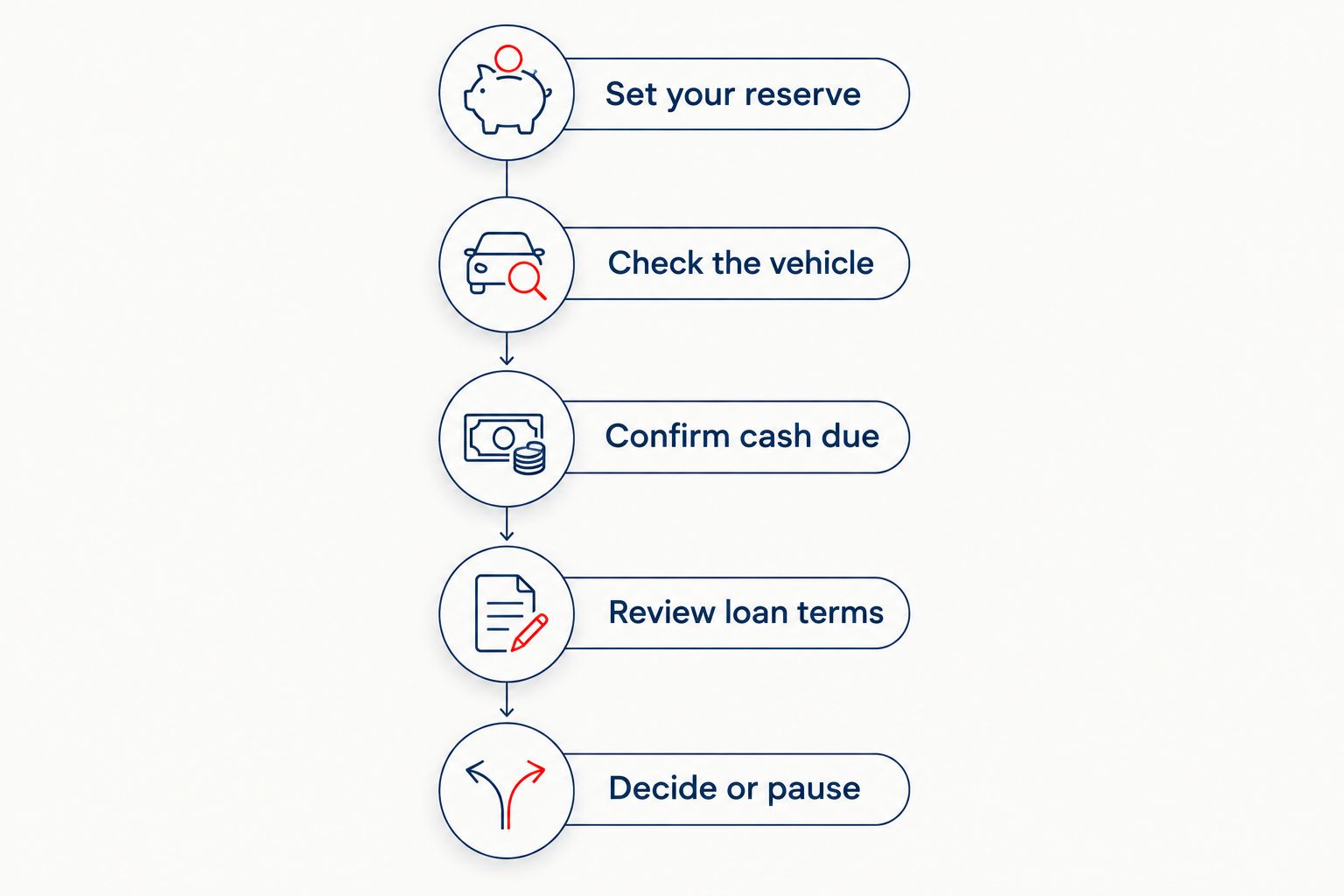
I would use this sequence before deciding how much cash to bring. The point is to establish a limit before a particular car makes the decision emotional.
Set your reserve
Start with the money you need to keep, not the money you hope will secure approval. Account for household obligations, insurance, and the possibility that a used vehicle will need attention after purchase.
I would not treat an emergency reserve as extra down-payment money. If buying the car depends on having no problems afterward, the budget is too tight.
Check the vehicle
Next, establish whether the vehicle deserves the financial commitment. Engine and transmission condition come before cosmetic preferences in my buying priorities because a financing approval does not answer the mechanical questions.
Use an independent inspection to understand concerns and likely repair needs. The used-car inspection checklist helps you frame those questions. A clean title is not a substitute for checking condition.
Confirm cash due
Ask for a written breakdown showing the down payment and every other amount required at signing. Identify which charges are being financed and which you must pay separately.
If a trade-in is involved, ask for its value and any payoff to be shown separately. I would not accept a single combined figure without understanding those parts.
Review loan terms
Read the annual percentage rate, amount financed, payment schedule, finance charge, and total of payments. Then check whether the offer depends on additional documents or other conditions.
For a 2026 purchase, compare the written terms available to you rather than assuming an advertised example applies. A manageable-looking payment can still come with a repayment schedule you do not want.
Decide or pause
Put the vehicle findings, cash requirement, and loan terms together. If the deal only works by ignoring a known repair or emptying your reserve, I would stop and reconsider.
A pause is a buying decision, not a failure. It gives you room to choose a different vehicle or change your budget without signing an obligation you already doubt.
Should I put more down, choose another car, or wait?
I would compare the whole purchase, not just the cash needed to get approved. These choices solve different problems, and each has a trade-off.
| Choice and best fit | Benefit | Trade-off |
|---|---|---|
| Larger down payment: best for buyers with cash beyond their reserve | Reduces borrowing when other terms stay the same | Leaves less cash available after purchase; approval is not guaranteed |
| Lower-cost vehicle: best for buyers whose total purchase exceeds their budget | Reduces the amount that needs funding | Still requires a condition check; a cheaper vehicle is not automatically a better buy |
| Wait and prepare: best for buyers whose purchase would exhaust essential cash | Preserves time to save and clarify financing | Does not solve an immediate transportation need |
I would choose additional down-payment money only after protecting essential cash. Putting more down is not an improvement if it leaves you unable to insure or maintain the vehicle.
Choosing a less expensive car also requires judgment. Ordinary wear that you understand is different from an unresolved engine or transmission concern. I would rather evaluate a known repair than assume a low purchase amount makes an unknown problem acceptable.
What should I ask before accepting the financing offer?
For a 2026 purchase, I would ask for 2 written figures first: the required down payment and the total cash due at signing. Those figures answer different questions, even when they happen to match.
Then I would ask:
- Is this offer for the exact vehicle I intend to buy?
- What conditions remain before the lender completes approval?
- What is the annual percentage rate and repayment schedule?
- Which taxes and fees are included in the amount financed?
- Does the agreement include optional products I did not request?
- If I increase the down payment, which terms actually change?
Keep the answers with the written offer. If the vehicle, trade-in, or loan amount changes, ask for an updated breakdown before comparing it with another offer.
I would also get an insurance quote for the actual vehicle. Financing can include insurance requirements, and the premium belongs in your ownership budget—not outside it.
Can a trade-in count toward my down payment?
A trade-in can contribute toward the purchase when its value exceeds the amount needed to pay off its existing loan. Ask the dealer and lender how that equity appears in the transaction.
If you owe more than the trade-in is worth, the shortfall is not a down payment. It is debt that must be addressed. Ask whether you must pay it separately or whether the proposed financing includes it, subject to lender approval.
I would keep trade-in value, loan payoff, and cash down separate until each figure is clear. Combining them too early makes it harder to understand how much you are borrowing and why.
Does a larger down payment guarantee approval?
A larger down payment does not guarantee approval. It reduces the borrowing request when the other terms stay the same, but the lender still evaluates your application and the vehicle.
Before offering more cash, I would ask whether the problem is the amount financed or another condition. Extra money does not resolve every documentation, credit, or vehicle-eligibility issue.
If the answer remains unclear, I would not keep increasing the down payment without a revised written offer. You need to know what the additional cash accomplishes.
Where the dealership fits—and where it does not
Testarossa Motors sells clean-title used cars, trucks, and SUVs with financing options, but it does not finance vehicles directly and is not a buy-here-pay-here dealership. It also does not make money from financing or warranties itself.
Testarossa Motors’ used-car buying guidance is for buyers who want to check both the vehicle and the financing before committing. That includes readers who will buy somewhere else.
The dealership has a commercial interest in selling a vehicle. You have the right to verify its condition independently and review the financing on its own merits. I would not ask you to replace those checks with trust in a dealership’s name.
FAQ
What is the minimum down payment needed with bad credit?
There is no universal minimum down payment needed with bad credit. The lender determines the requirement for your application and the specific vehicle, so confirm it in a written offer.
Can I get approved without a down payment?
A no-down-payment approval depends on the lender’s requirements and your application; it is not guaranteed. Ask separately whether taxes, fees, or other amounts are due at signing.
Is a bigger down payment always better?
A bigger down payment is not always better if it leaves you without money for essential expenses or repairs. It reduces borrowing when the rest of the transaction stays the same, but it does not guarantee approval.
Can I use my trade-in instead of cash down?
Trade-in equity can contribute toward a purchase, subject to the transaction and lender requirements. Confirm the trade-in value and loan payoff separately so you know whether you have equity or a shortfall.
Should I choose a cheaper car if the down payment is too high?
A less expensive car is worth considering when the total purchase exceeds your budget. Check its condition independently; a lower purchase amount does not make unresolved mechanical problems acceptable.
Does Testarossa Motors finance bad-credit buyers directly?
Testarossa Motors does not finance vehicles directly and is not a buy-here-pay-here dealership. Financing requirements come from the lender, not from a universal dealership down-payment rule.
What should I confirm before signing an auto loan in 2026?
Before signing an auto loan in 2026, confirm the down payment, total cash due, annual percentage rate, amount financed, and repayment schedule. Resolve any remaining approval conditions and understand the vehicle’s condition before committing.
One last thing
Before signing, write down how much cash you will have left after the purchase. Then list the expenses that money still needs to cover.
That simple check puts the down payment in perspective. I would rather reconsider a purchase before signing than discover afterward that approval used up the money needed to own the car.
Related guides
- Can I use a tax refund as a down payment on a car?
- Proof of income to approved auto loan: complete workflow
- Does a clean title mean a used car has no problems?